🤖AI-Optimized Query Plans Beat Postgres Defaults
AI can now outsmart Postgres query optimization
TL;DR
A new method uses AI to optimize Postgres query plans, outperforming default plans. The approach leverages supervised fine-tuning and reinforcement learning to produce faster plans, impacting database performance for specific workflows.
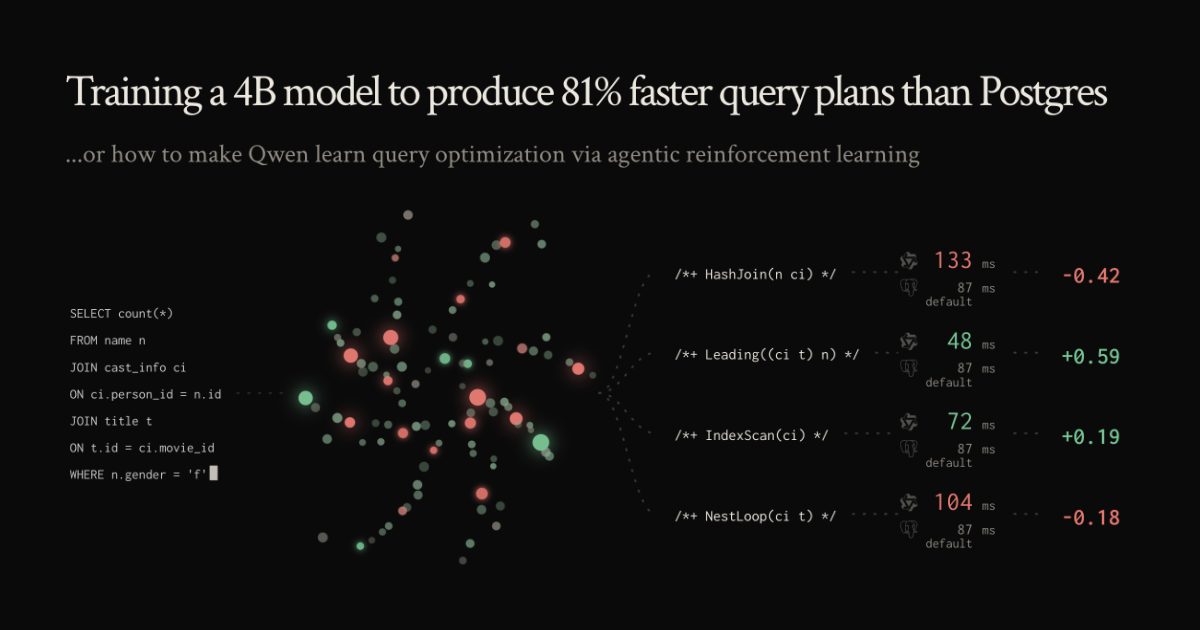
AI is now capable of optimizing Postgres query plans better than the database's default optimizer. This breakthrough uses supervised fine-tuning and reinforcement learning to guide the model towards producing faster query plans. Developers working with complex joins and large datasets will see performance improvements. The IMDb dataset, with tables containing millions of rows, demonstrates the effectiveness of this method, showing significant speedups in query execution times.
Key Points
A small model post-trained via supervised fine-tuning and RL produces faster query plans than Postgres defaults.
The IMDb dataset includes 1M rows in the title table, 2M rows in movie_companies, and 100k rows in company_name.
The join of (company_name ⋈ movie_companies) with title produces 2M rows, showcasing the complexity of the dataset.
The query optimizer can use different join algorithms, including hash join, merge join, and nested-loop join, to improve performance.
There are 4,608 different ways to run this query, highlighting the complexity and potential for optimization.
Why It Matters
If you're working with complex joins and large datasets in Postgres, this could be a game-changer. The new method shows that AI can produce faster query plans, impacting workflows that rely on efficient data retrieval and processing. For teams dealing with millions of rows, the performance gains are significant, but the cost and complexity of implementing this approach need careful consideration.
Comments
Be the first to comment
Enjoyed this article?
Get it daily. 7am. Free. Reads in 5 minutes.
Join 3,482 builders reading daily.