🚜AI Trained in Simulation Balances 5-Ton Loader on Two Wheels
Your heavy equipment could soon drive itself through rough ground
TL;DR
Researchers from ETH Zurich, Gravis Robotics, Blue River Technology, and Intel taught a five-ton John Deere 332G loader to balance on two wheels and clear 75 cm bumps, using reinforcement learning trained in simulation. The controller runs on a standard laptop. For anyone building autonomous construction or mining machinery, it's a credible route past hydraulic control headaches.
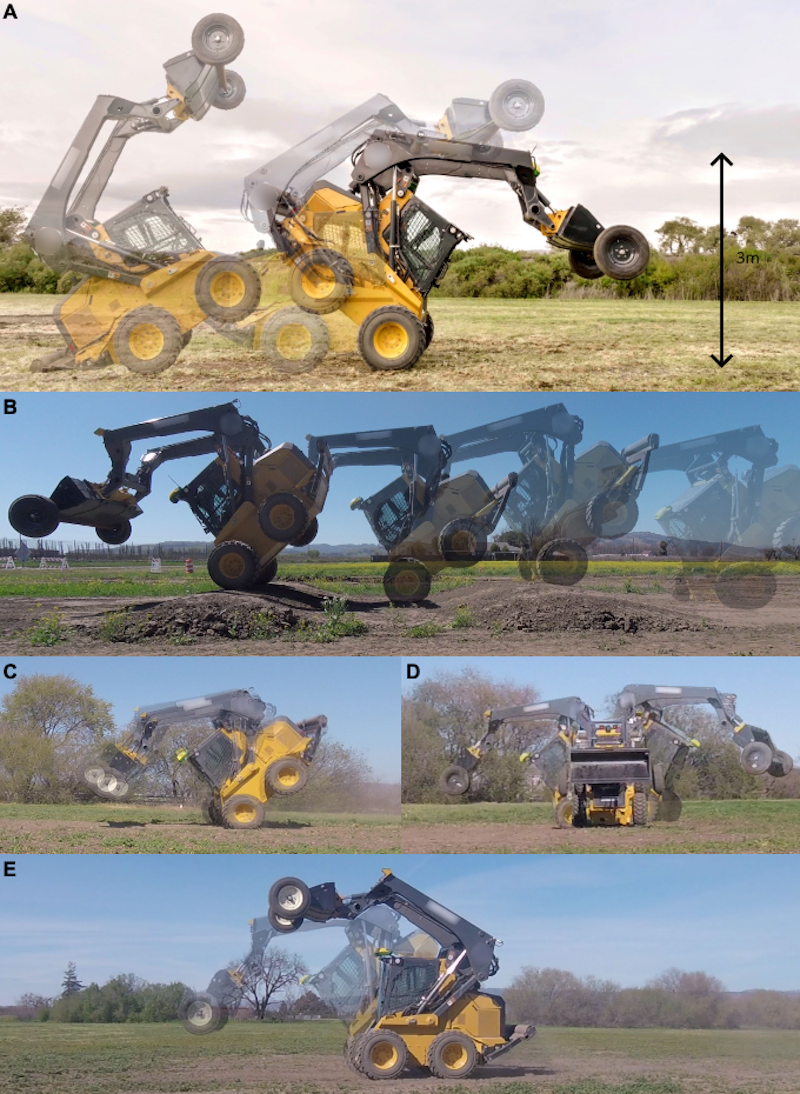
A five-ton John Deere skid-steer loader just learned to stand on its front wheels, spin in place, and drive itself back down to four, all from an AI trained almost entirely in simulation. The work, published in Science Robotics, comes from ETH Zurich, Gravis Robotics, Blue River Technology, and Intel. Why should you care? If you build autonomous machinery for construction, mining, agriculture, or material handling, hydraulics have been the hard part. Actuators respond nonlinearly, delays show up unpredictably, and testing on a machine this heavy is slow and risky. Training the control policy in simulation with reinforcement learning, and no expert operator demos, sidesteps much of that danger. The numbers: the team logged operational data from the physical machine and trained a neural network to predict hydraulic actuator behavior. The reinforcement learning controller crossed terrain with undulations up to 75 cm, where a conventional model predictive controller kept its balance but could not get over the obstacles. The catch? The classic MPC controller showed less oscillation at higher spin speeds, so this isn't a clean sweep. The AI controllers ran on a standard laptop with no GPU. Watch next: the researchers want lidar and cameras for environmental awareness, plus a higher-level planner to pick the right skill for each situation.
Key Points
The team taught a five-ton John Deere 332G skid-steer to stand on its front wheels, cross uneven ground, and return to four wheels without operator intervention during testing.
Keep reading — it's free
Enter your email to keep reading — plus the best of AI & tech, daily. Free, forever.
Already a member? Sign in
Comments
Be the first to comment