💥BES III Confirms Glueball X(2370) With 90% Gluon Content
The elusive glueball is finally in our sights
TL;DR
Physicists at BES III have confirmed the existence of the X(2370) particle, which they believe is a glueball made up of 90% gluons. This discovery could validate decades-old theories about quantum chromodynamics and the strong nuclear force.
Physicists with the Beijing Spectrometer III (BES III) experiment have confirmed the existence of the X(2370) particle, a candidate for the lightest glueball state. The BES III team estimates that X(2370) is comprised of about 90% gluons, making it a strong contender as a direct prediction of quantum chromodynamics. This discovery could validate theories on how quarks are held together by gluons to form protons and neutrons, which comprise the core of every atom. The measured mass of X(2370) at 2.395 GeV/C² aligns with lattice QCD theory predictions.
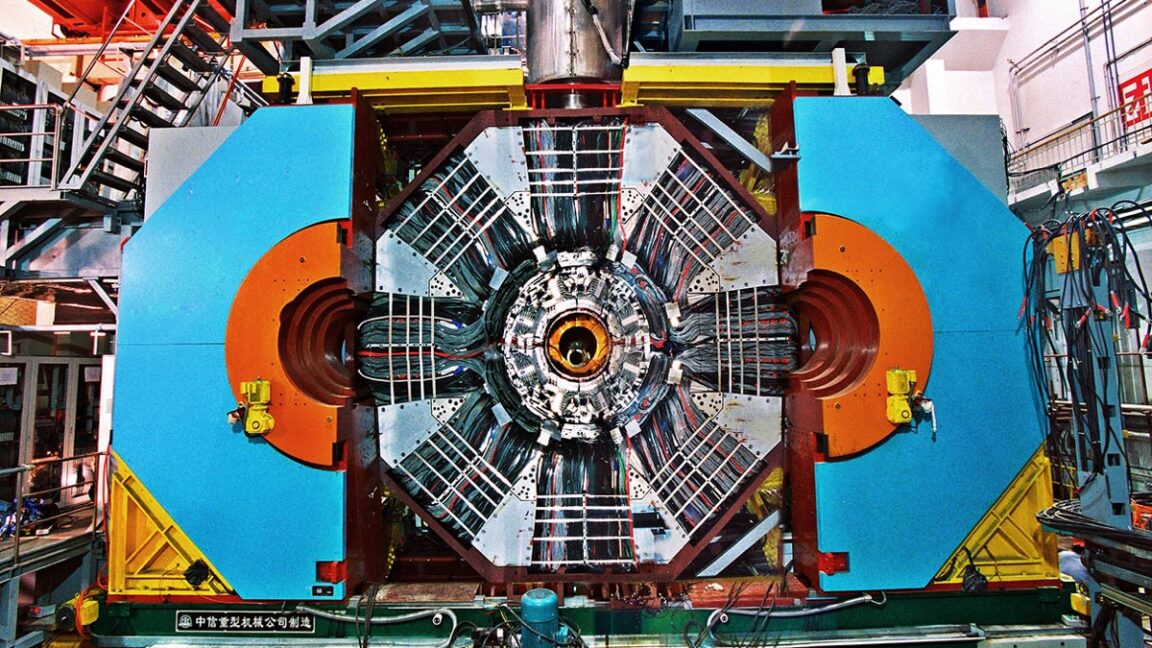
Key Points
The BES III experiment recorded over 226 million events within its first year of operation in 2008.
By 2024, the number of recorded J/ψ particles exceeded 10 billion.
X(2370) is a flavor singlet particle discovered at BES III in 2011.
The predicted mass of X(2370) was measured at 2.395 GeV/C², matching lattice QCD theory.
BES III is currently the only machine dedicated to hunting for gluons and glueballs.
Why It Matters
If you're studying quantum chromodynamics or working on theories related to the strong nuclear force, this discovery at BES III could validate decades of research. The confirmation that X(2370) is a glueball with 90% gluon content means we're closer to understanding how quarks are held together by gluons to form protons and neutrons.
Frequently Asked Questions
Why does this matter?
If you're studying quantum chromodynamics or working on theories related to the strong nuclear force, this discovery at BES III could validate decades of research. The confirmation that X(2370) is a glueball with 90% gluon content means we're closer to understanding how quarks are held together by gluons to form protons and neutrons.
What happened?
Physicists at BES III have confirmed the existence of the X(2370) particle, which they believe is a glueball made up of 90% gluons. This discovery could validate decades-old theories about quantum chromodynamics and the strong nuclear force.
Comments
Be the first to comment
Enjoyed this article?
Get it daily. 7am. Free. Reads in 5 minutes.
Join 2,950 builders reading daily.