🦾Electric Motor Model Shows Muscle Coordination Needs No Brain Signal
Your robot arms might not need a conductor anymore
TL;DR
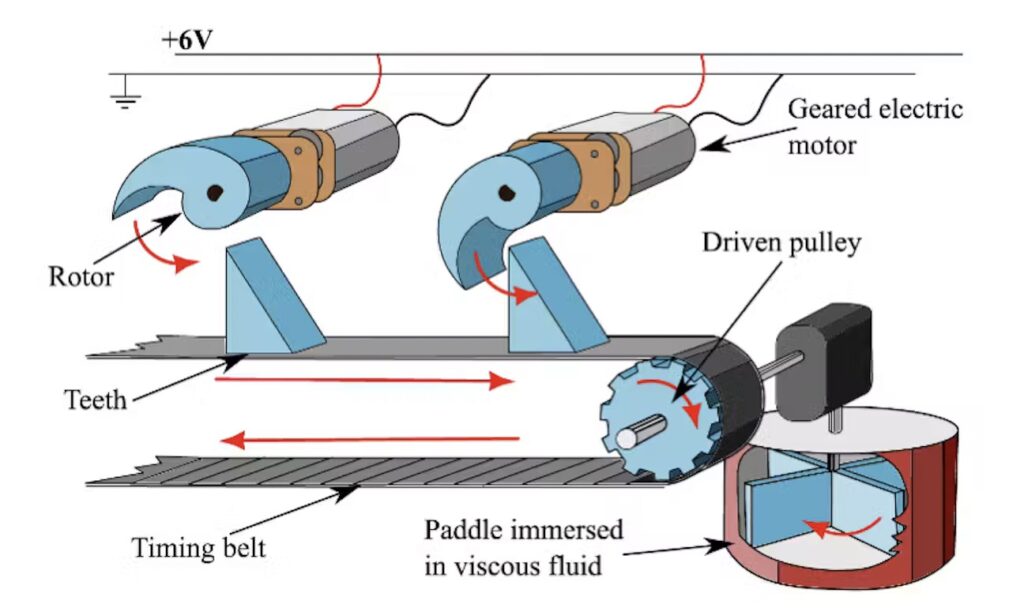
Researchers built a physical model using ordinary electric motors that mimics how muscle fibers coordinate force. The motors never talk to each other, yet they sync up anyway. That's a direct hint for robotics teams fighting with centralized control.
Muscle coordination might not need a boss. A physical model built from ordinary electric motors reproduces the coordinated pulling seen in real muscle, and the coordination shows up purely from how the setup is wired. No motor ever signals another. Why should you care? If you build robots, this is a design argument. Right now most multi-actuator systems rely on a central controller to keep motors in step. This work suggests a shared mechanical backbone can do that job for free, which could mean simpler control loops and fewer failure points. The model treats each force-producing unit as a rotor that only contributes when engaged with a moving backbone. Under increasing load, more units join in, and the load-speed relationship shifts accordingly. Push it hard and motion turns jerky, with sudden slips. The system can also self-organize into travelling waves of coordination. Worth watching: whether anyone scales this beyond a benchtop array.
Key Points
Each sarcomere, the smallest functional unit of muscle, relies on thousands of myosin motors working together to produce steady force.
Keep reading — it's free
Enter your email to keep reading — plus the best of AI & tech, daily. Free, forever.
Already a member? Sign in
Comments
Be the first to comment