🌌Helium Bleeds From Exoplanet LHS 1140b's Atmosphere
Red Dwarf Star Planets Losing Their Gases
TL;DR
Researchers observed helium escaping from the atmosphere of exoplanet LHS 1140b as it orbits a red dwarf star. This study sheds light on how planets lose their atmospheres over billions of years.
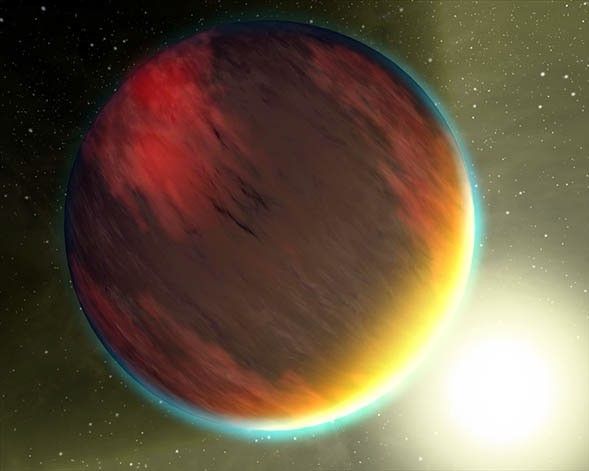
Scientists have spotted helium bleeding out of the atmosphere of exoplanet LHS 1140b, orbiting a red dwarf star named LHS 1140. The planet's upper atmosphere is rich in helium but lacks hydrogen, indicating significant atmospheric changes since its formation. This discovery helps us understand how planets lose their atmospheres over billions of years due to stellar radiation and magnetic fields. Researchers estimate the current escape rate at about 100,000 kilograms per second, suggesting past loss rates were even higher during more active periods.
Key Points
LHS 1140b completes an orbit in nearly 25 days, closer to its host star than Mercury is to the Sun
The system is at least 3 billion years old, providing ample time for atmospheric changes
Near-infrared imaging hardware at Las Campanas Observatory detected helium loss from LHS 1140b's atmosphere
Helium escape rate estimated at about 100,000 kg/s, suggesting past higher rates during more active periods
The study reveals that lighter elements like hydrogen are lost faster than heavier ones, impacting atmospheric composition
Why It Matters
If you're studying exoplanet atmospheres, this research offers insights into how planets evolve over billions of years. The loss rate and composition changes suggest LHS 1140b's atmosphere has been significantly altered since its formation.
Frequently Asked Questions
Why does this matter?
If you're studying exoplanet atmospheres, this research offers insights into how planets evolve over billions of years. The loss rate and composition changes suggest LHS 1140b's atmosphere has been significantly altered since its formation.
What happened?
Researchers observed helium escaping from the atmosphere of exoplanet LHS 1140b as it orbits a red dwarf star. This study sheds light on how planets lose their atmospheres over billions of years.
Comments
Be the first to comment
Enjoyed this article?
Get it daily. 7am. Free. Reads in 5 minutes.
Join 2,077 builders reading daily.