⚛️IQM and AMD Run Hybrid Quantum-GPU Chemistry on a 20-Qubit Chip
Your supercomputer may soon mix quantum chips with GPUs
TL;DR
IQM and AMD split a hydrogen molecule energy calculation between a 20-qubit quantum processor and AMD GPUs, reproducing a dissociation curve across 17 bond lengths. It's a multi-vendor blueprint for supercomputing centers, and the notebook is open source.
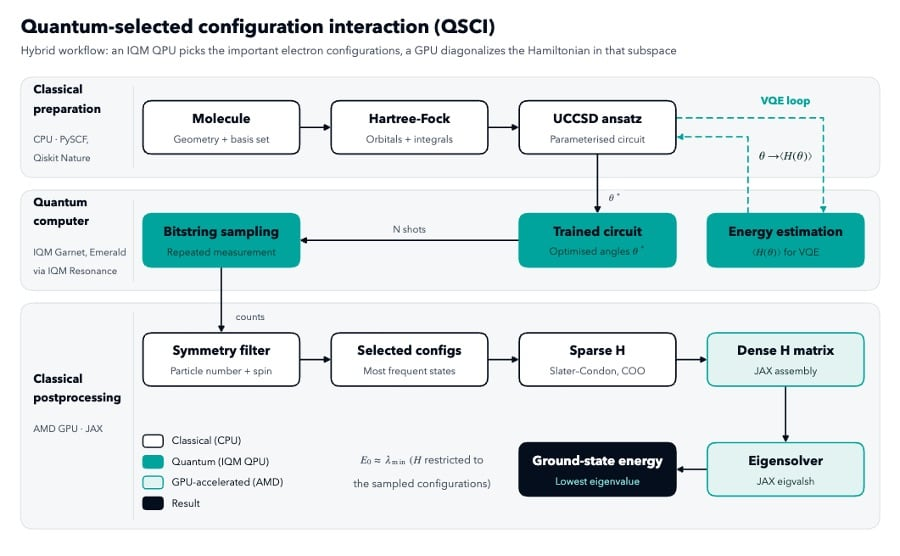
IQM Quantum Computers and AMD just showed that a quantum chip and a GPU can share one chemistry calculation, and the whole thing runs from an open-source notebook. The quantum side is IQM's 20-qubit Garnet processor, which prepares a parameterized trial circuit and samples bitstrings to find the dominant electron configurations. The GPU side takes those samples, filters out unphysical ones, builds the projected subspace Hamiltonian, and diagonalizes it. If you run HPC or scientific workloads, this matters because it's a multi-vendor recipe, not a single-vendor lock-in demo. Supercomputing centers are already wiring quantum processors next to classical accelerators, and this shows a concrete division of labor you can copy. The notebook runs on AMD Developer Cloud GPU instances, so you can poke at it without buying hardware. The chemistry test case was molecular hydrogen in the minimal STO-3G basis, which is deliberately small. The pipeline reproduced the H2 dissociation curve across 17 bond lengths on physical hardware. The GPU diagonalization is cubic-scaling, O(N3), using JAX on ROCm. The teams say this is an interoperability validation, not quantum advantage, and the next steps are tighter physical interconnects and active spaces above eight qubits.
Key Points
The quantum processor is IQM's 20-qubit superconducting Garnet chip, which prepares a parameterized trial circuit and samples bitstrings to find dominant electron configurations.
Keep reading — it's free
Enter your email to keep reading — plus the best of AI & tech, daily. Free, forever.
Already a member? Sign in
Comments
Be the first to comment