✨Martian Cloud Mystery Solved: AMEC Formation Modeled
Martian Cloud Mystery Solved, Revealing Rare Atmospheric Process
TL;DR
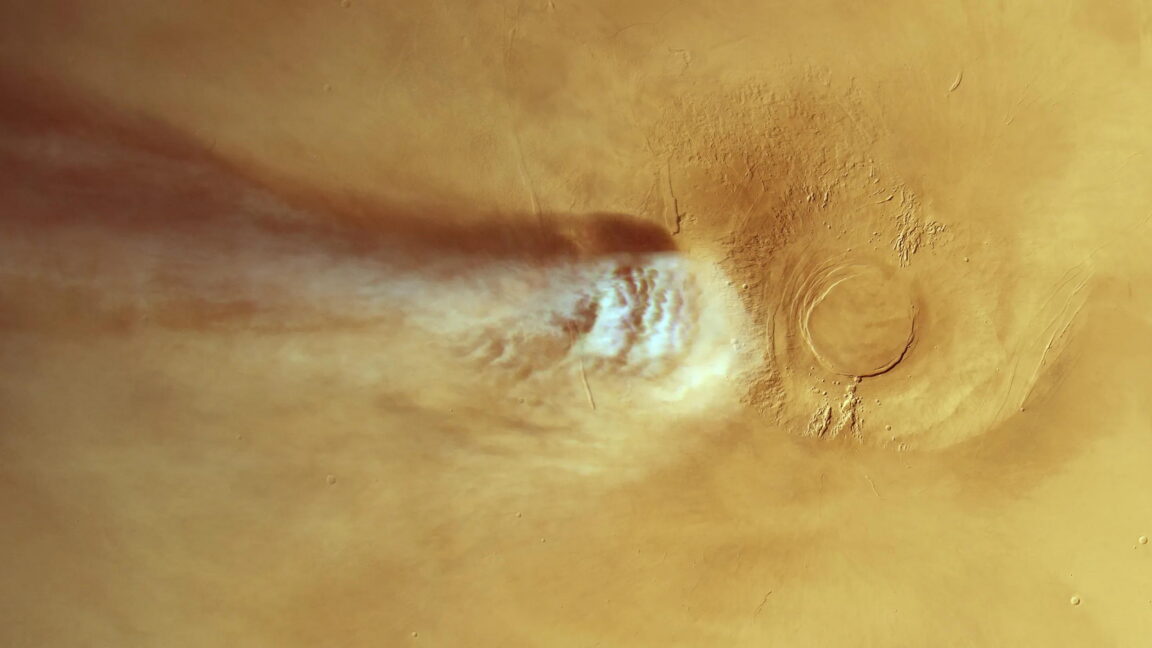
Scientists have modeled the formation of the Arsia Mons Elongated Cloud (AMEC) on Mars, revealing a rare atmospheric process that could occur on other planets. The AMEC appears during Martian spring and summer, stretching over 1,000 miles before dissipating.
Researchers have successfully modeled the formation of the Arsia Mons Elongated Cloud (AMEC) on Mars, a phenomenon that has puzzled scientists since its discovery in 2018. The AMEC appears every Martian spring and summer, stretching over 1,000 miles before dissipating. This rare atmospheric process requires extreme conditions, including a sharp 30°C temperature drop within 10 minutes and high relative humidity. The Arsia Mons volcano plays a key role, launching moist air high into the atmosphere in minutes. The study, published in Nature Geoscience, suggests similar phenomena could occur in the upper atmospheres of other planets, including Venus and Earth, though it has never been observed.
Key Points
The AMEC appears near the volcano Arsia Mons and stretches over 1,000 miles during Martian spring and summer.
The process requires a sharp 30°C temperature drop within 10 minutes and high relative humidity, conditions not seen on Earth.
The Arsia Mons volcano launches moist air high into the atmosphere in minutes, playing a key role in the AMEC's formation.
The study, published in Nature Geoscience, reproduces the AMEC to a high degree, suggesting similar phenomena could occur on other planets.
The AMEC is a result of homogeneous nucleation, where vapor changes directly into ice crystals without any help from debris.
Why It Matters
The AMEC's formation on Mars reveals a rare atmospheric process that could occur in the upper atmospheres of other planets, including Venus and Earth. However, the extreme conditions required—sharp temperature drops and high humidity—make it unlikely to be observed on Earth. This discovery could lead to new insights into atmospheric processes on other planets.
Comments
Be the first to comment
Enjoyed this article?
Get it daily. 7am. Free. Reads in 5 minutes.
Join 3,567 builders reading daily.