🏗️MIT Researchers Build Room-Sized Origami Aluminum Sculpture Using Flat Sheets and Folds
Disaster shelters could fold up flat and ship cheap
TL;DR
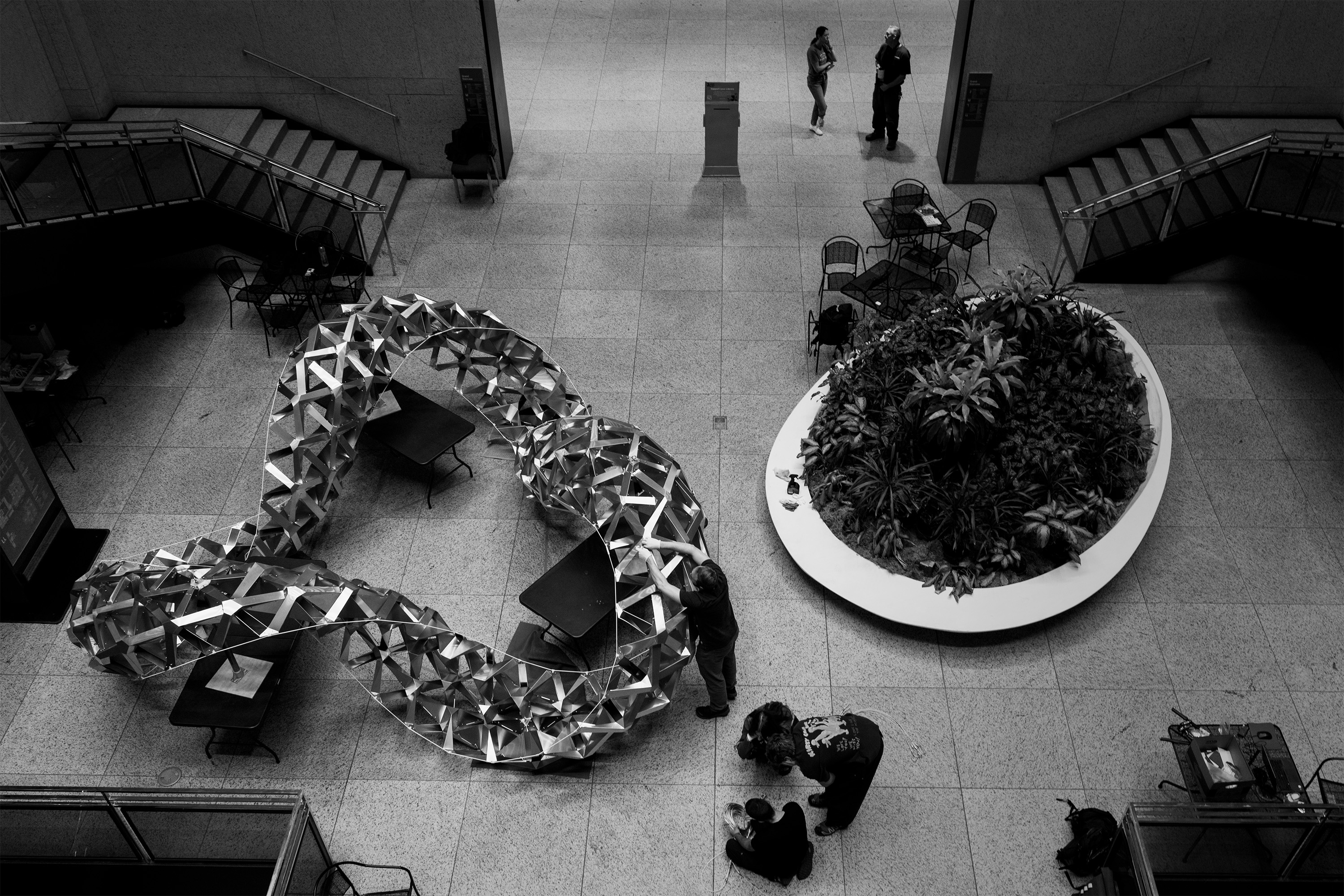
Researchers developed a modular origami construction method that makes structures about 3.5 times stiffer than some alternatives while using less material. A 23-foot aluminum sculpture hangs in the Boston Public Library as proof. Disaster shelters that ship flat could be next.
Cheap, stiff, lightweight structures just got a lot more practical, and the trick is folding. Researchers built a modular origami system that cuts flat sheets into interlocking blocks, then folds them into a large 3D lattice without welding gear. Why should you care? If you work on hardware prototyping, robotics, or architecture, this is a new way to get strength without bulk. The team says the approach suits disaster relief shelters that ship flat and assemble fast, plus airplane parts, modular robots, sound-dampening panels, and building facades. An automated solver turns your target shape into manufacturable unit cells, and the output feeds straight into a CNC mill. The numbers: simulations show roughly 3.5 times the stiffness of some other structural origami techniques at about two-thirds the material. A 23-foot folded aluminum sculpture went up in days, built by a team with no professional construction background. It now hangs in the atrium of the Boston Public Library for the Fab Lab Conference and Symposium. Next up: larger architectural tests and more complex unit cell geometries. Those are the parts that decide whether this leaves the gallery.
Key Points
The method cuts modular blocks from flat sheets with a CNC milling machine, then folds them into a 3D lattice using simple tools and no large-scale welding equipment at all.
Keep reading — it's free
Enter your email to keep reading — plus the best of AI & tech, daily. Free, forever.
Already a member? Sign in
Comments
Be the first to comment