⚛️Photonic Quantum Chips Pass Exact Classical Simulation at 31 Inputs on One H100
Your classical simulators have a shelf life now
TL;DR
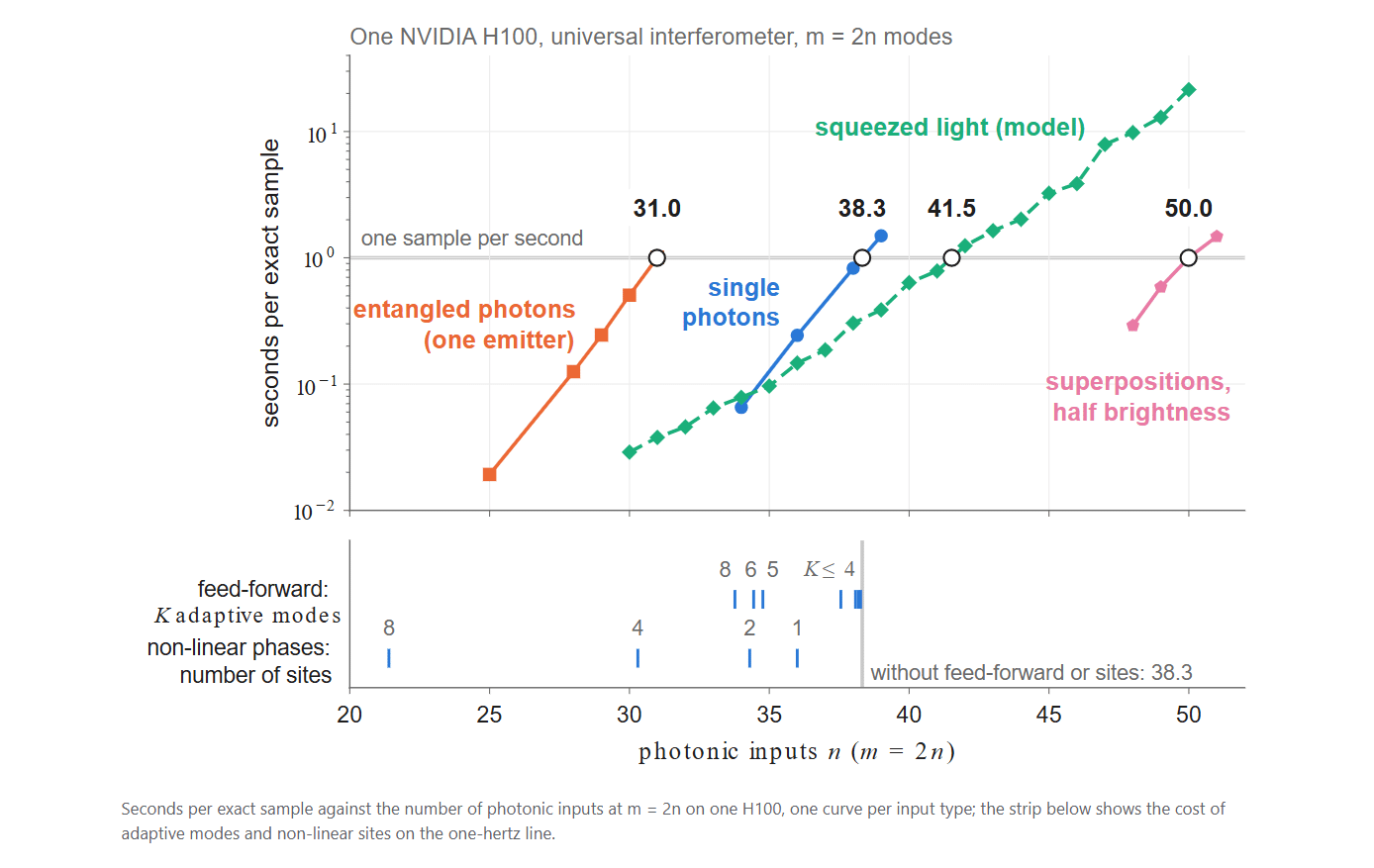
Researchers defined a standard simulability frontier for photonic quantum chips using one H100 GPU and the open-source photonic-engines library. Entangled emitters hit the frontier at 31 inputs, single photons at 38.3. Adding GPUs barely moves the line, so hardware scaling won't save classical methods.
Photonic quantum processors are about to outrun exact classical simulation, and the line sits lower than many people assumed. A new benchmarking study defines a single number for where that happens: the input count at which the fastest exact classical sampler produces one sample per second on a single NVIDIA H100 PCIe GPU, using interferometers with twice as many modes as inputs. If you work on quantum software or evaluate quantum hardware claims, this gives you a yardstick that replaces a mess of literature thresholds ranging from 50 to 98 photons. Teams comparing vendor advantage claims can now ask one concrete question: what is the frontier for this specific source type? The study runs on the open-source photonic-engines GPU library, so you can reproduce the numbers yourself. The headline figures: 31.0 inputs for entangled quantum emitters, 38.3 for single photons, 41.5 for squeezed light, and 50.0 for coherent superpositions. Quantum coherence lowers the frontier by 14.2 inputs compared to incoherent lossy photons, which sit at 64.2. Adding 8 H100s buys only +3.5 inputs, while 16,384 GPUs add +16.2. The catch? Hardware scaling is brutally slow compared to hardware growth on the quantum side.
Key Points
Entangled quantum emitters reach the simulability frontier at 31.0 photonic inputs, meaning the fastest exact classical sampler manages only one sample per second at that size on one H100 GPU.
Keep reading — it's free
Enter your email to keep reading — plus the best of AI & tech, daily. Free, forever.
Already a member? Sign in
Comments
Be the first to comment