⚛️Quantum Machines Decodes Quantum Errors in 0.22μs Per Round on NVIDIA GH200
Quantum error correction just got fast enough for real hardware
TL;DR
Quantum Machines demoed real-time quantum error correction decoding on its OPX1000 using NVIDIA CUDA-Q and a GH200 server, hitting sub-microsecond per-round decode times at code distances 7 and 11. If you're building toward fault-tolerant quantum systems, this is the latency benchmark to track. Early access opens to customers in December 2026.
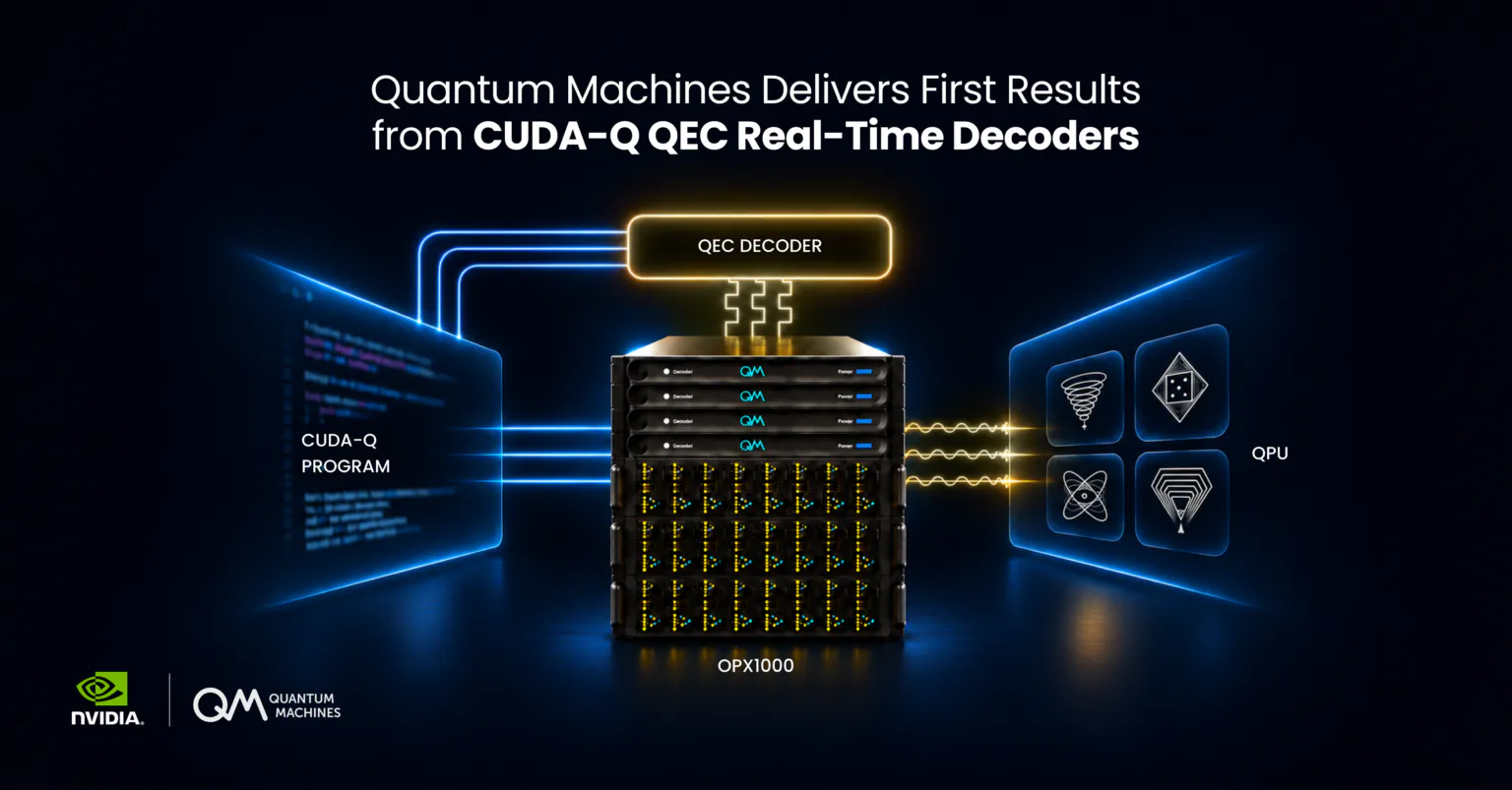
Quantum Machines just showed that real-time quantum error correction decoding can run fast enough to keep up with the hardware. Running on its OPX1000 control platform paired with an NVIDIA GH200 Grace Hopper server, the team decoded surface-code syndromes in sub-microsecond time per round for code distances 7 and 11. Why should you care? Because error correction only works if the decoder finishes before the next round of qubit measurements arrives. Miss that window and the correction is useless. The CUDA-Q QEC decoding server also separates decoder logic from transport code, so you can swap algorithms through a YAML edit without touching control firmware. That's the kind of modularity that lets a team iterate on decoders without re-flashing hardware. The numbers: at a 0.1% physical error rate over 10,000 shots, distance 7 decoded in 0.19 to 0.22 μs per round, distance 11 in 0.56 to 0.67 μs, and distance 15 in 1.20 to 1.50 μs. The controller-to-decoder round trip held at 2.4 μs. The catch is that the first release routes callbacks through host CPU dispatch threads, with direct GPU dispatch promised later.
Key Points
Surface-code decoding at a 0.1% physical error rate ran over 10,000 shots per test, with the GH200 Grace Hopper server handling all decoder computation.
Keep reading — it's free
Enter your email to keep reading — plus the best of AI & tech, daily. Free, forever.
Already a member? Sign in
Comments
Be the first to comment