⚛️Qubrio Uses Multi-Agent LLMs to Compile Neutral-Atom Quantum Circuits 4.7× Faster
Your quantum compiler just got a lot faster
TL;DR
Researchers from UC San Diego, Rice, QuEra and others released Qubrio, a multi-agent LLM framework that compiles neutral-atom quantum circuits. It cuts runtime 4.7× and lifts fidelity 1.3× on average. Accepted to NeurIPS 2026, it's worth watching if you touch quantum hardware tooling.
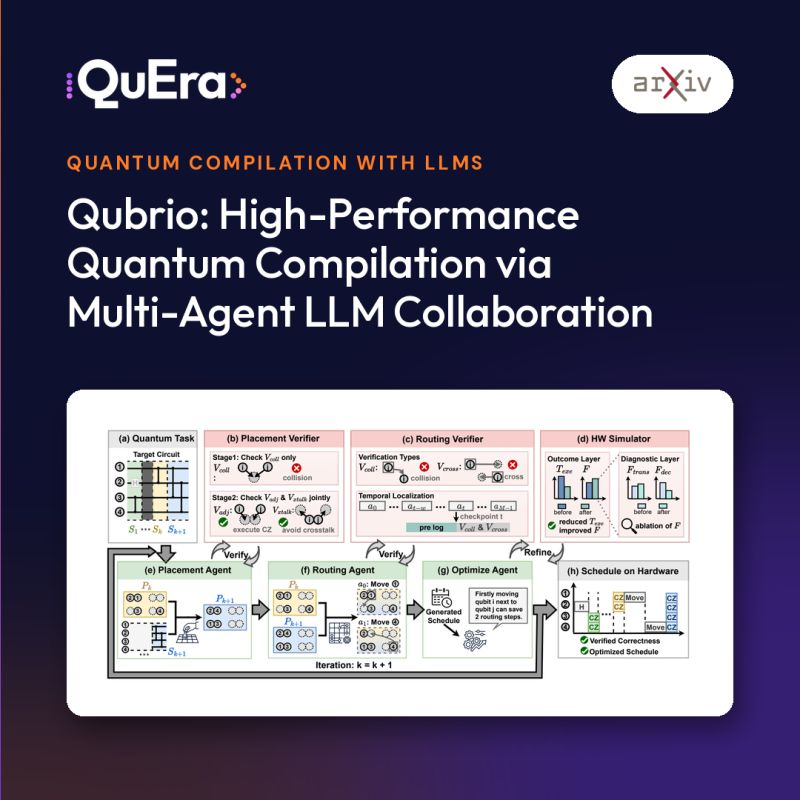
A multi-agent LLM system just beat heuristic compilers at one of quantum computing's messiest problems. Qubrio, from researchers at UC San Diego, Rice, QuEra Computing, RIT and UW-Madison, automates qubit placement, AOD routing, and schedule optimization for neutral-atom hardware. It was accepted to NeurIPS 2026. Why should you care? Compiling quantum circuits for neutral-atom machines is brutal, and most teams rely on hand-tuned heuristics. Qubrio pairs specialized LLM proposal agents with deterministic constraint verifiers and a physical hardware simulator, so the LLM suggests and the verifier rejects anything physically impossible. That split is the pattern worth stealing if you build LLM systems for any constrained domain. The numbers: against PowerMove on QFT, QAOA, GHZ and Ising circuits up to 78 qubits, the baseline configuration averages a 4.7× runtime reduction and a 1.3× fidelity gain. On GHZ-78, its convoy-style shuttling packs up to 30.3 qubits per AOD move. Swapping the backbone between GPT-5.4, DeepSeek-V3.2 and Qwen-3.5 still gives 2.1× to 4.7× speedups, at $0.29 to $0.59 per stage. Batches compile in roughly five minutes. Watch whether the declarative-constraint approach holds up on hardware beyond the simulator.
Key Points
Qubrio averages a 4.7× runtime reduction and a 1.3× fidelity gain against PowerMove across QFT, QAOA, GHZ and Ising circuits scaling up to 78 qubits.
Keep reading — it's free
Enter your email to keep reading — plus the best of AI & tech, daily. Free, forever.
Already a member? Sign in
Comments
Be the first to comment