💡Rekursiv Processor Buried in Scottish Canal
A 1980s Processor with Ahead-of-Its-Time Features?
TL;DR
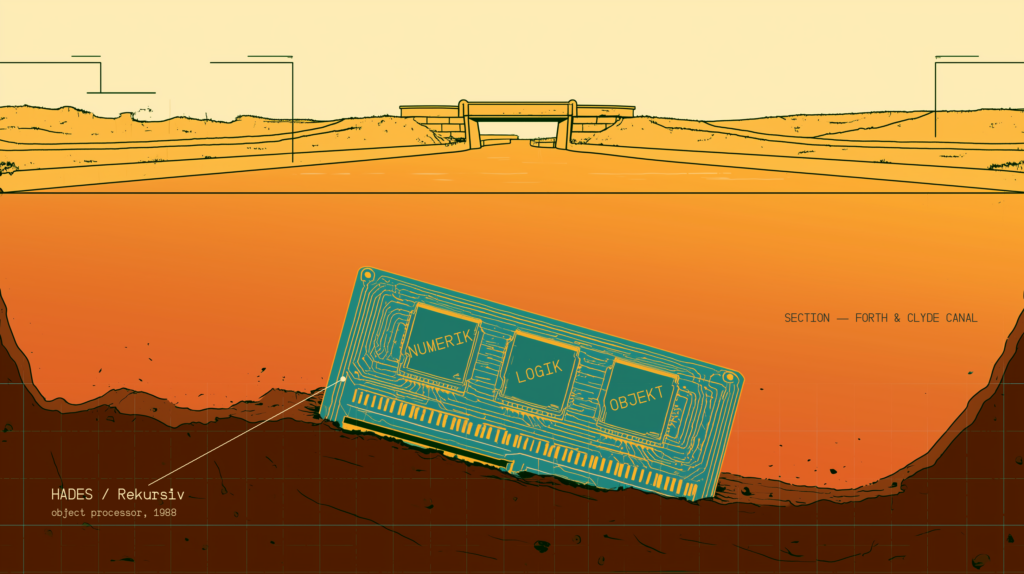
In 1988, a Scottish hi-fi company buried their custom silicon processor at the bottom of a canal. The Rekursiv chip was ahead of its time with hardware-based memory checks and garbage collection.
A box of custom silicon was buried in Scotland's Forth and Clyde Canal in 1988 by Linn Products, marking the end of an ambitious project that started in 1972. The Rekursiv processor featured groundbreaking hardware-level memory safety and automatic garbage collection. This chip treated memory and disk as a single persistent object store, with each object carrying a unique 40-bit number for tracking history. If you're into retro tech or curious about the evolution of computing architecture, this is worth a read.
Key Points
Ivor Tiefenbrun founded the Rekursiv project in 1972, aiming for a system where every physical object has a shadowing software object accumulating history.
Linn Products built a modern factory at Eaglesham, south of Glasgow, in the early eighties to support their ambitious hardware projects.
The Department of Trade and Industry funded roughly £10 million towards the Rekursiv project alongside Linn's own money.
LSI Logic fabricated four gate arrays named NUMERIK, LOGIK, OBJEKT, and KLOK for the Rekursiv processor.
Rekursiv claimed a CONS cell every two microseconds, showcasing impressive performance metrics for its time.
Why It Matters
The Rekursiv project was funded by Linn's own money plus roughly £10 million from the Department of Trade and Industry. It aimed to create a system where every physical object had a shadowing software object accumulating history, treating memory and disk as one persistent object store. This ambitious hardware-level approach to safety and garbage collection influenced future computing architectures.
Frequently Asked Questions
Why does this matter?
The Rekursiv project was funded by Linn's own money plus roughly £10 million from the Department of Trade and Industry. It aimed to create a system where every physical object had a shadowing software object accumulating history, treating memory and disk as one persistent object store. This ambitious hardware-level approach to safety and garbage collection influenced future computing architectures.
What happened?
In 1988, a Scottish hi-fi company buried their custom silicon processor at the bottom of a canal. The Rekursiv chip was ahead of its time with hardware-based memory checks and garbage collection.
Comments
Be the first to comment
Enjoyed this article?
Get it daily. 7am. Free. Reads in 5 minutes.
Join 2,073 builders reading daily.