⚛️Researchers Demonstrate Two-Qubit Gates on Electrons Trapped Above Solid Neon
A cheaper, compact qubit platform just got a working two-qubit gate
TL;DR
Researchers have run two-qubit gates on electrons floating on solid neon, a platform that is low-noise, compact, and fully electrically controlled. Coupling comes naturally from electrons confined close together. It is a credible route to scalable quantum hardware that does not need exotic fabrication.
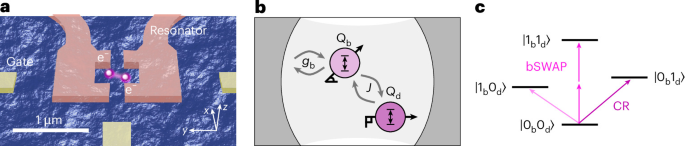
Researchers have demonstrated two-qubit operations using electrons trapped on the surface of solid neon. That's a big step, because two-qubit gates are the part of this platform that refused to work until now. Why should you care? If you follow quantum hardware roadmaps, this is a new contender with a different set of trade-offs. Superconducting and trapped-ion systems dominate the conversation, but they come with heavy cryogenic and fabrication overhead. Electrons on neon are compact and electrically controlled, which matters if you are thinking about how these machines get built at scale. The team implemented cross-resonance and bSWAP operations using global microwave drives, and showed strong qubit-qubit coupling from electrons that sit naturally close together on the neon surface. The catch: this is still a lab demonstration, and the authors say engineering electron confinement is what will decide whether the coupling can be tuned well enough for larger arrays.
Key Points
The team demonstrated coherent manipulation of multiple interacting electron-on-solid-neon charge qubits, showing the platform works beyond single-qubit control.
Keep reading — it's free
Enter your email to keep reading — plus the best of AI & tech, daily. Free, forever.
Already a member? Sign in
Comments
Be the first to comment