⚛️Researchers Rotate Majorana Qubits Using Fermion Parity in Minimal Kitaev Chains
Majorana qubits just moved from detection to actual control
TL;DR
Experimenters rotated a qubit built from Majorana fermion parity on minimal Kitaev chains, with oscillations in both parity sectors. Protection is still missing, but the device and code are public for anyone to check.
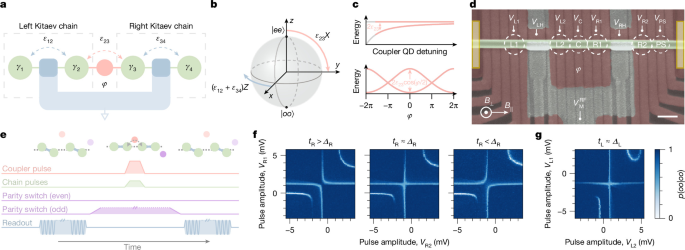
Here's the milestone: someone can now rotate a qubit using the parity of Majorana zero modes, not just detect those modes in transport data. The experiment ran on minimal Kitaev chains, the simplest arrangement that can host them. Why should you care? Majorana zero modes store information non-locally, and their noise sensitivity should drop exponentially as the modes move apart. That's the fault-tolerance pitch. The catch: minimal chains produce poor man's Majoranas, which look right at near-zero energy with balanced electron-hole character but have no topological protection. Treat this as a platform proof, not a working fault-tolerant qubit. The data show clean parity oscillations in both the even and odd sectors of the system, since total parity conservation splits it into those two manifolds. Oscillation rate, rotation axis, and coherence all shift predictably with inter-chain coupling and dot detuning, so the controls behave as expected. Raw data sit on Zenodo, so you can verify the numbers yourself. Worth watching: whether coherence survives as chains get longer.
Key Points
Coherent parity oscillations appear in both the even and odd fermion parity manifolds, so control works in each global sector of the device.
Keep reading — it's free
Enter your email to keep reading — plus the best of AI & tech, daily. Free, forever.
Already a member? Sign in
Comments
Be the first to comment