💡Rule 30 Generates Randomness with 00011110 Pattern
Rule 30's Randomness and Patterns Explained
TL;DR
Rule 30, a simple binary pattern, generates complex, seemingly random behavior. It's been featured in Mathematica and on railway station walls, challenging researchers with three unsolved questions about its center column.
Rule 30, a simple binary pattern (00011110), generates complex, seemingly random behavior. This pattern has been used in Mathematica and even featured on the walls of Cambridge North railway station. The challenge? Three unsolved questions about the center column's behavior. Why should you care? Rule 30's output has been computed for a billion cells, but it doesn't prove randomness. The left side settles into stripes, while the right side remains unpredictable. This matters for anyone working with randomness or pattern recognition in algorithms.
Key Points
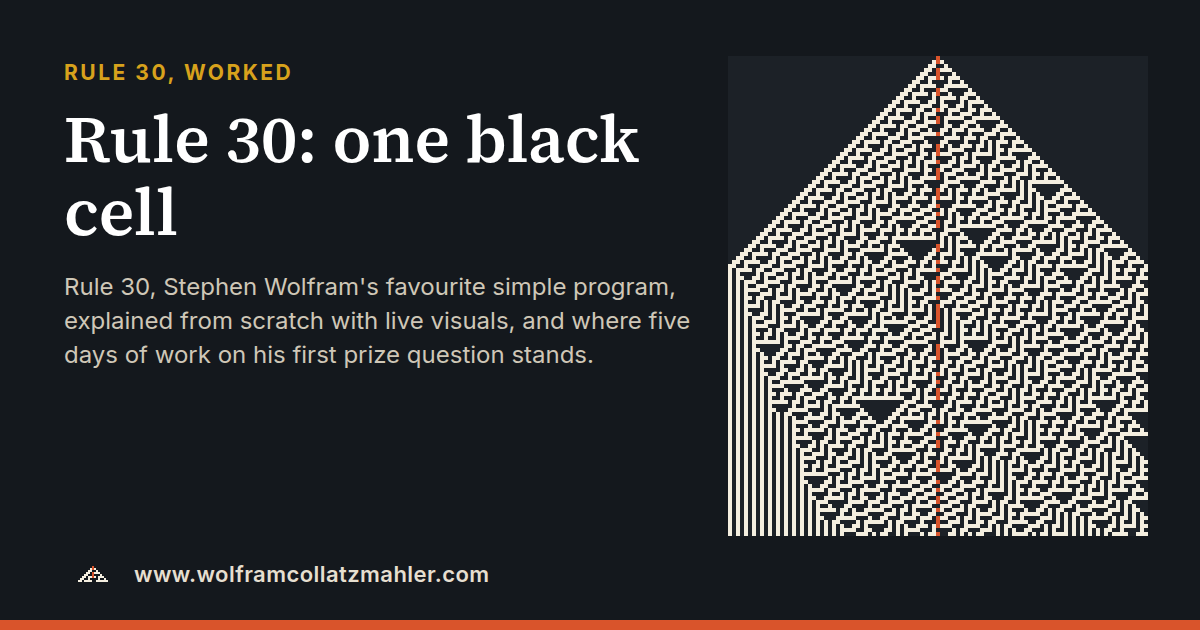
Rule 30 is a binary pattern, 00011110, which translates to the number 30.
The left side of Rule 30's output settles into regular stripes, while the right side remains unpredictable.
The center column's randomness is a subject of a challenge with prizes for answers to three questions.
The output has been computed for a billion cells, but this doesn't prove randomness.
The left edge of Rule 30's output has an average speed of 0.244 squares per row.
Why It Matters
If you're working with randomness or pattern recognition in algorithms, Rule 30's unpredictable center column challenges conventional wisdom. For example, Mathematica uses Rule 30 for random number generation, but the unresolved questions about its center column mean we can't fully trust its randomness.
Comments
Be the first to comment
Enjoyed this article?
Get it daily. 7am. Free. Reads in 5 minutes.
Join 3,568 builders reading daily.