✨Saturn's South Pole Hides a 10-Sided Atmospheric Structure
Saturn's south pole just got a decagonal makeover
TL;DR
Astronomers spotted a 10-sided structure in Saturn's south pole atmosphere, suggesting conditions ripe for polygonal waves. The decagon, unlike the stable north pole hexagon, is a recent formation and could provide insights into atmospheric dynamics.
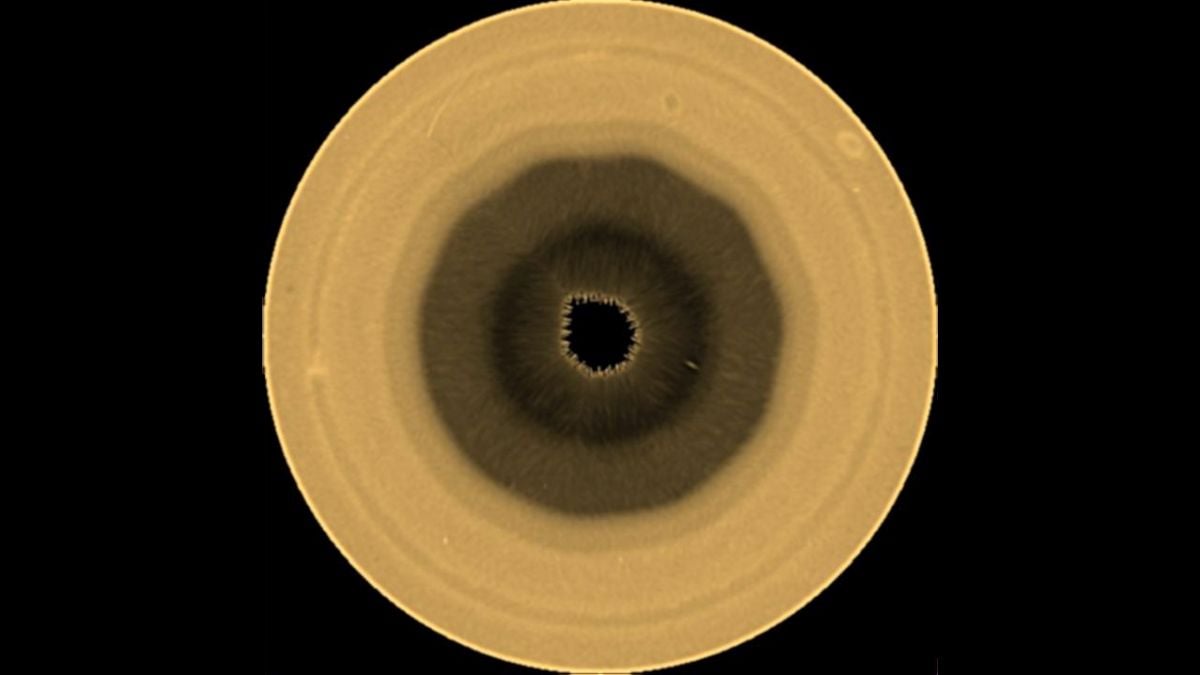
Astronomers have detected a 10-sided structure in Saturn's south pole atmosphere, marking a significant discovery in planetary science. This decagonal wave, unlike the stable hexagon at Saturn's north pole, is a recent formation and could reveal new insights into atmospheric dynamics and wave formation. The structure, confirmed through Hubble observations between 2023 and 2025, moves at a leisurely pace of around 10 kilometers per hour, embedded in one of Saturn's powerful eastward jet streams racing at 420 kilometers per hour. This discovery suggests that Saturn's southern subpolar jets can indeed produce polygonal waves, challenging previous assumptions. Scientists are now closely monitoring the decagon to understand its formation and evolution over time.
Key Points
Astronomers detected a 10-sided structure in Saturn's south pole atmosphere, confirmed through Hubble observations between 2023 and 2025.
The decagon moves at 10 km/h, embedded in a jet stream racing at 420 km/h.
The decagon is a recent formation, unlike the stable north pole hexagon first spotted in 1980.
Simulations suggest a high-pressure vortex could have played a role in the decagon's formation.
Scientists are monitoring the decagon to understand its evolution and formation over the coming months and years.
Why It Matters
If you're studying planetary atmospheres, Saturn's south pole decagon is a goldmine of data. Unlike the stable north pole hexagon, this recent formation could reveal new insights into atmospheric dynamics and wave formation. The decagon's presence suggests that Saturn's southern subpolar jets can indeed produce polygonal waves, challenging previous assumptions and opening up new avenues for research.
Frequently Asked Questions
Why does this matter?
If you're studying planetary atmospheres, Saturn's south pole decagon is a goldmine of data. Unlike the stable north pole hexagon, this recent formation could reveal new insights into atmospheric dynamics and wave formation. The decagon's presence suggests that Saturn's southern subpolar jets can indeed produce polygonal waves, challenging previous assumptions and opening up new avenues for research.
What happened?
Astronomers spotted a 10-sided structure in Saturn's south pole atmosphere, suggesting conditions ripe for polygonal waves. The decagon, unlike the stable north pole hexagon, is a recent formation and could provide insights into atmospheric dynamics.
Comments
Be the first to comment
Enjoyed this article?
Get it daily. 7am. Free. Reads in 5 minutes.
Join 3,465 builders reading daily.