💡Spin-Qubit Shuttling Enables Quantum Processor Breakthrough
Long-range connectivity and error correction just got a huge boost
TL;DR
Recent advances in spin-qubit shuttling enable dynamic, long-range connectivity essential for quantum error-correction schemes. A five-qubit processor demonstrates universal control and multi-qubit entanglement using the surface code. This marks a significant step towards scalable quantum computing.
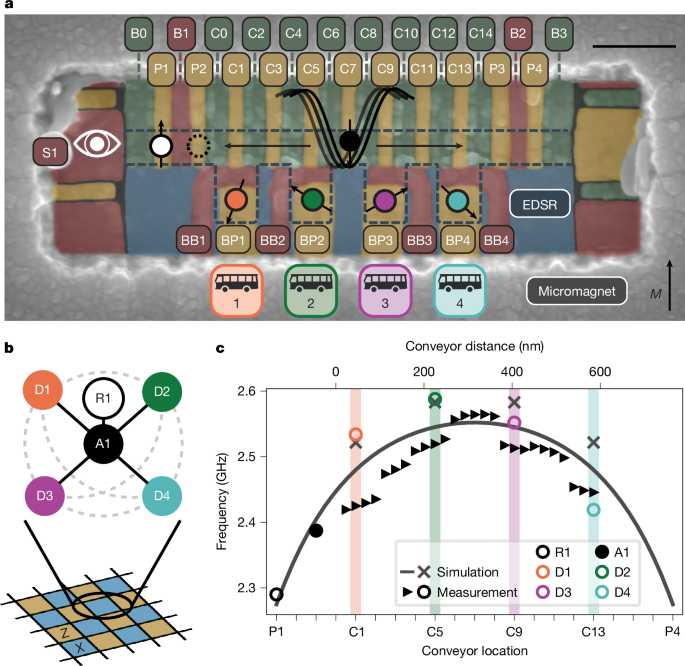
Scientists have made a breakthrough in quantum computing with the demonstration of spin-qubit shuttling, enabling dynamic connectivity across sparse semiconductor arrays. The new method allows for long-range interactions between qubits without direct physical contact, crucial for implementing error correction schemes like the surface code. Universal control over an effective five-qubit processor was achieved, showcasing multi-qubit entanglement and genuine Greenberger-Horne-Zeilinger states. This development is a game-changer for teams working on quantum error correction and scalable architectures. Why does this matter? Quantum computing researchers now have a viable alternative to dense qubit arrays, which are notoriously difficult to calibrate and operate. The sparse array approach reduces crosstalk and simplifies control signal routing, making large-scale deployment of quantum error correction more feasible.
Key Points
Spin-qubit arrays can now interact at four isolated locations called bus stops, demonstrating dynamic and long-range connectivity
Universal control of an effective five-qubit processor was achieved using the surface code with X- and Z-type parity checks up to weight four
Multi-qubit entanglement between all qubit combinations in the array was generated using parity checks, marking a significant step forward
A genuine Greenberger-Horne-Zeilinger state of five spin-qubits was reported, one of the largest constructed with gate-defined semiconductor spins
The sparse array approach reduces crosstalk and simplifies control signal routing, making large-scale quantum error correction more feasible
Why It Matters
If you're working on quantum error-correction schemes or scalable architectures, this breakthrough in spin-qubit shuttling is a must-read. It enables dynamic reconfiguration of qubits for long-range connectivity and reduces the complexity of control signal routing. This marks a significant step towards practical large-scale deployment of quantum processors.
Frequently Asked Questions
Why does this matter?
If you're working on quantum error-correction schemes or scalable architectures, this breakthrough in spin-qubit shuttling is a must-read. It enables dynamic reconfiguration of qubits for long-range connectivity and reduces the complexity of control signal routing. This marks a significant step towards practical large-scale deployment of quantum processors.
What happened?
Recent advances in spin-qubit shuttling enable dynamic, long-range connectivity essential for quantum error-correction schemes. A five-qubit processor demonstrates universal control and multi-qubit entanglement using the surface code. This marks a significant step towards scalable quantum computing.
Comments
Be the first to comment
Enjoyed this article?
Get it daily. 7am. Free. Reads in 5 minutes.