🔬Superconducting Circuits Prepare 500-Photon Probes, Beat Quantum Limit by 19.2 dB
Quantum sensors just got a lot more precise
TL;DR
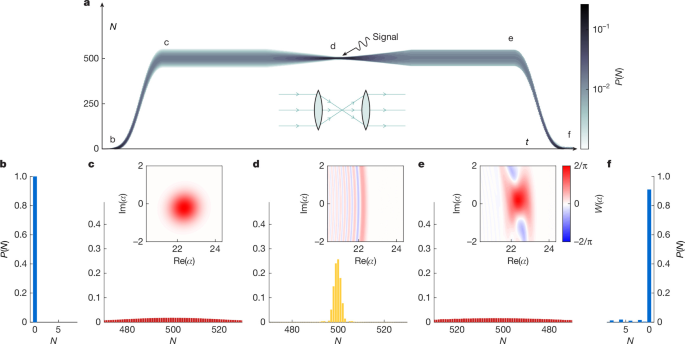
Researchers deterministically prepared Fock-like probe states with up to 500 photons on a superconducting platform, cutting photon-number variance 21.5 dB below a coherent state. The result is a 19.2 dB gain beyond the standard quantum limit, from a compact confocal protocol other bosonic hardware could adopt.
Quantum sensors just got a serious upgrade. A team using superconducting circuit QED deterministically prepared focused probe states holding up to 500 photons, and measured a 19.20 ± 0.20 dB gain beyond the standard quantum limit. Why should you care? Two problems have kept quantum-enhanced measurement stuck: preparing non-trivial probes on demand, and reading out information efficiently in large Hilbert spaces. This work tackles both with a confocal lens system whose circuit runs at O(1) depth, so the protocol stays short even as photon counts climb. The numbers: photon-number variance drops 21.5 ± 1.1 dB below a coherent state at N = 500. The authors argue the approach can carry over to other bosonic hardware and to large many-body quantum systems. Source data sits on Figshare, and the solver code is available on request. What to watch: whether the method survives outside this one superconducting stack, since the headline gain comes from a single platform.
Key Points
Probe states with mean photon numbers up to N = 500 were prepared deterministically on a superconducting circuit QED platform, a large jump in controllable quantum probe size.
Keep reading — it's free
Enter your email to keep reading — plus the best of AI & tech, daily. Free, forever.
Already a member? Sign in
Comments
Be the first to comment