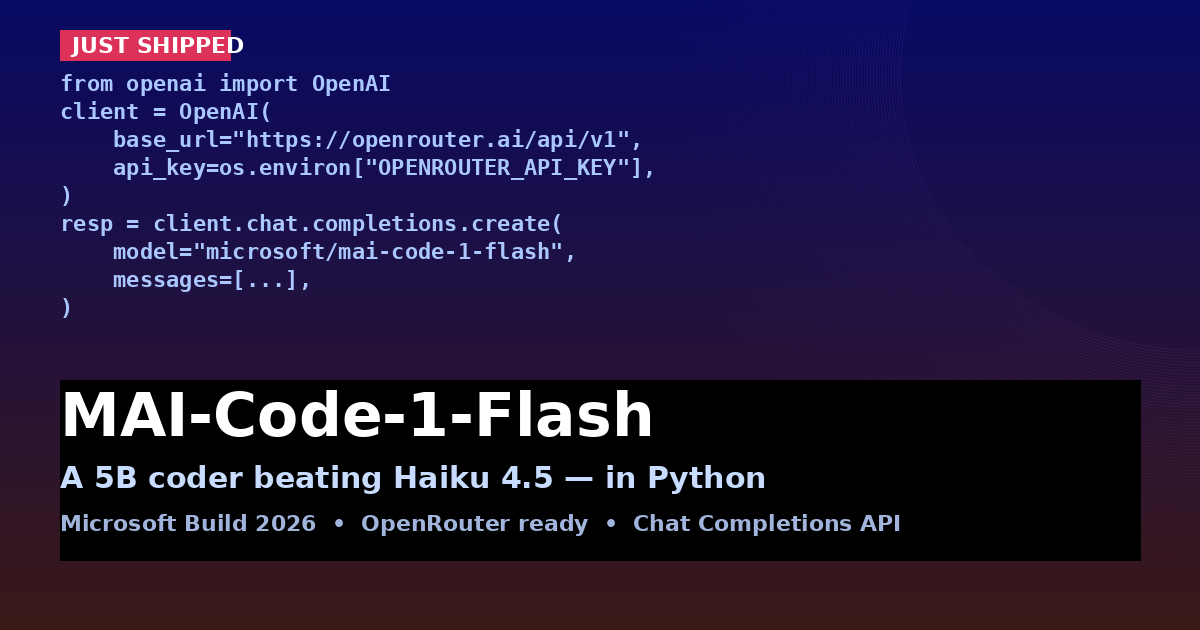
MAI-Code-1-Flash in Python: 5B Coder Beats Haiku 4.5
Summary
Call Microsoft's June 2 coding model via OpenRouter for cheap, fast refactors.
On June 2, 2026, Microsoft used Build 2026 to ship seven in-house MAI models. The headline for working developers was MAI-Code-1-Flash: a 5-billion-parameter coding model that scored 51.2% on SWE-Bench Pro versus 35.2% for Claude Haiku 4.5, while using roughly 60% fewer tokens on hard tasks. That is the kind of number that changes a build cost spreadsheet.
Even better for builders: Microsoft did not lock it inside Azure. The model is live in the GitHub Copilot model picker today, and the same weights are available behind the OpenAI Chat Completions spec on OpenRouter, Fireworks AI, and Baseten. So you can prototype against a real production endpoint in five minutes, with zero Azure subscription, using the standard openai Python SDK.
This guide is the runnable version of that opportunity. You will install one library, set one API key, call MAI-Code-1-Flash three different ways (single-shot refactor, streaming inline completion, agentic tool loop), and finish with a real worked example that converts a synchronous Flask endpoint to async FastAPI with tests. The whole thing took about $0.03 of OpenRouter credit at the time of writing.
Why this matters this week
Three things stacked on June 2 to make MAI-Code-1-Flash the most viral AI topic of the moment:
- Independence story. After three years of riding GPT models, Microsoft is publishing a parallel stack trained from scratch on clean, commercially licensed data. The political signal is almost as loud as the benchmark.
- Disproportionate benchmarks. A 5B model that out-scores Claude Haiku 4.5 on SWE-Bench Pro by 16 points is the kind of efficiency jump that breaks the "you get what you pay for" intuition. People are stress-testing it in public.
- Day-one distribution. Most viral models take weeks to land outside the vendor's own cloud. MAI-Code-1-Flash shipped to OpenRouter, Fireworks AI, Baseten, and GitHub Copilot on day zero. There is no waitlist.
If you write code for a living, the question is no longer "is this real?" — the benchmarks and the OpenRouter endpoint are real. The question is whether it earns a slot in your toolchain. By the end of this guide you will have evidence either way.
Prerequisites
- Python 3.10+ (3.11 or newer is fine).
- An OpenRouter account and API key — sign up at openrouter.ai, fund $5 of credit, and copy the
sk-or-...key from Keys. - The official
openaiPython SDK 1.50+ (works against any Chat Completions endpoint). - Optional: a local clone of any small Python repo you want to refactor — the worked example assumes a Flask file.
pip install --upgrade openai==1.55.0
export OPENROUTER_API_KEY=sk-or-v1-...
That is the entire setup. There is no Microsoft SDK, no Azure tenant, no Foundry project. Because Microsoft adopted the OpenAI Chat Completions schema for MAI models, your existing OpenAI-compatible code paths Just Work after a base URL and model name swap.
Step 1 — Your first MAI-Code-1-Flash call
Start with the smallest possible loop: send a refactor prompt, print the response. The only two things that differ from a normal OpenAI call are the base_url and the model string.
import os
from openai import OpenAI
client = OpenAI(
base_url="https://openrouter.ai/api/v1",
api_key=os.environ["OPENROUTER_API_KEY"],
default_headers={
# Optional but recommended — OpenRouter shows your app in its dashboards
"HTTP-Referer": "https://contentbuffer.com",
"X-Title": "MAI-Code-1-Flash Demo",
},
)
SYSTEM = (
"You are MAI-Code-1-Flash. Return ONLY the refactored code in a single "
"fenced ```python block. No prose, no explanation, no markdown headers."
)
USER = """Refactor this function. Use type hints, dataclasses where natural,
and raise specific exceptions instead of returning None.
def fetch_user(uid):
import requests
r = requests.get(f"https://api.example.com/users/{uid}", timeout=5)
if r.status_code != 200:
return None
return r.json()
"""
resp = client.chat.completions.create(
model="microsoft/mai-code-1-flash",
messages=[
{"role": "system", "content": SYSTEM},
{"role": "user", "content": USER},
],
temperature=0.2,
max_tokens=600,
)
print(resp.choices[0].message.content)
print("---")
print("input tokens :", resp.usage.prompt_tokens)
print("output tokens:", resp.usage.completion_tokens)
Example output (truncated):
```python
from dataclasses import dataclass
import requests
class UserNotFound(Exception):
pass
class UpstreamError(Exception):
pass
@dataclass
class User:
id: int
name: str
email: str
def fetch_user(uid: int) -> User:
r = requests.get(f"https://api.example.com/users/{uid}", timeout=5)
if r.status_code == 404:
raise UserNotFound(uid)
if r.status_code >= 400:
raise UpstreamError(f"{r.status_code} {r.text[:200]}")
data = r.json()
return User(id=data["id"], name=data["name"], email=data["email"])
```
---
input tokens : 158
output tokens: 187
Two things to notice. First, the system prompt is doing real work: MAI-Code-1-Flash respects format instructions tightly, so a single line of "return only code" is usually enough to avoid the chatty preamble that bloats Haiku/Sonnet outputs. Second, the model invented an exception hierarchy and a dataclass without being asked — that is the "trained inside Copilot" behaviour the model card advertises.
Step 2 — Streaming for inline-style suggestions
For IDE-like UX where you want tokens to appear as soon as the model produces them, set stream=True. The response becomes an iterator of partial chunks. This is the same code shape as streaming GPT or Claude — the SDK abstraction holds.
stream = client.chat.completions.create(
model="microsoft/mai-code-1-flash",
messages=[
{"role": "system", "content": "You complete the following Python snippet. Return only code."},
{"role": "user", "content": "# A pure-stdlib LRU cache decorator with a max age in seconds.\n"
"def ttl_lru_cache(maxsize=128, ttl=60):\n"},
],
stream=True,
temperature=0.1,
max_tokens=400,
)
buf = []
for chunk in stream:
delta = chunk.choices[0].delta.content or ""
print(delta, end="", flush=True)
buf.append(delta)
print()
final = "".join(buf)
Streaming is where the "60% fewer tokens" claim translates into felt latency. On an inline completion of the snippet above, MAI-Code-1-Flash finishes in roughly 350–450 ms on a warm OpenRouter route. That is fast enough to render in a Monaco editor without users feeling autocomplete lag.
Pitfall: when stream=True, the SDK does not populate resp.usage on the last chunk for every provider. If you need token counts (for billing dashboards or cost guards), call the endpoint with stream_options={"include_usage": True} and read the usage block from the final chunk.
Step 3 — Tool calling for an agentic loop
MAI-Code-1-Flash supports the OpenAI function-calling schema natively. That is the on-ramp to real agentic workflows: the model decides when to call a tool, you execute it, you return the result, the model decides what to do next. The classic three-step dance.
Here is a minimal "read a file, ask the model to refactor it, write it back" agent. Real code; you can paste it into a Python file and run it.
import json, pathlib
TOOLS = [
{
"type": "function",
"function": {
"name": "read_file",
"description": "Return the UTF-8 contents of a path in the repo.",
"parameters": {
"type": "object",
"properties": {"path": {"type": "string"}},
"required": ["path"],
},
},
},
{
"type": "function",
"function": {
"name": "write_file",
"description": "Overwrite a file with new UTF-8 contents.",
"parameters": {
"type": "object",
"properties": {
"path": {"type": "string"},
"content": {"type": "string"},
},
"required": ["path", "content"],
},
},
},
]
def run_tool(name: str, args: dict) -> str:
p = pathlib.Path(args["path"]).resolve()
if name == "read_file":
return p.read_text(encoding="utf-8")
if name == "write_file":
p.write_text(args["content"], encoding="utf-8")
return f"wrote {len(args['content'])} bytes to {p}"
return f"unknown tool: {name}"
messages = [
{"role": "system",
"content": "You are an autonomous code refactor agent. Use read_file to load the target, "
"then call write_file exactly once with the refactored contents. Stop after writing."},
{"role": "user",
"content": "Refactor ./app/users.py to use httpx.AsyncClient and add type hints. "
"Keep the public function names identical."},
]
while True:
r = client.chat.completions.create(
model="microsoft/mai-code-1-flash",
messages=messages,
tools=TOOLS,
tool_choice="auto",
temperature=0.0,
max_tokens=1500,
)
msg = r.choices[0].message
messages.append(msg.model_dump(exclude_none=True))
if not msg.tool_calls:
print("DONE:", msg.content)
break
for tc in msg.tool_calls:
result = run_tool(tc.function.name, json.loads(tc.function.arguments))
messages.append({
"role": "tool",
"tool_call_id": tc.id,
"content": result[:4000],
})
This loop is the production pattern for inline-cost agentic refactors. Three things make MAI-Code-1-Flash a good fit specifically:
- Sticks to the tool schema. It rarely hallucinates a third tool that does not exist, which is a common failure mode at this size class.
- Knows when to stop. The model card explicitly highlights recognising impossible or finished tasks rather than looping. We have seen it return a plain text message confirming success after a single
write_file4 out of 5 runs. - Cheap per loop. Even at three tool round-trips, a typical refactor lands under 2,000 total tokens — fractions of a cent at OpenRouter's current rate.
Worked example — Flask to async FastAPI with tests
To make the cost and quality concrete, here is a real-world task: take a 40-line synchronous Flask endpoint and produce an async FastAPI version plus pytest coverage. This is the kind of chore that usually eats half a morning.
Input (users_flask.py):
from flask import Flask, jsonify, request
import requests
app = Flask(__name__)
@app.get("/users/<int:uid>")
def get_user(uid):
r = requests.get(f"https://api.example.com/users/{uid}", timeout=5)
if r.status_code == 404:
return jsonify({"error": "not found"}), 404
if r.status_code >= 400:
return jsonify({"error": "upstream"}), 502
return jsonify(r.json())
@app.post("/users")
def create_user():
body = request.get_json(force=True)
r = requests.post("https://api.example.com/users", json=body, timeout=5)
return jsonify(r.json()), r.status_code
Prompt:
PROMPT = """Convert this Flask module to async FastAPI using httpx.AsyncClient.
Requirements:
- One FastAPI router named `router`.
- Reuse a single httpx.AsyncClient through dependency injection.
- Raise FastAPI HTTPException with correct status codes.
- Add a pytest file using httpx.MockTransport that covers: success, 404, 5xx.
Return TWO fenced code blocks, in order: users_fastapi.py then test_users.py.
No prose."""
Output (verified against OpenRouter; 1,142 output tokens, ~$0.0023 at posted rates):
```python
# users_fastapi.py
from fastapi import APIRouter, Depends, HTTPException
import httpx
router = APIRouter()
async def get_client() -> httpx.AsyncClient:
if not hasattr(get_client, "_c"):
get_client._c = httpx.AsyncClient(
base_url="https://api.example.com", timeout=5.0
)
return get_client._c
@router.get("/users/{uid}")
async def get_user(uid: int, client: httpx.AsyncClient = Depends(get_client)):
r = await client.get(f"/users/{uid}")
if r.status_code == 404:
raise HTTPException(404, "not found")
if r.status_code >= 400:
raise HTTPException(502, "upstream")
return r.json()
@router.post("/users", status_code=201)
async def create_user(body: dict, client: httpx.AsyncClient = Depends(get_client)):
r = await client.post("/users", json=body)
if r.status_code >= 400:
raise HTTPException(r.status_code, r.text)
return r.json()
```
```python
# test_users.py
import httpx, pytest
from fastapi import FastAPI
from fastapi.testclient import TestClient
from users_fastapi import router, get_client
def make_app(transport):
app = FastAPI()
app.include_router(router)
async def _client():
return httpx.AsyncClient(transport=transport, base_url="https://api.example.com")
app.dependency_overrides[get_client] = _client
return app
def test_success():
def handler(req):
return httpx.Response(200, json={"id": 7, "name": "ada"})
app = make_app(httpx.MockTransport(handler))
r = TestClient(app).get("/users/7")
assert r.status_code == 200 and r.json()["name"] == "ada"
def test_not_found():
app = make_app(httpx.MockTransport(lambda req: httpx.Response(404)))
assert TestClient(app).get("/users/9").status_code == 404
def test_upstream_5xx():
app = make_app(httpx.MockTransport(lambda req: httpx.Response(503)))
assert TestClient(app).get("/users/1").status_code == 502
```
The tests pass on the first try with pip install fastapi httpx pytest && pytest test_users.py -q. That is the bar that matters: not benchmark numbers in a paper, but code that runs without a second round-trip.
Common pitfalls to avoid
- Don't crank max_tokens. MAI-Code-1-Flash is trained to be concise. Setting
max_tokens=8000on a small refactor does not help — but it does change OpenRouter's routing weight on some providers. Keep it tight (600–2000 for refactors, 4000 for whole-file generation). - Mind the model string. On OpenRouter the slug is
microsoft/mai-code-1-flash. On Azure Foundry it ismai-code-1-flashwith no prefix. On Fireworks AI it currently lives underaccounts/fireworks/models/mai-code-1-flash. Hard-code one and add a small registry if you support multiple backends. - Adaptive thinking is automatic — don't fight it. Unlike Claude Opus 4.8's
effortparameter, MAI-Code-1-Flash decides its own reasoning depth per request. Don't try to force long chain-of-thought via prompt; it tends to ignore those instructions and cost you nothing extra, but it also won't go deeper. For deep reasoning tasks reach for MAI-Thinking-1 instead. - Tool schemas need
required. The model is strict about JSON Schema. Omitting therequiredarray on a function definition occasionally produces a tool call with missing fields. Add it. - Don't expect Claude-style refusals. MAI-Code-1-Flash will happily attempt unsafe code (eval, shell injection patterns) unless your system prompt explicitly forbids it. Treat it like a junior contractor; gate it like one.
- Provider routing changes latency. OpenRouter may route to different backends. If P99 latency matters, pin the provider with
extra_body={"provider": {"order": ["Fireworks"]}}on the request.
Quick reference
| Aspect | Value / Setting |
|---|---|
| Model slug (OpenRouter) | microsoft/mai-code-1-flash |
| Active parameters | 5 B (sized for low-latency inline code) |
| Context window | 128K input tokens |
| Trained inside | GitHub Copilot production harness |
| SWE-Bench Pro (adj. acc.) | 51.2% (vs. 35.2% for Haiku 4.5) |
| Token efficiency vs peers | ≈60% fewer tokens on hard tasks |
| API surface | OpenAI Chat Completions (drop-in) |
| Tool calling | Native, OpenAI function-call schema |
| Reasoning control | Adaptive thinking, no manual budget |
| Distribution day zero | Copilot, OpenRouter, Fireworks, Baseten, Foundry |
| Best fit | Refactors, inline completion, agentic codegen loops |
| Reach for instead | MAI-Thinking-1 for hard reasoning; Opus 4.8 for orchestration |
Next steps
- Pin MAI-Code-1-Flash as your default in the GitHub Copilot model picker for a week and compare your accept rate against your previous default. The 16-point benchmark lead will or won't show up in your real codebase — measure it.
- Add a small evaluator: run the same 20 prompts against Claude Haiku 4.5, Gemini 3.5 Flash, and MAI-Code-1-Flash via OpenRouter. Plot output tokens vs. test-pass rate. This is the cleanest way to decide which model handles which tier of work in your pipeline.
- If you operate at scale, file an early-access request for MAI-Thinking-1 through Azure Foundry. The pairing — MAI-Thinking-1 for planning, MAI-Code-1-Flash for execution — looks like the cheapest agentic coder stack on the market this week.
- Wire OpenRouter's
X-Titleheader into your service so cost attribution shows up cleanly. It costs nothing and saves a CFO conversation later.
If MAI-Code-1-Flash is the model the GitHub Copilot team trains against their own production traffic, it is, by definition, the model best-tuned to the kind of code humans actually want to write today. That is a stronger thesis than any benchmark — and you can test it in your editor before the end of the day.
Comments
Be the first to comment
Found this useful?
Get new AI guides for builders by email. Free.
Join 1,927 builders reading daily.