Skip to content
ContentBuffer
ContentBuffer
September 9, 2026·~4 min read
ContentBuffer

ContentBuffer

Welcome, Tech Leaders.

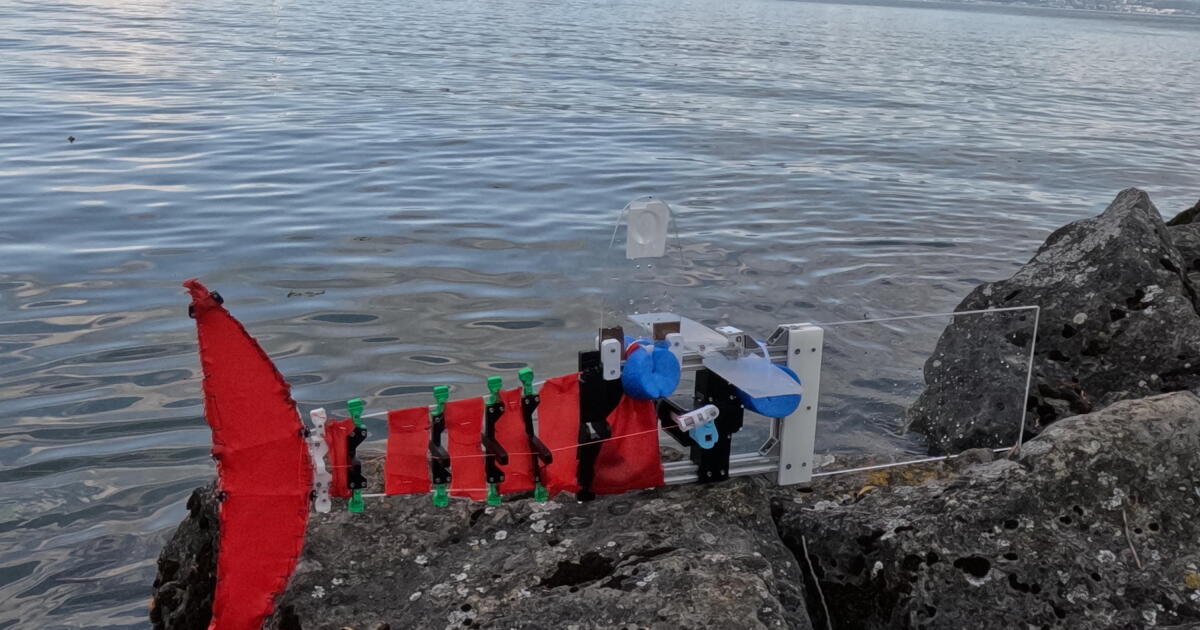
Researchers at NYU's Tandon School of Engineering created ScaFi, a robotic device that mimics fish movement. Unlike traditional underwater robots, ScaFi bends its body to move forward, using fiberglass rods and fabric for its tail. The robot's unique design allows for easy scaling without a complete rebuild. Three versions were built: 0.6, 1.1, and 2.9 meters long, each tested in different water environments. Smaller robots were more agile and energy-efficient, while the largest was more stable in currents. This innovation could change how underwater exploration is conducted, making robots more adaptable to various conditions.

Aletta, the first autonomous blood-draw machine, has been approved by the FDA for use in non-hospital settings. This machine uses near-infrared light and ultrasound to identify veins, ensuring a high success rate of 94.5% in clinical trials. A single phlebotomist can oversee up to three Aletta machines, addressing the high turnover rate of phlebotomists. Aletta's technology is designed to work for all skin tones and includes multiple safety features to prevent complications. Let's dive deeper…

In today's ContentBuffer update:

  • Ann Droid: The Future of Elderly Care with Robots

  • Scientists slash magnetic memory energy by orders of magnitude

  • AI Takes Real-Time Control of Fusion Plasma

  • XDOF Eyes $1.2B Series B After Rapid Growth

  • 5 new AI tools & 5 new AI jobs

  • More tech news

Latest Development

Underwater Robotics
NYU Engineers Build ScaFi Fish-Like Robot, 3 Sizes Tested

Image source: assets.newatlas.com

Summary: NYU researchers built ScaFi, a fish-like robot that scales up or down without a rebuild. It's a game changer for underwater exploration, offering flexibility in size and environment.

Key Points:

  • ScaFi moves by bending its body, unlike traditional underwater robots that use propellers.

  • Three versions of ScaFi were built: 0.6, 1.1, and 2.9 meters long.

  • The smallest robot swam in creeks 15 to 30 cm deep, the medium-sized one was tested in a Swiss stream, and the largest explored Lake Geneva.

  • The robot's flexible tail is made of fiberglass rods and fabric, with a single motor pulling two tendons.

  • The base of ScaFi – motor and cross-tendon mechanism – stays the same regardless of the robot's size.

Why it matters: If you're working on underwater exploration projects, ScaFi's design could significantly impact your robot's adaptability. The ability to scale up or down without a complete rebuild offers flexibility in various environments, from shallow creeks to deep lakes.

Medical Robotics
FDA Approves Aletta, First Autonomous Blood-Draw Machine

Image source: spectrum.ieee.org

Summary: FDA approved Aletta, the first autonomous blood-draw machine, for non-hospital use. It's a game-changer for reducing phlebotomist shortages.

Key Points:

  • Aletta uses near-infrared light and ultrasound to identify veins, ensuring a 94.5% success rate in clinical trials.

  • A single phlebotomist can supervise up to three Aletta machines, addressing the 25% annual turnover rate of phlebotomists.

  • Aletta's technology works well for all skin tones, with unpublished data showing no effect of skin tone on performance.

  • A U.S.-based trial is planned for next year to assess sample quality and routine laboratory tests.

  • Aletta includes sensors that track arm movement and needle position, halting the process if something goes wrong.

Why it matters: If you're a lab or clinic dealing with phlebotomist shortages, Aletta could be a game-changer. It successfully drew blood on the first attempt in 94.5% of cases, and a single phlebotomist can oversee up to three machines. This reduces reliance on phlebotomists, who have a median annual turnover rate of nearly 25%. Aletta's technology also works well for all skin tones, ensuring equitable care.

Elderly Care
Ann Droid Imagines Future Care Robots for the Elderly

Image source: robohub.org

Summary: Ann Droid imagines a future where robots provide care and companionship to the elderly, raising questions about the role of technology in addressing loneliness among older people. Current systems are limited to monitoring and prompting, but researchers are watching closely.

Key Points:

  • Ann Droid centers on Sue, a recent widow, her son Michael, and Linda, an assistive care robot, exploring the dynamics of human-robot relationships.

  • A social enterprise in south-west England is piloting AI companions to supplement human care, with Age UK South Gloucestershire involved.

  • Robotic pets are being tested in care homes by West Berkshire Council, offering companionship but not full care.

  • Current systems tend to be AI avatars on screens, robotic pets, or speakers providing voice interaction, not full humanoid robots.

  • Robots struggle with social subtleties and interpreting older faces, limiting their effectiveness in addressing loneliness.

Why it matters: If you're involved in social care or elderly support, Ann Droid raises critical questions about the role of technology. While AI companions can offer some benefits, they are unlikely to solve loneliness without human interaction. The challenge is to find ways for technology to enhance, not replace, human relationships.

Energy-efficiency
Scientists Cut Magnetic Memory Energy by Several Orders of Magnitude

Image source: www.sciencedaily.com

Summary: Edinburgh researchers cut magnetic memory energy by orders of magnitude, bringing future devices closer to the Landauer limit. This could drastically reduce data center power usage.

Key Points:

  • University of Edinburgh team uses Optimal Control Theory to design ultrafast magnetic-field pulses for switching memory states.

  • Simulations suggest the method could lower switching energy by several orders of magnitude compared to current technologies.

  • The framework moves future magnetic memory closer to the Landauer limit, the minimum energy required to process a single bit.

  • The team's approach can be adapted for use with electrical currents and ultrafast laser pulses, expanding potential applications.

  • As data centers' energy demands rise, this breakthrough could significantly reduce power consumption and carbon emissions.

Why it matters: If you're running a data center, this could be a game-changer. The new method could drastically reduce energy consumption, making it more sustainable and cost-effective. For example, a data center with 10,000 servers could see a significant drop in electricity bills and carbon footprint. However, the technology is still in the theoretical stage, so practical implementation timelines are uncertain.

Fusion-research
AI System Controls Fusion Plasma in Real-Time

Image source: www.sciencedaily.com

Summary: PACMAN, an AI system, took real-time control of fusion plasma at DIII-D, predicting and preventing instabilities. This could transform fusion research and safety.

Key Points:

  • PACMAN tested on DIII-D tokamak in San Diego, USA

  • System combines multiple ML models in a control loop

  • Operates in milliseconds, faster than human operators

  • Successfully predicted and controlled plasma instabilities

  • Stopped a tearing mode instability before it occurred

Why it matters: If you're involved in fusion research, PACMAN's real-time control could enhance safety and efficiency. It predicted and controlled plasma instabilities, including a tearing mode, demonstrating its potential to prevent dangerous events. Researchers can now introduce additional AI models faster, accelerating fusion research.

Data-supply-chain
XDOF Eyes $1.2B Series B After Rapid Growth

Image source: techcrunch.com

Summary: XDOF, a startup building data pipelines for robotics, is in late-stage talks for a $1.2B Series B led by 8VC. Rapid growth and $50M annualized revenue are driving interest from VCs.

Key Points:

  • XDOF's Series B round is led by 8VC and aims for a $1.2 billion valuation.

  • XDOF's $70 million Series A was reported in June, with participation from Thrive Capital, Andreessen Horowitz, Lux, and Spark Capital.

  • XDOF's annualized revenue is approaching $50 million, prompting VCs to approach the company.

  • XDOF is partnering with UC Berkeley's AI Research lab to release a collection of high-quality robot training data, dubbed ABC.

  • XDOF aims to build data pipelines, collection tools, and annotation systems for frontier AI labs and robotics companies.

Why it matters: XDOF's rapid growth and $1.2B Series B valuation signal a major player in robotics data. The company's data pipelines and annotation systems are crucial for frontier AI labs and robotics companies. XDOF's partnership with UC Berkeley's AI Research lab to release high-quality robot training data, dubbed ABC, will be a game-changer for the robotics industry.

New Tools & Job

  • MachineTranslation.com - MachineTranslation.com is an AI-powered translation platform that translates text and documents by comparing outputs from multiple leading AI translation models. Its consensus technology helps users choose the most accurate translation, reducing errors and improving quality across more than 330 languages. What it does Translates text and documents using AI. Compares translations from multiple AI models. Provides a consensus translation to improve accuracy. Supports 330+ languages. Helps users evaluate and refine translations. What makes it good Higher accuracy: Compares multiple AI translations instead of relying on a single model. Better quality: Consensus technology helps identify the strongest translation. Fast and easy: Delivers results in seconds with a simple interface. Broad language support: Covers over 330 languages. Useful for professionals and travelers: Suitable for business, marketing, legal, technical, and everyday communication.

  • Format Factory - Format Factory is a browser-based workbench for common audio and video conversion jobs. It supports batch processing for video and audio conversion, compression, merging, audio extraction, and audio removal, with transparent credits and temporary results. Try Format Factory for practical media conversion without installer bundles or per-file setup.

  • HappyHorse.AI - HappyHorse.AI is a multimodal AI video generator for creators, marketers, and social media teams. Users can create videos from text prompts, animate images, or generate videos from reference characters. The platform focuses on browser-based video creation and native audio support.

  • NeatScribe - NeatScribe is designed for anyone who needs to reuse information from recorded speech. It creates timestamped transcripts, supports translation, and exports results as text files, documents, subtitles, captions, or timed lyrics.

  • Sakana Marlin - Sakana Marlin is Sakana AI's first commercial product: an autonomous 'Ultra Deep Research' agent positioned as a Virtual Chief Strategy Officer. Given a research topic, Marlin works autonomously for up to roughly eight hours, forming hypotheses, gathering and reconciling information from online sources, and synthesizing a detailed strategy report up to ~100 pages plus executive-summary slides. It builds on Sakana AI research including AB-MCTS (NeurIPS 2025 Spotlight) and The AI Scientist (published in Nature). A closed beta ran from April 2026 with ~300 professionals across finance and consulting.

QUICK HITS

Read more news here →

THAT'S A WRAP

Partner with Us

Showcase your product to our engaged community of Tech enthusiasts

Our newsletter reaches a diverse audience of tech professionals, investors, engineers, managers, and business leaders worldwide. Get in touch today.

Comments

Subscribe to join the conversation...

Be the first to comment

Want this in your inbox?

Get the daily edition delivered free every morning.

Join 3,474 builders reading daily.

Also get