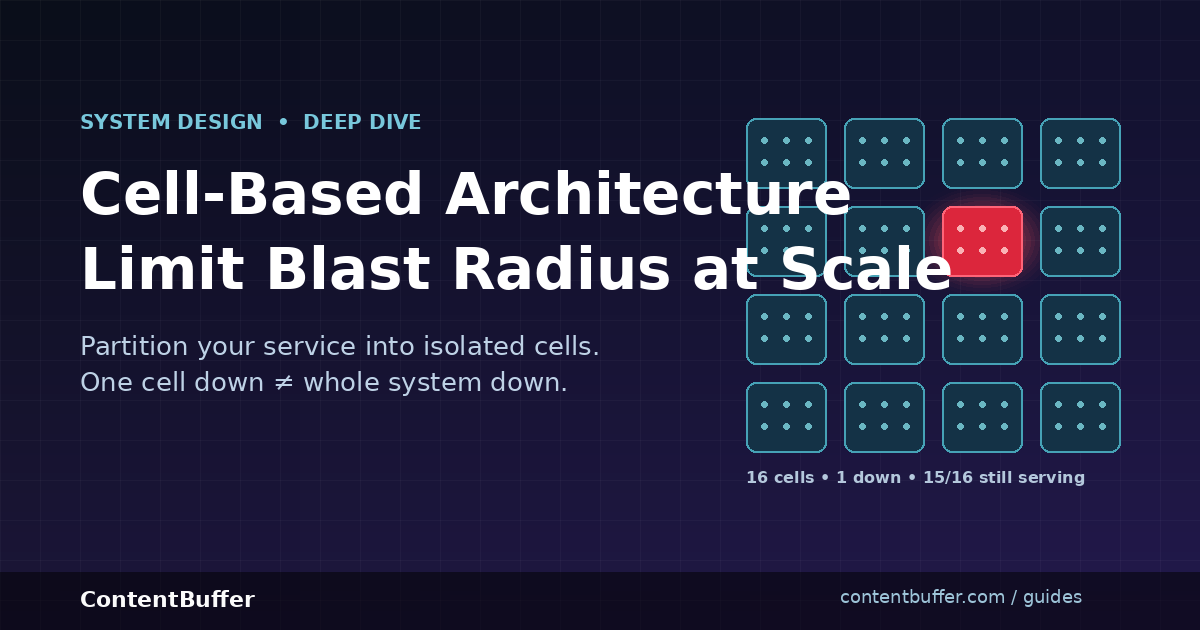
Cell-Based Architecture: Limit Blast Radius at Scale
Summary
Partition systems into isolated cells to cap blast radius and survive failures gracefully.
On a Tuesday afternoon in October 2025, a single misconfigured deployment took down a service that powered authentication for half of a Fortune-100 retailer. The bad pod started returning 500s. The load balancer treated the pod as healthy because the health check still returned 200. Retries from upstream callers slammed the surviving pods. Within ninety seconds, every region was down. A textbook gray failure that no amount of multi-AZ deployment could save.
Cell-based architecture exists to make that story impossible. Instead of running one logical service across the fleet, you carve the fleet into independent cells, route each customer to a small subset of cells, and design every blast radius to be smaller than a single cell. AWS, Slack, Roblox, and Stripe have all published deep dives on this pattern in the last year, and the AWS Well-Architected reliability guidance now treats it as the default for high-availability tier-1 systems.
This guide walks through the architectural decisions: how big should a cell be, how do you map traffic to cells, how do you stop a poison-pill request from spreading, and what observability and deployment changes are needed to actually capture the resiliency benefits. By the end you will have a concrete worked example for a notification API, code for the routing layer and the deployment pipeline, and a clear set of trade-offs to argue about with your team.
Prerequisites
- Comfort with stateless service design and load balancing.
- Working knowledge of consistent hashing and partition keys.
- Familiarity with at least one container orchestrator (Kubernetes, ECS, Nomad).
- Basic understanding of multi-AZ and multi-region deployments.
- An existing service that has hit availability or scaling pain — this pattern is overkill for an MVP.
Why Multi-AZ Is Not Enough
The default high-availability story for cloud services goes like this: deploy your service across three availability zones, put it behind a load balancer, scale horizontally on CPU. If a zone disappears, traffic shifts to the surviving zones. This is necessary but not sufficient.
The class of failures that takes down modern services is not infrastructure failure. It is logical failure. A bad config push, a noisy tenant, a poison-pill payload that triggers an OOM, a database migration that locks a hot table. These failures replicate across availability zones because the code is the same in every zone. Your three-AZ deployment is one logical failure away from a 100% outage.
Cell-based architecture treats logical failures as the primary threat model. Each cell is a complete, independent stack — its own compute, its own data store, its own queue, its own metrics — and traffic is partitioned so that any one cell only sees a fraction of the load. A bad code path that takes down one cell takes down only its share of customers, and you have N-1 cells still serving traffic while you investigate.
The Cell Mental Model
Think of your service as an aircraft carrier instead of a cruise liner. A cruise liner is one big hull — flood it and the whole ship sinks. A carrier is divided into watertight bulkheads — flood one and the ship keeps fighting. The cell is the bulkhead.
A cell has four properties:
- Isolation. No shared compute, no shared cache, no shared database connection between cells. The only thing two cells share is the routing layer and the deployment pipeline.
- Boundedness. A cell has a hard upper limit on the load it accepts — number of tenants, requests per second, queue depth — beyond which it sheds load instead of degrading the cluster.
- Independence. A cell can be deployed, restarted, scaled, or destroyed without coordination with other cells.
- Symmetry. Every cell runs the same code and the same configuration. The differences between cells are runtime state and the tenants assigned to them.
The router — sometimes called the cell mapper — is the only component that knows about cell topology. Everything downstream of the router behaves as if it were the only cell in the world.
Step 1 — Size Your Cells
Cell size is the first and most consequential decision. Too small and operational overhead crushes you — every deployment, every dashboard, every on-call rotation multiplies. Too large and the blast radius approaches your whole fleet, defeating the point.
The rule of thumb that has emerged from production deployments is to size each cell at the largest workload that one team can confidently operate as a single unit. In practice this lands around:
| Service Type | Tenants per Cell | Cells per Region | Notes |
|---|---|---|---|
| B2B SaaS API | 500–5,000 | 8–32 | Tenants are companies; size by p99 traffic of largest tenant. |
| Consumer messaging | 100K–1M users | 16–64 | Size by sustained connections, not user count. |
| Multi-tenant database | 50–500 schemas | 16–128 | Storage and IOPS dominate the sizing math. |
| Internal platform (CI, build) | 10–50 teams | 4–16 | Right-size for compute, not request rate. |
A useful first-pass formula: cell_count = ceil(peak_tps / max_tps_per_cell) * 1.5. The 1.5 multiplier gives headroom to drain a cell during deployment while keeping the others under their ceiling.
Step 2 — Choose a Partition Key
Once you know how many cells you need, you need a deterministic way to route every request to one. The partition key is the input to the routing function — typically the customer ID, the workspace ID, or in consumer apps a hash of the user ID.
Three rules for a good partition key:
- Stable — the value never changes over the lifetime of the entity. A customer ID is stable; an email address is not.
- Available at the edge — it can be extracted from the request before any business logic runs. Headers, JWT claims, and subdomains are good. Database lookups are bad.
- High cardinality — many distinct values, so hashing distributes load evenly. A geo region with five values is a terrible partition key.
Once you pick the key, you have two routing strategies to choose between: simple hashing and shuffle sharding.
Simple Hashing
Each tenant maps to exactly one cell, deterministically. Cheap to implement, easy to reason about, but a single tenant cannot survive a cell failure without a router-level failover.
def cell_for(tenant_id: str, total_cells: int) -> int:
# FNV-1a is fast, deterministic, and avoids the locality issues of CRC32.
h = 2166136261
for byte in tenant_id.encode("utf-8"):
h ^= byte
h = (h * 16777619) & 0xFFFFFFFF
return h % total_cells
# >>> cell_for("acme-corp", 16)
# 11
# >>> cell_for("globex", 16)
# 3
Shuffle Sharding
Each tenant maps to a small random subset of cells (typically 2 of N). Requests for a tenant can land on any cell in the subset, and a cell failure only takes down the tenants whose entire shard intersects the failed cell. With 100 cells and a shard size of 2, the probability that two random tenants share both cells is 1 in C(100,2) = 1 in 4,950. Pioneered by AWS Route 53.
import hashlib
def shuffle_shard(tenant_id: str, total_cells: int, shard_size: int = 2) -> list[int]:
# Two independent hashes give a deterministic but de-correlated shard.
h1 = int(hashlib.sha256(("a:" + tenant_id).encode()).hexdigest(), 16)
h2 = int(hashlib.sha256(("b:" + tenant_id).encode()).hexdigest(), 16)
cells = []
used = set()
for i in range(shard_size):
c = (h1 + i * h2) % total_cells
# Linear-probe to avoid collisions when the offsets align.
while c in used:
c = (c + 1) % total_cells
used.add(c)
cells.append(c)
return sorted(cells)
# >>> shuffle_shard("acme-corp", 100)
# [27, 41]
# >>> shuffle_shard("globex", 100)
# [9, 73]
The router then load-balances within the shard — typically round-robin or least-loaded. When a cell fails, the router marks it unhealthy and traffic for affected tenants moves to the surviving cell in their shard.
Step 3 — Build the Router
The router is the most operationally sensitive component in a cell-based system. It is shared by every cell, so a router outage is a total outage. Three properties matter:
- Stateless. The router computes the cell mapping from the request alone. No database lookups in the hot path. The cell topology comes from a periodically refreshed config blob.
- Cheap to fail open. If the router cannot determine a cell, it should pick deterministically (for example by hashing the source IP) rather than rejecting the request.
- Aware of cell health. A separate control plane publishes per-cell health signals; the router excludes unhealthy cells from the candidate set.
Here is a sketch of a production router using Envoy-style cluster selection. In practice you can implement this in your existing API gateway, in an L7 load balancer with a Lua filter, or as a thin sidecar.
# router.py — runs as a sidecar in front of every API gateway pod.
import time, json, urllib.request, threading
class CellRouter:
REFRESH_S = 5
def __init__(self, control_plane_url: str):
self.control_plane_url = control_plane_url
self.topology = {"cells": [], "unhealthy": set()}
self._lock = threading.Lock()
threading.Thread(target=self._refresh_loop, daemon=True).start()
def _refresh_loop(self):
while True:
try:
data = json.load(urllib.request.urlopen(self.control_plane_url, timeout=2))
with self._lock:
self.topology = {
"cells": data["cells"], # ["cell-001", ...]
"unhealthy": set(data["unhealthy"]),
}
except Exception:
pass # Keep last-known-good topology — never block requests.
time.sleep(self.REFRESH_S)
def route(self, tenant_id: str) -> str:
with self._lock:
cells = self.topology["cells"]
unhealthy = self.topology["unhealthy"]
if not cells:
raise RuntimeError("router not warmed up")
shard = shuffle_shard(tenant_id, len(cells), shard_size=2)
for idx in shard:
cell_name = cells[idx]
if cell_name not in unhealthy:
return cell_name
# All cells in the shard are unhealthy — fail to the first one anyway
# so the failure surfaces in metrics rather than as a 503.
return cells[shard[0]]
The control plane that publishes the topology should be on a separate availability budget from the data plane. A common pattern is to host it behind S3 with CloudFront in front, so even a control-plane outage does not prevent routers from serving traffic with their last-known-good topology.
Step 4 — Cell-Aware Deployment
If you deploy a new build to all cells simultaneously, you have just made cell-based architecture meaningless. The point of cells is fault isolation, including isolation from your own bad code. The deployment pipeline must respect cell boundaries.
The canonical wave structure is:
- Wave 0 (canary cell). One cell only. Holds for a soak period (typically 30–60 minutes) and watches per-cell SLOs. If anything regresses, the cell is automatically rolled back and the wave halts.
- Wave 1 (5%). The next 5% of cells, deployed in parallel within the wave but with a 15-minute soak.
- Wave 2 (25%). Speed up: 5-minute soak, more cells per batch.
- Wave 3 (remaining). Full fleet, batched to respect deployment-tool concurrency limits.
Each wave gates on a per-cell SLO check, not a global one. A globally-aggregated metric will mask a single bad cell because the other cells dominate the average. The check should ask, for each cell that just deployed, did its error rate, p99 latency, and saturation stay within the same band as a peer cell on the previous build.
# Per-cell SLO gate, called between deployment waves.
def wave_passed(cell: str, peer_cell: str, since: int) -> tuple[bool, str]:
me = prom_query(f'sum(rate(http_requests_errors{{cell="{cell}"}}[5m]))' f' / sum(rate(http_requests_total{{cell="{cell}"}}[5m]))')
peer = prom_query(f'sum(rate(http_requests_errors{{cell="{peer_cell}"}}[5m]))' f' / sum(rate(http_requests_total{{cell="{peer_cell}"}}[5m]))')
if me > peer * 1.5 and me > 0.005:
return False, f"error rate {me:.4f} on {cell} vs {peer:.4f} on {peer_cell}"
me_p99 = prom_query(f'histogram_quantile(0.99, sum by (le) (rate(http_request_duration_bucket{{cell="{cell}"}}[5m])))')
peer_p99 = prom_query(f'histogram_quantile(0.99, sum by (le) (rate(http_request_duration_bucket{{cell="{peer_cell}"}}[5m])))')
if me_p99 > peer_p99 * 1.3:
return False, f"p99 {me_p99:.0f}ms on {cell} vs {peer_p99:.0f}ms on {peer_cell}"
return True, "ok"
Pair this with a poison-pill quarantine: when a single tenant repeatedly drives a cell into degradation (high error rate concentrated to one tenant ID), the control plane temporarily routes that tenant to a quarantine cell — a cell with extra resources whose only job is to absorb pathological workloads while the tenant is investigated.
Step 5 — Per-Cell Observability
Every metric, log, and trace must carry a cell label. Without it, your dashboards will silently aggregate the bad cell into the good ones and you will lose hours debugging a non-existent fleetwide problem.
- Metrics: every Prometheus series gets a
celllabel. Build a top-level dashboard that shows per-cell error rate as a heatmap — one row per cell, color by error rate. A bad cell lights up immediately. - Logs: structured logs include
cellandtenant_id. The log pipeline indexes both. You should be able to filter to a single cell in one query. - Traces: the cell name is set as a span attribute at the gateway and propagated through the call chain. This makes it possible to ask 'show me all traces for tenant X in cell Y in the last hour'.
- Alerts: alert on per-cell SLO violations, not fleetwide. A 5% increase in p99 across the fleet is noise; a 50% increase in one cell is a page.
Two dashboards are non-negotiable. The fleet view shows a small tile per cell, sized by traffic, colored by health. The cell view drills into one cell with the full set of golden signals. Train the on-call engineer to start at the fleet view, identify the bad cell, then drill into the cell view.
Worked Example: A Notification Service
Concretizing all of this: a multi-tenant notification API that delivers push, SMS, and email on behalf of B2B customers. Peak traffic is 50K req/s, with one customer typically driving 1–3K req/s and a long tail of small customers.
Decisions:
- Cell size: target 5K req/s peak per cell. With 50K peak and 1.5x headroom, that is 16 cells per region.
- Partition key: customer ID, available in every request as a JWT claim.
- Routing strategy: shuffle sharding with shard size 2. With 16 cells and 2-cell shards, the probability that any two specific large customers fully overlap is 1 in 120, and the worst-case impact of a single cell loss is 12.5% of customers.
- Storage: each cell has its own RDS Aurora cluster, sized for 5K req/s. Cross-cell joins are forbidden by design.
- Queue: each cell has its own SQS queue and worker pool for delivery. A queue backup in cell-007 cannot starve cell-008.
Topology config — published to S3 every 30 seconds and consumed by every router instance:
{
"version": "2026-05-01T19:00:00Z",
"cells": [
"us-east-1.cell-001", "us-east-1.cell-002", "us-east-1.cell-003",
"us-east-1.cell-004", "us-east-1.cell-005", "us-east-1.cell-006",
"us-east-1.cell-007", "us-east-1.cell-008", "us-east-1.cell-009",
"us-east-1.cell-010", "us-east-1.cell-011", "us-east-1.cell-012",
"us-east-1.cell-013", "us-east-1.cell-014", "us-east-1.cell-015",
"us-east-1.cell-016"
],
"unhealthy": [],
"quarantine": "us-east-1.cell-quarantine",
"shard_size": 2,
"topology_ttl_seconds": 60
}
When cell-007 starts failing — say a regression in the new SMS provider integration — its health probes fail, the control plane marks it unhealthy in the topology, and within the 30-second refresh window every router has stopped sending traffic to it. Customers whose shards include cell-007 transparently shift their full load to the other cell in their shard. The blast radius is exactly 1/16th of the fleet for at most 30 seconds, then it is zero.
Common Pitfalls and Gotchas
1. Sharing a database between cells
The single biggest anti-pattern. Teams adopt cells for compute but keep one big shared Postgres because 'migrations are too painful otherwise'. The shared DB then becomes the failure mode that takes down every cell at once. If you cannot afford per-cell databases, you have not actually adopted cell-based architecture — you have rebranded your service tier.
2. Letting cell count grow unbounded
Every cell has a fixed operational cost: a runbook entry, a dashboard tile, a Terraform module, a secret rotation. A fleet of 200 cells per region is unmanageable for most teams. Cap the cell count and grow cell capacity instead, until the cell becomes too large and you split.
3. Shuffle sharding without a tenant cap
Shuffle sharding's probabilistic isolation guarantees collapse if your largest tenant takes more than 1/shard_size of a single cell's capacity. Enforce a per-tenant rate limit at the router that is at most 1/shard_size of cell capacity, otherwise one giant tenant can poison every cell in its shard.
4. Cell migration as an afterthought
Tenants outgrow cells, cells get rebalanced, customers get acquired and merged. You will need to move tenants between cells, and that is hard if you did not design for it on day one. At minimum: plan a dual-write window during migration, version your partition-key-to-cell mapping, and keep the old mapping live for as long as any in-flight async work might reference it.
5. The router is a singleton SPOF
The router fans into every cell, so a router bug is a fleet outage. Treat the router as the most critical service in your stack: deploy it more conservatively than the cells themselves, keep it small, and write integration tests that verify topology refresh, fail-open behavior, and graceful degradation when the control plane is down.
6. Forgetting per-cell capacity tests
Cells provide isolation only if the capacity ceiling per cell is real. Load test each cell to its declared ceiling at least quarterly, and after every infrastructure change. A cell that silently degrades at 60% of its declared capacity is a time bomb.
Quick Reference
| Concept | What It Is | When to Use |
|---|---|---|
| Cell | Independent stack — compute, data, queue | Always; the unit of fault isolation. |
| Cell size | Target load ceiling per cell | Start at largest tenant times 5; revisit yearly. |
| Partition key | Stable, edge-available value | Customer ID for B2B; user ID hash for consumer. |
| Simple hashing | 1 cell per tenant | Small fleets, simple workloads. |
| Shuffle sharding | K cells per tenant (typically 2) | Need per-tenant fault tolerance without DR. |
| Router | Stateless cell mapper | Required; treat as tier-0 service. |
| Topology config | Source of truth for cell list | Publish via S3 + CDN, refresh every 30s. |
| Quarantine cell | Isolated cell for poison tenants | Recommended for B2B with noisy-neighbor risk. |
| Per-cell SLO gates | Wave gating signal | Required; aggregate SLOs hide bad cells. |
| Dual-write migration | Tenant-mover playbook | Required before first prod cell rebalance. |
Next Steps
- Pick a single tier-1 service in your stack and sketch what its cells would look like — partition key, cell count, what is shared vs isolated.
- Read AWS's Reducing the Scope of Impact with Cell-Based Architecture Well-Architected paper for the formal version of this pattern.
- Prototype the router in a test environment with two cells and a kill switch — prove that traffic moves within 30 seconds when you mark a cell unhealthy.
- Establish per-cell SLOs and dashboards before you run a single cell in production. The observability is the architecture.
- Plan your first cell migration on paper before your first cell reaches capacity. The hardest cell migration is the one you have not thought about.
Cell-based architecture is not free. It costs a routing layer, deployment-pipeline complexity, more dashboards, and a permanent operational tax of N copies of your stack. In exchange you get a system whose worst day is one cell down, not the whole product. For tier-1 services in 2026, that trade has become the default.
Comments
Be the first to comment