🧲HRL Researchers Turn Standard CMOS Chip Into Quantum Sensor at Millikelvin Temperatures
Your standard chip fab might now read quantum qubits
TL;DR
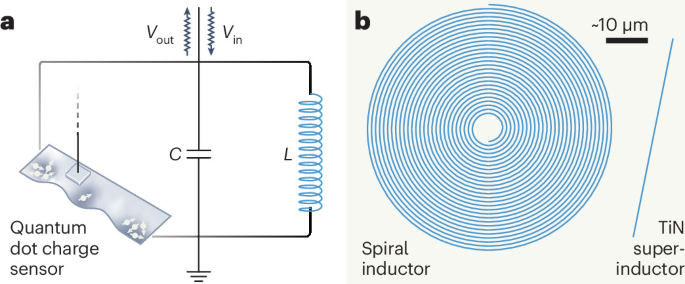
HRL Laboratories reports that titanium nitride films made in a commercial CMOS process can act as high-impedance superconductors near millikelvin temperatures. That lets spin qubits be read out from the chip's existing gate metal, a compact and sensitive approach with no exotic fabrication.
Titanium nitride films made in an ordinary commercial CMOS process can become high-impedance superconductors at millikelvin temperatures. That's the punchline from a Nature Electronics paper titled "A serendipitous CMOS quantum sensor," published November 4, 2026, with an HRL Laboratories corresponding author. Why should you care? If you're working on spin qubits, readout is a bottleneck: you usually need bulky external circuitry. This work suggests the sensing element can live inside the chip's existing gate metallization. Teams building scalable qubit arrays on standard foundry processes should take note, since it removes a layer of custom hardware. The enabling structure is a nonlinear superinductor built in a deep-submicrometre integrated circuit, described in a related Nature Electronics article on gate-stack superinductors. The paper is open access and sits under Springer Nature's SharedIt initiative, with references spanning 2019 to 2023 work in Nat. Electron., Rev. Mod. Phys., Phys. Rev. X and Appl. Sci. What to watch: how this performs across full qubit arrays rather than single-device demonstrations.
Key Points
Titanium nitride films native to a commercial CMOS process can become high-impedance superconductors at millikelvin temperatures, according to the Nature Electronics paper published November 4, 2026.
Keep reading — it's free
Enter your email to keep reading — plus the best of AI & tech, daily. Free, forever.
Already a member? Sign in
Comments
Be the first to comment