⚛️Researchers Cut CZ Gate Counts for Logical Clifford Circuits Down to Sixteen Qubits
Fewer CZ gates means fault-tolerant quantum circuits get cheaper to build
TL;DR
A new framework compiles logical Clifford gates for any stabilizer code into hardware-tailored circuits using as few CZ gates as possible. It scales to at least 16 physical qubits and gives fault-tolerance builders a much better starting point.
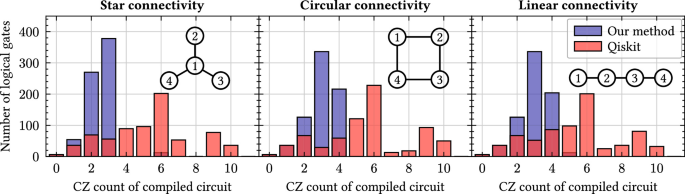
Logical operations on error-corrected qubits are expensive, and this work makes them cheaper. The authors introduce a mathematical framework and software that compile any desired Clifford unitary on the logical level of a given stabilizer code into a physical circuit, with the number of CZ gates minimized as the explicit objective. If you're building toward fault-tolerant hardware, this matters for the compilation step that usually eats your time. The framework respects connectivity constraints and fully characterizes gauge freedom, improving on prior work that ignored both. Teams writing flag-gadget implementations now get circuits that are already sparse in CZ gates, which is where most of the error budget goes. The methods scale to at least 16 physical qubits, and the authors develop several flag gadgets, including weakly fault-tolerant logical Hadamard circuits for the [[8, 3, 2]] code. Compilation focuses on entire logical circuits rather than single gates, which the authors say yields significant practical savings. The catch: results are demonstrated at this scale, not on large surface or qLDPC codes.
Key Points
The framework minimizes the number of CZ gates in hardware-tailored circuits implementing any desired Clifford unitary on a given stabilizer code's logical level.
Keep reading — it's free
Enter your email to keep reading — plus the best of AI & tech, daily. Free, forever.
Already a member? Sign in
Comments
Be the first to comment