Skip to content
ContentBuffer
ContentBuffer
November 8, 2026·~6 min read
ContentBuffer

ContentBuffer

Welcome, Tech Leaders.

Anthropic says AI is now speeding up its own research, and its models are improving roughly twice as fast as they did a year ago. The gain isn't just from throwing more compute at training. AI's share of the speedup keeps growing. If you build on Claude, this is the part to read closely. The company says employees using its most capable internal model were 12 times as productive as they would have been without AI help. That's a claim about a frontier lab's internal workflow, not your codebase, so don't plan your sprint around it. But it tells you where the labs are pointing their tooling next. The numbers come from METR, the outside evaluator Anthropic gave confidential research, performance data, and employee interviews. Anthropic also held the power to redact METR's final report, and it used that power extensively. Three newer models remain unreleased, finishing training in July, August-September, and September-October. Anthropic says releasing details could help rivals. Anthropic plans its own report on AI progress and new safety steps, and the METR publication has already drawn fierce criticism from safety researchers.

Every Mac since macOS 13 ships with a pair of daemons quietly building a graph of who you know, how those people relate to each other, where you go, and when you do it. The graph lives in ~/Library/IntelligencePlatform as SQLite databases, and it's designed to be queried by LLMs. Nobody asked for a personal knowledge graph on their laptop, but here we are. If you do anything on a Mac for work, this touches you. The graph pulls from Contacts, Calendar, Photos, Messages, Mail, location, Screen Time, and device signals like Wi-Fi, Bluetooth, and charging state. That means your team's org charts, your client meetings, and your side projects are all cross-referenced in one place. Check your own machine before you assume it's empty. The core file is graph.db, a triple store with 181 entity classes and 278 predicates. Every row is a subject, predicate, and object, and each edge carries a confidence value, its sources, source duplicates, and a timestamp. It also feeds Family Sharing ages, Medical ID emergency contacts, and Siri Suggestions data. The catch? The data is local, but anything that can read the file can read your life. Let's dive deeper…

In today's ContentBuffer update:

  • Chainalysis Breach Exposes Every Customer's Personal Data and Live Tokens

  • PyTorch 2.15 Ships a Rewritten NCCL Backend and a Flight Recorder for GPU Failures

  • Memorilla Gives Frozen LLMs Long-Term Memory With Just 16 Tokens

  • Meta Delays Controversial Terms Update Targeting Off-Facebook AI Training Data

  • 5 new AI tools & 5 new AI jobs

  • More tech news

Latest Development

Frontier-models
Anthropic Says AI Now Speeds Up Its Own R&D, Employees 12x More Productive

Image source: platform.theverge.com

Summary: Anthropic says AI now accelerates its own R&D, with models improving about twice as fast as last year. Its top internal model reportedly made staff 12x more productive. METR's outside review was heavily redacted, so the claims are hard to verify.

Key Points:

  • Anthropic says its models improve roughly twice as quickly as they did a year ago, and the speedup is not explained by scaling compute alone.

  • Employees using the company's most capable internal model reported being 12 times as productive as they would be without AI assistance.

  • Three of Anthropic's newest models are still unreleased, having finished training in July, August-September, and September-October respectively.

  • METR received confidential research, model performance data, and employee interviews, but Anthropic redacted its final report extensively before publication.

  • Anthropic justified the redactions by arguing that releasing the information could benefit rivals, and it plans its own report on AI progress.

Why it matters: If you run evals or pick models for production, the METR redactions mean you can't independently check Anthropic's productivity claims yet. Teams building on Claude should keep watching release timing, since three unreleased models are queued up behind the current lineup. Safety and platform leads evaluating vendor disclosures should note that the only outside review came back with its most useful parts blacked out.

Privacy And Data Exposure
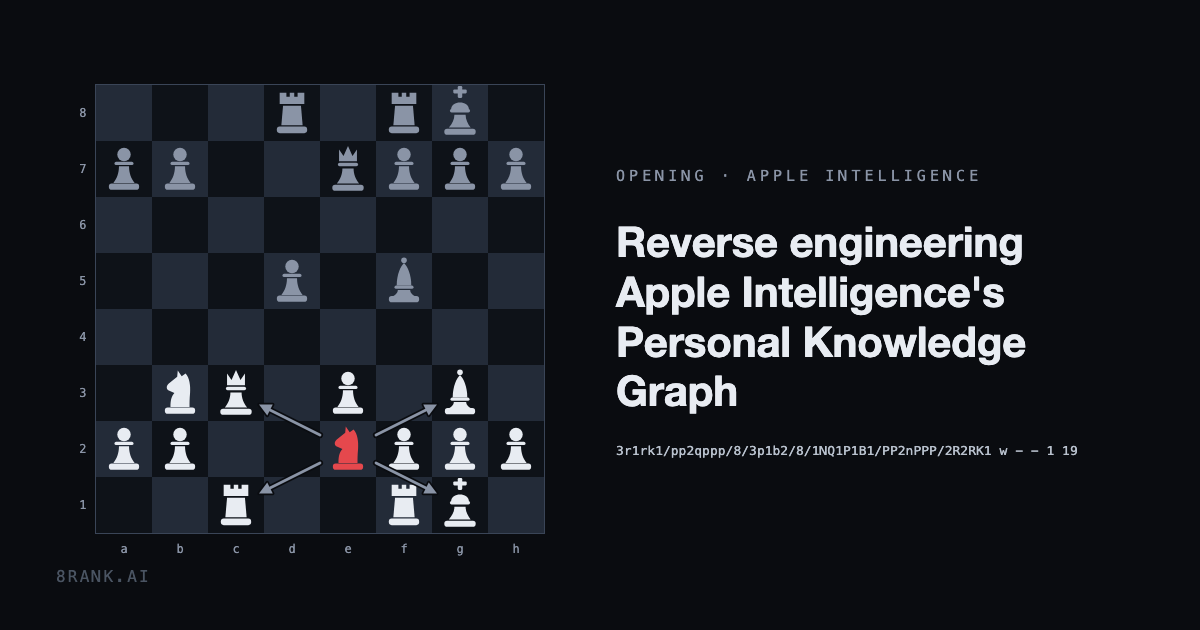
Every Mac Since macOS 13 Quietly Builds a Graph of Your Life

Image source: 8rank.ai

Summary: Macs running macOS 13 and later quietly build a personal relationship graph from Contacts, Messages, Photos, and location data. It lives in ~/Library/IntelligencePlatform as SQLite, and LLMs can query it. Go look at graph.db before your next security review.

Key Points:

  • The core store, graph.db, is a triple store using 181 entity classes and 278 predicates to describe people, organizations, events, and software.

  • Each edge in the graph stores a confidence value, its sources, source duplicates, and a timestamp, so you can trace where any inference came from.

  • The graph ingests Family Sharing data including the age of every family member, plus Health's Medical ID emergency contact details on the device.

  • Device signals feeding the graph include screen locked state, Wi-Fi, Bluetooth, charging status, and ambient light readings sampled over time.

  • Photos co-appearance tables record who shows up with whom, while a separate communication log and location and movement tables track your routine.

Why it matters: If you run a security review on developer laptops, graph.db in ~/Library/IntelligencePlatform is now part of the attack surface you need to scope. Teams handling client data through Mail, Messages, or Calendar should assume that metadata is being indexed into a queryable store. Anyone building local LLM tooling on macOS should check whether they can legitimately read this graph, and whether they should.

Data Breaches
Chainalysis Breach Exposes Personal Data of All Customers Including Government Agencies

Image source: cdn.arstechnica.net

Summary: Chainalysis disclosed a breach that exposed personal data for every customer, including names, password hashes, and live tokens. Attackers used AI agent-assisted techniques, and Reactor and Data Solutions are offline. If you use Chainalysis, reset your credentials the moment access returns.

Key Points:

  • Hackers obtained names, usernames, password hashes, and live tokens for every Chainalysis user, a scope that covers the entire customer base rather than a subset.

  • Chainalysis discovered the exposure two days before disclosing it on Wednesday, a delay that leaves customers with less time to rotate secrets before attackers act.

  • An on-path attack exposed some customer passwords. Chainalysis says the attack vector has been identified and fixed, but the origin of the attack remains unknown.

  • Reactor and Data Solutions access has been removed, while KYT and Address Screening are returning in phases. Customers must reset credentials once they regain access.

  • Chainalysis has not found evidence that investigation data was accessed or that attribution data was manipulated, according to the company's statement on the incident this week.

Why it matters: If your compliance or investigations pipeline calls Chainalysis APIs, your stored tokens are presumed compromised and need rotation before KYT or Address Screening come back online. Security teams should audit where those live tokens are cached, especially in CI jobs and internal dashboards. The AI agent angle also means threat models for vendor breaches now have to account for automated, agent-driven intrusion, and nobody outside Chainalysis knows yet how those agents operated.

Distributed Training
PyTorch 2.15 Rewrites NCCL Backend With 3,117 Commits From 583 Contributors

Image source: image.theregister.com

Summary: PyTorch 2.15 rewrites its NCCL backend to kill communicator crosstalk and adds a flight recorder for debugging GPU failures. The legacy backend stays as a rollback until 2.16 drops it early next year.

Key Points:

  • The update bundles 3,117 commits from 583 contributors, making it one of the larger PyTorch releases in recent memory for distributed training internals.

  • The old ProcessGroupNCCL could spawn dozens of communicators per process group, which made debugging and tuning distributed jobs painful for most teams.

  • The new backend eliminates crosstalk between multiple communicators by default, so you no longer need to manually tune around interference between process groups.

  • The flight recorder captures every operation as a series of snapshots, letting admins inspect exactly what happened before a GPU job failed in production.

  • The legacy ProcessGroupNCCL ships inside the 2.15 package as a rollback, and it gets removed in the 2.16 release planned for early next year.

Why it matters: If you're running multi-GPU training with DistributedDataParallel or FSDP, the new backend changes how your process groups behave, so test your jobs on 2.15 before anything else. Teams running large clusters where stragglers stall gradient syncs will get easier reconfiguration and better failure forensics from the flight recorder. Platform teams should plan migrations before 2.16 removes the legacy ProcessGroupNCCL in early next year.

Memory Systems For Frozen Llms
Memorilla Packs Whole Document Collections Into Just 16 Memory Tokens

Summary: Researchers at Vignesh Kothapalli's group built Memorilla, which squeezes a whole document collection into 16 memory tokens for frozen LLMs. It hit 84.33% on FactKG using 108x fewer tokens. Worth a look if your RAG context bill hurts.

Key Points:

  • Memorilla uses only 16 memory tokens and still beats baselines on five of the eight benchmarks the authors tested against.

  • On the FactKG benchmark, Memorilla reaches 84.33% accuracy while representing source documents with 108 times fewer tokens than the baseline approach.

  • In a TextWorld environment, the system reduces how often agents revisit rooms they have already explored, and it raises average task success rate.

  • Memorilla encodes documents into reusable embeddings, so you can compute them once and retrieve query-specific memory later without re-reading the corpus.

  • The paper was submitted October 15, 2026, revised November 3, 2026, and is available in three versions, with a DOI of 10.48550/arXiv.2610.21375.

Why it matters: If you're running a RAG pipeline on a frozen model like a hosted Llama or GPT endpoint, your token spend scales with how much context you stuff in per query. Memorilla's 16-token memory layer could cut that bill dramatically for document-heavy workloads like support bots or internal knowledge search. Agent builders managing long trajectories should test it against their current memory setup before rewriting anything.

Ai Training Data Policy
Meta Pauses Terms Update That Would Let It Crawl Publisher Sites for AI

Image source: cdn.arstechnica.net

Summary: Meta has indefinitely delayed a Business terms update that would have let it crawl linked external sites for AI training and ignore robots.txt. Courts in Brazil and Norway blocked it, and the UK's CMA opened an investigation. If you run a site linked from Facebook, double-check your robots.txt rules.

Key Points:

  • The update was originally scheduled for October 30, then pushed to November 20 before Meta indefinitely paused it amid global pushback from users, courts, and regulators.

  • Preliminary injunctions from courts in Brazil and Norway blocked the terms, while the UK's Competition and Markets Authority opened a formal investigation into Meta's dominant market position.

  • Draft terms would have required publishers to create test credentials so Meta's bots could reliably bypass paywalls on linked sites, a detail that alarmed news organizations.

  • Nieman Lab estimated Meta could avoid millions in licensing fees under the update, since it would have crawled off-Facebook content without negotiating AI training deals.

  • Meta's VP of communications posted on X that the delay is coming, while insisting crawling practices remain unchanged and robots.txt signals still apply to content owners.

Why it matters: If your marketing team runs a Facebook Business page linking to your blog or docs, that content was on track to become Meta training data. Your robots.txt is the only control you currently hold, and Meta's revised terms still don't mention respecting it. Audit your crawler directives now and get your legal team reviewing any Business terms that touch external linked content.

New Tools & Job

  • Babydoll Dance AI - Babydoll Dance AI helps creators turn their own portrait, or photos of up to three people, into a coordinated Babydoll dance video. Upload a clear photo for the center dancer and optionally add friends on the sides. The output is a downloadable 15-second, 9:16 MP4. The site shows the example, photo requirements and credit price before generation. It uses one-time credit packs rather than a subscription.

  • TunedGift - TunedGift is a browser-based AI music tool for turning personal stories into songs for birthdays, weddings and anniversaries. Start with a recipient, an occasion and a few details from a shared memory. Review and edit the title and lyric draft, then listen to a one-minute audio excerpt before choosing whether to purchase the song. The workflow focuses on making a gift from your own details and gives you a way to review the lyrics and hear the result before checkout. Submitted by the TunedGift team.

  • ReelAI - Submitted by the ReelAI team with AI-assisted preparation. ReelAI helps creators animate photos into short videos using AI-powered motion templates and effects. It also offers AI image generation. Paid credit-based plans and current pricing are available at https://tryreelai.com/pricing.

  • Repostit Clips - Repostit Clips helps creators turn long YouTube videos, podcasts, interviews, webinars and livestreams into vertical short clips. It can find highlight moments automatically or let users choose them in a manual editor. Each clip receives a score, and users can schedule clips across their connected apps. Repostit is affiliated with this submission.

  • Vidlantern - Vidlantern is a browser-based photo-to-video tool with creative templates, including an AI rap duo workflow. Upload two separate photos or one shared photo, choose a template and available settings, and review the credit price before generating. Video generation is paid. Use photos you have permission to animate.

  • Senior Software Engineer - Backend Infrastructure - P-1346 At Databricks, we are passionate about enabling data teams to solve the world's toughest problems — from making the next mode of transportation a reality to accelerating the development of medical breakthroughs. We do this by building and running the world's best data and AI infrastructure pl

  • Engineering Manager, Site Reliability Engineering - ABOUT BASETEN Baseten powers mission-critical inference for the world's most dynamic AI companies, like Cursor, Notion, OpenEvidence, Abridge, Clay, Gamma, and Writer. By uniting applied AI research, flexible infrastructure, and seamless developer tooling, we enable companies operating at the fronti

  • Sr. Product Designer - Measurement, Data, & AI - About Pinterest: Millions of people around the world come to our platform to find creative ideas, dream about new possibilities and plan for memories that will last a lifetime. At Pinterest, we’re on a mission to bring everyone the inspiration to create a life they love, and that starts with the peo

  • Staff+ Software Engineer, STEM - About Anthropic Anthropic’s mission is to create reliable, interpretable, and steerable AI systems. We want AI to be safe and beneficial for our users and for society as a whole. Our team is a quickly growing group of committed researchers, engineers, policy experts, and business leaders working tog

  • Manager, Data Science - POSITION SUMMARY: Natera is a global leader in cell-free DNA testing, advancing diagnostics in oncology, women’s health, and organ health to support better patient care. As a Data Science Manager in R&D Operations, you will lead a team of data scientists to design and implement data solutions to acc

QUICK HITS

Read more news here →

THAT'S A WRAP

Partner with Us

Showcase your product to our engaged community of Tech enthusiasts

Our newsletter reaches a diverse audience of tech professionals, investors, engineers, managers, and business leaders worldwide. Get in touch today.

Comments

Subscribe to join the conversation...

Be the first to comment

Want this in your inbox?

Get the daily edition delivered free every morning.

Join 3,569 builders reading daily.

Also get

Latest Issues

View Archive →
Anthropic says its models now improve about twice as fast as a year ago, and AI is driving more of that gain. Its top internal model made staff 12x as productive. METR's independent review was heavily redacted, so treat the numbers as the company's story until you see more.
Daily Edition#341

Anthropic says its models now improve about twice as fast as a year ago, and AI is driving more of that gain. Its top internal model made staff 12x as productive. METR's independent review was heavily redacted, so treat the numbers as the company's story until you see more.

Every Mac running macOS 13 or later runs daemons that build an on-device graph of your contacts, relationships, locations, and habits. It's stored in SQLite and queryable by LLMs. If you care about data exposure, this one's worth auditing today.

November 8, 2026
Attackers used AI agent-assisted techniques to breach Chainalysis and steal personal data for all users, including names, password hashes, and live tokens. Some passwords were exposed through an on-path attack. Customers must reset credentials once access returns.
Daily Edition#340

Attackers used AI agent-assisted techniques to breach Chainalysis and steal personal data for all users, including names, password hashes, and live tokens. Some passwords were exposed through an on-path attack. Customers must reset credentials once access returns.

PyTorch 2.15 replaces its chaotic NCCL backend with a cleaner rewrite that kills crosstalk between communicators by default. It adds a flight recorder for post-mortem debugging of failed GPU runs. The old backend sticks around as a rollback until 2.16 removes it.

November 7, 2026
Google's new K-12 AI policy makes schools opt into AI products, and search counts as one of them. Schools can block Gemini and still keep search, but there's no way to use search without AI. Educators and parents are pushing back hard.
Daily Edition#339

Google's new K-12 AI policy makes schools opt into AI products, and search counts as one of them. Schools can block Gemini and still keep search, but there's no way to use search without AI. Educators and parents are pushing back hard.

Tencent released Hy4, an open-source LLM with vision for the first time, topping a 213-expert financial blind evaluation with a 3.04 score. Its hallucination rate fell to 7.2%. If you build finance or agent tools, it's worth a serious test drive this week.

November 6, 2026