Skip to content
AI Newsletter

Your Git server just got a lot busier, and OpenAI built for it

In this issue

From the ContentBuffer AI newsletter

ContentBuffer
ContentBuffer
November 25, 2026·~6 min read
ContentBuffer

ContentBuffer

Welcome, Tech Leaders.

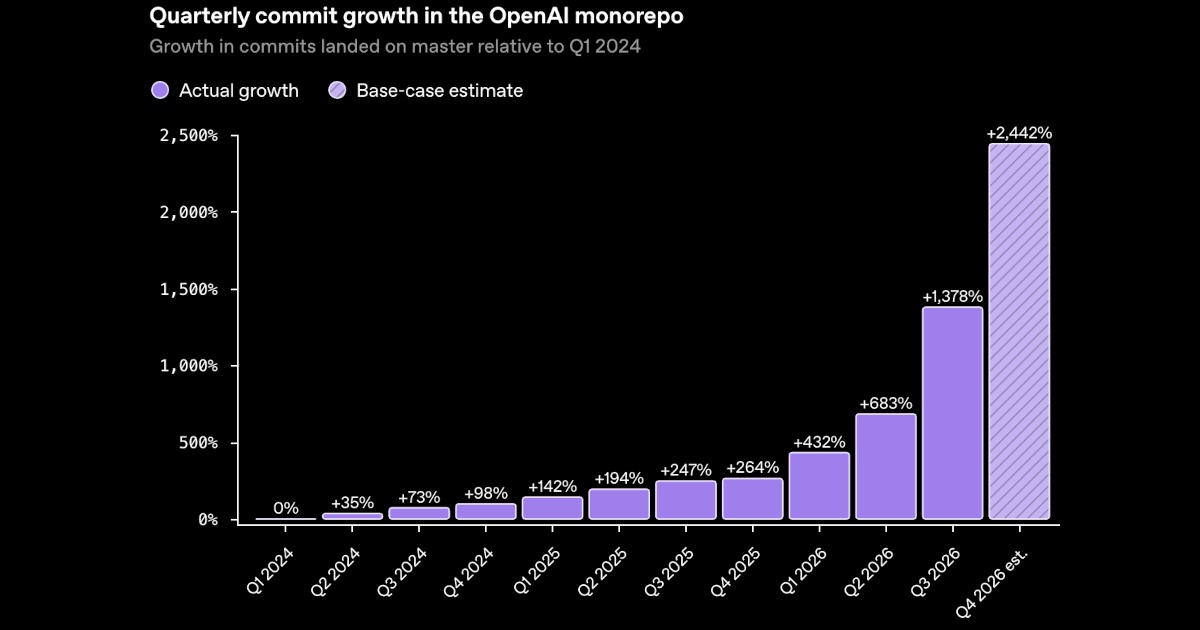
OpenAI has rebuilt the backend under Git, and the headline number is nearly 80% lower median push latency. Pando went into production in April 2026 and now runs all development in OpenAI's monorepo, serving close to a petabyte of Git data a day. The load is largely coming from Codex-driven development, where a single push can kick off several CI jobs that all fetch the same history. If you run a big monorepo with lots of automated pushes, this is the part that matters. Pando keeps Git's object model and client workflows exactly as they are, so your developers don't relearn anything. What changes is the server: unrelated pushes no longer contend on a shared coordination point, and reads get served from reusable packfiles. The catch is that fetching several branches won't give you a repository-wide snapshot, so tooling that assumes one has to be checked. The numbers are concrete. Regional pack-delivery cache Express reports hit rates above 99%, and internal tests saturated 10 Gbps links during clone and fetch. Topic-branch pushes can resend objects outside trunk, trading some bandwidth for reusable packs. Watch how that tradeoff plays out for stacked-branch workflows.

Data center developers are skipping the grid. They're building their own gas power plants on-site, and the announcements have piled up fast: more than 100 behind-the-meter facilities across the US, with a combined planned capacity above 115 gigawatts. Most of that came after the start of 2025. Why? Speed. Getting approval to connect to the grid can take up to a decade, while a gas plant can be stood up far sooner. Building your own power is usually more expensive than hooking up to the grid, so developers are paying a premium to get compute online. If you're planning infrastructure or capacity for AI training, this is the new reality: the bottleneck is electricity, and people are routing around it. The catch? The emissions. On-site gas could emit 345 million metric tons of CO2-equivalent per year by 2035, about 152 million more than if those same facilities drew from the grid. That's more than the Netherlands' total annual emissions. Very few of these plants plan to use combined-cycle turbines, which recover heat and are far more efficient. Equipment makers are also backlogged, pushing developers toward less efficient options. Worth watching: whether pairing gas with on-site renewables and storage becomes standard, since a recent study found that approach can be reliable and cheaper than fossil-only supply. Let's dive deeper…

In today's ContentBuffer update:

  • Anthropic researcher posts 17M-line Lean proof of the Riemann hypothesis, made with Claude

  • GPT-6.2 Designs Proteins From Reasoning Alone, 35 of 322 Bind in the Lab

  • Tidal Bans AI Music on December 9, Deleting 29 Million Songs

  • Tidal Bans AI Music December 9, Removing 29 Million Tracks From Catalog

  • 5 new AI tools & 5 new AI jobs

  • More tech news

Latest Development

Version-control

OpenAI Cuts Git Push Latency 80% With Pando, Now Serving a Petabyte Daily

Image source: res.infoq.com

Summary: OpenAI's new Git backend Pando cut median push latency nearly 80% and now serves close to a petabyte of Git data daily, driven largely by Codex-generated CI load. It keeps Git's client workflows intact while reworking server coordination and pack delivery. Monorepo teams running heavy automation should take note.

Key Points:

  • Pando went into production in April 2026 and now powers all development in OpenAI's monorepo, serving nearly a petabyte of Git data every single day across its infrastructure.

  • Median push latency dropped nearly 80% by coordinating branch updates independently and reusing stored packfiles across fetches, which matters when every push triggers multiple CI jobs.

  • Regional cache Express serves pack downloads with cache-hit rates above 99%, and internal tests showed clone and fetch operations saturating 10 Gbps network links end to end.

  • By default, new feature branches advertise only the trunk as their base, so readers who already have trunk history can reuse stored packs instead of receiving bespoke packfiles.

  • OpenAI shipped a custom Git build supporting parallel download and indexing of independent packs, with some client improvements already merged upstream and others in its public repository.

Why it matters: If you run a large monorepo with heavy CI fan-out, Pando shows where Git bottlenecks really sit: coordination and per-fetch computation, not object storage. Platform teams using hosted Git or self-hosted Gitaly-style backends should audit whether unrelated pushes contend on a shared lock. Anyone scripting multi-branch fetches expecting a consistent repo snapshot needs to rethink that assumption now.

Data-center-infrastructure

Data Centers Are Building 115 GW of Off-Grid Gas Plants to Skip Grid Delays

Image source: wp.technologyreview.com

Summary: Data center developers are building over 100 off-grid gas plants in the US, totaling more than 115 GW, because grid hookups can take a decade. The tradeoff is pricier power and up to 152 million extra metric tons of CO2 per year by 2035.

Key Points:

  • Over 100 behind-the-meter gas power plants have been announced at US data centers, with the vast majority announced since the beginning of 2025, according to recent tracking of planned facilities.

  • Combined planned capacity exceeds 115 gigawatts, which is more than double California's peak power demand and rivals the output of a large fraction of the national fleet.

  • Grid connection requests can take up to a decade to clear, since planners must study whether upgrades like new transmission lines or larger transformers are needed to deliver reliable power.

  • On-site gas could emit 345 million metric tons of CO2-equivalent annually by 2035, roughly 152 million more than the same data centers drawing from the grid, exceeding the Netherlands' annual emissions.

  • Very few planned behind-the-meter plants will use combined-cycle turbines, the more efficient design that captures waste heat, partly because equipment manufacturers are struggling to meet the surge in orders.

Why it matters: If you're planning capacity for GPU clusters or AI training runs, a grid connection that takes years means your timeline now depends on whether your provider has its own power plant. Teams choosing cloud regions or colocation contracts should ask about power sourcing, since on-site gas can mean different reliability, pricing, and emissions profiles than grid-backed capacity. Sustainability reporting teams will also need to account for these facilities' emissions when they start appearing in supplier footprints.

Ai For Mathematics

Anthropic Researcher Publishes 17-Million-Line Riemann Hypothesis Proof Written With Claude

Image source: media.wired.com

Summary: An Anthropic researcher published a 17-million-line Lean proof of the Riemann hypothesis, made with Claude, and the code compiles. Over 200 people are now verifying it, and it will take months to digest. Verify before you celebrate.

Key Points:

  • The Lean proof runs 17 million lines, while the equivalent paper version would stretch to about 250,000 pages of human-readable mathematics.

  • The Lean Focused Research Organization and Mathlib confirmed the proof is sound and that the Riemann hypothesis is formulated correctly in the code.

  • Over 200 collaborators have been working to verify the proof since its Friday publication, with the community aiming to condense it below 10,000 pages.

  • The proof draws on many advanced branches of number theory in a long argument that the author describes as incredibly counterintuitive, and experts expect months of study.

  • The release came just before Anthropic's Thursday IPO, and OpenAI had proved a weaker quasi-Riemann version back in October, which collaborator Tristan Buckmaster says spurred a rushed race.

Why it matters: If you're building formal verification or theorem-proving pipelines in Lean, this is a real stress test of AI-generated proofs at a scale nobody has tried before. Teams using Mathlib should watch how the 17-million-line artifact holds up under community review, since it will show what breaks when machine-checked code outgrows human comprehension. For everyone else, it's a case study in whether AI labs can be trusted to publish breakthrough claims without cutting corners on peer review.

Ai For Science

GPT-6.2 Designs Working Minibinder Proteins, 10.9% Hit Rate in Lab Tests

Image source: images.ctfassets.net

Summary: OpenAI's GPT-6.2 designed working minibinder proteins from reasoning and code, with 35 of 322 binding their targets in the lab. It matched or beat specialized biology models on most of 14 tasks, though full structure prediction still lags.

Key Points:

  • GPT-6.2 designed small protein binders for chosen targets, and 35 of 322 minibinders tested positive for their intended binding target in the lab, a 10.9% hit rate.

  • Redesigned sequences for existing minibinders and antibodies showed evidence of binding the same targets as the originals, suggesting the model captures functional structure rather than memorized examples.

  • The models were evaluated across 14 protein tasks, performing comparably to or better than specialized models on most, with full protein structure prediction still a clear weakness.

  • Written reasoning and code traces show the model drawing on mathematics, physics, chemistry, and recurring sequence and structure patterns, not just surface-level pattern matching on protein databases.

  • Newer model generations improved on many of the 14 tested tasks, and the original RFdiffusion study reported higher hit rates that depend heavily on filtering strictness and binding definitions.

Why it matters: If your team runs a protein design pipeline built on RFdiffusion plus sequence design tools, a general model that handles shape, sequence, and binding prediction in one pass could replace several stages. The catch is that predicting complete protein structures remains weak, so keep your structure validation tools in place. Treat the 10.9% hit rate as your baseline and benchmark against your own filtering criteria before swapping anything out.

Generative-ai-policy

Tidal Will Ban AI Music December 9 and Delete 29 Million Tracks

Image source: platform.theverge.com

Summary: Tidal starts banning AI-generated music December 9 and will delete around 29 million existing AI tracks. Distributors can no longer submit fully AI-made songs, though AI-assisted work stays allowed. If you ship music through a distributor, check your pipeline before the deadline.

Key Points:

  • Tidal will reject an estimated 80,000 to 85,000 AI-generated tracks per day once the ban on fully AI-generated music takes effect on December 9.

  • AI-generated music made up 43 percent of tracks distributed to Tidal over the last 90 days, which explains why the platform is cracking down now.

  • Tidal uses the Ircam Amplify AI detection tool plus metadata checks to identify submissions created solely with AI before they reach listeners.

  • 96 percent of all AI-generated songs on streaming platforms receive zero plays, a stat Tidal cites to justify removing the catalog bloat.

  • Spotify removed 50 million AI-generated tracks from recommendations over the past year, while Deezer lets users filter out AI music entirely.

Why it matters: If you distribute music through a third-party aggregator, your submission pipeline now needs an AI detection step before anything reaches Tidal on December 9. Teams building generative audio tools should expect distributors to tighten their intake rules, since Tidal explicitly bars them from submitting fully AI songs. AI-assisted workflows remain allowed as long as AI isn't the sole output, so document your human contribution now.

Generative-ai-policy

Tidal Bans AI-Generated Music From December 9, Pulling 29 Million Tracks

Image source: variety.com

Summary: Tidal will ban AI-generated music starting December 9 and remove those tracks from its catalog by year's start. Its parent Block says 43% of recent uploads were detected as AI, and 96% of those songs get zero plays. Spotify and Apple Music are moving the same direction with labels and tests.

Key Points:

  • Tidal says 43% of tracks distributed to it over the last 90 days were detected as AI-generated, a share that pushed the company toward a full ban on December 9.

  • Tidal expects to reject between 80,000 and 85,000 songs a day once enforcement starts, a volume that will test how well its automated detection actually works.

  • The purge will remove 29 million tracks from Tidal's catalog, one of the largest content cleanups any major streaming platform has carried out in a single move.

  • Spotify removed 75 million slop or spam tracks from its catalog this year and 50 million from user recommendations, showing how far the problem has spread.

  • Spotify will label AI-generated or AI-assisted tracks as an AI Persona, while Apple Music will label such tracks and test its own methods to combat AI-generated music.

Why it matters: If you distribute music through a third-party aggregator, your releases may get flagged or rejected on Tidal starting December 9, so check how your distributor handles AI disclosure. Teams building audio upload pipelines or content moderation tools now have a concrete benchmark, since Tidal's 80,000 to 85,000 daily rejections show what detection at scale looks like. Anyone shipping recommendation features should note that 96% of AI tracks getting zero plays means the spam problem is a ranking problem as much as a catalog problem.

New Tools & Job

  • Suzy Says Game - A short first-person horror game hidden inside a cheerful kids' interactive DVD. Obey Suzy, but only when she says "Suzy says". The Suzy Says game is a short first-person horror game by the indie studio MOONBIT. You can play the Suzy Says game here for free. There is no download, no account and no payment on this site. Content note: horror, jump scares, sudden loud sounds and flashing lights. This site is an independent fan page and is not run by MOONBIT.

  • AI Headshots - AI Headshots has crafted professional headshots for over 63,537 clients. A flawless headshot is essential for entrepreneurs, executives, and professionals. Craft your professional image in minutes, with no photo shoot required. Easily upload your photos, choose your desired styles, and receive over 120 refined headshots.

  • Optofriend - Optofriend is a web app for YouTube creators and channel managers. It uses video transcript context to draft titles, descriptions, keywords, hashtags and chapters. Creators can review and edit the generated metadata before publishing. The site also offers transcript and video idea tools, with free and paid plans.

  • VectorMint - VectorMint is an AI SVG generator that transforms text descriptions or uploaded images into editable vector files. Users can preview artwork, adjust colors, compare color and outline views, and export standard SVG files. The tool supports multiple styles including illustrations, icons, logos, and line art, with one free preview available before requiring a paid plan.

  • PavoAI - Pavo AI lets you create videos up to 15 seconds using Seedance 2.0 or Wan 2.7, and images using Nano Banana 2 or Seedream 4. Choose your model, set quality and aspect ratio, enter a text prompt, and generate using paid credits. Results can be downloaded and used in editing workflows.


  • Applied AI Architect, Industries - About Anthropic Anthropic’s mission is to create reliable, interpretable, and steerable AI systems. We want AI to be safe and beneficial for our users and for society as a whole. Our team is a quickly growing group of committed researchers, engineers, policy experts, and business leaders working tog

  • Life Sciences Operator, External Research - About Anthropic Anthropic’s mission is to create reliable, interpretable, and steerable AI systems. We want AI to be safe and beneficial for our users and for society as a whole. Our team is a quickly growing group of committed researchers, engineers, policy experts, and business leaders working tog

  • Senior Software Engineer - Platform Billing Core - Elastic, the Search AI Company, enables everyone to find the answers they need in real time, using all their data, at scale — unleashing the potential of businesses and people. The Elastic Search AI Platform, used by more than 50% of the Fortune 500, brings together the precision of search and the i

  • Principal Software Engineer - Search Infra - Elasticsearch - Elastic, the Search AI Company, enables everyone to find the answers they need in real time, using all their data, at scale — unleashing the potential of businesses and people. The Elastic Search AI Platform, used by more than 50% of the Fortune 500, brings together the precision of search and the i

  • Software Engineer 3 - MongoDB’s Application Modernization Platform (AMP) helps organizations modernize legacy applications and move their workloads and associated data from relational databases to MongoDB. Our customers need a dependable way to bring analysis, transformation, testing, and migration capabilities into thei

QUICK HITS

Read more news here →

THAT'S A WRAP

Partner with Us

Showcase your product to our engaged community of Tech enthusiasts

Our newsletter reaches a diverse audience of tech professionals, investors, engineers, managers, and business leaders worldwide. Hear when ads open.

More from the AI Newsletter

AI Newsletter

Get the next issue

One email a day. Free. Unsubscribe anytime.

How we handle your email: Privacy policy

Comments

Subscribe to join the conversation...

Be the first to comment