Skip to content
ContentBuffer
ContentBuffer
July 15, 2026·~4 min read
ContentBuffer

ContentBuffer

Welcome, Tech Leaders.

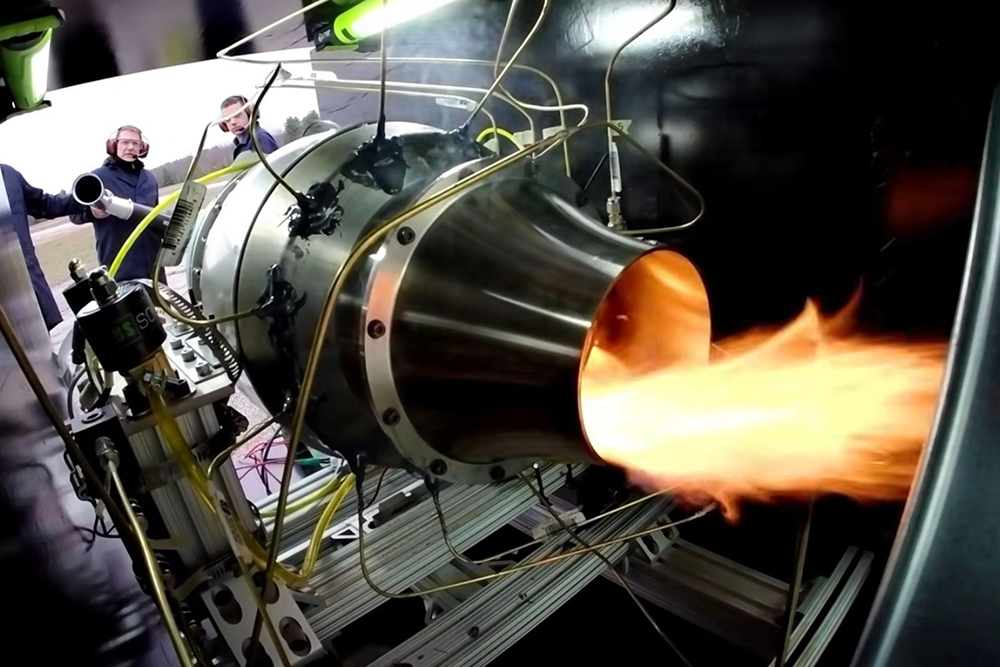
MIT students designed and tested a JARVIS-class jet engine with AI in just four weeks. Teams had access to MIT's machine shops and commercial software, using AI as their primary partner for design and fabrication. However, the project highlighted that while AI can accelerate tasks like summarizing textbooks or sourcing vendors, it cannot replace human engineering judgment. The fundamental rate-limiting step remained manufacturing, with teams facing challenges in working with vendors. By week 1, one team had withdrawn; by week 2, detailed CAD designs were underway.

Alan Turing's seminal 1950 paper might have steered AI research down a path that doesn't lead to true artificial general intelligence (AGI). The paper posited two key ideas: intelligence can be replicated in software and machines can demonstrate it through conversation, known as the Turing test. However, recent studies show these assumptions may be flawed. Machine learning struggles with common sense, practical skills, emotions, perception, social knowledge, and cultural context — all forms of tacit knowledge that are essential for human-like understanding but beyond current AI capabilities. This means scaling up language models won't bridge this gap. Let's dive deeper…

In today's ContentBuffer update:

  • SceneSmith: AI Agents Create Hyper-Realistic 3D Environments for Robot Training

  • Study Reveals Early Decision Making in the Brain

  • New Flying-Swimming Robot Mimics Birds, Could Monitor Ecosystems

  • MIT Engineers Unveil Ultrasound Wristband for Precise Hand Movement Tracking

  • 5 new AI tools & 5 new AI jobs

  • More tech news

Latest Development

Engineering-ai
MIT Students Build Jet Engine With AI in Four Weeks

Image source: news.mit.edu

Summary: MIT students used AI to design and test jet engines in four weeks, showing the benefits of AI but also its limitations. The real challenge was manufacturing, not software or data.

Key Points:

  • Seven teams participated, ranging from first-year to senior-heavy groups

  • Teams had access to MIT's machine shops and commercial engineering software

  • AI helped summarize textbooks and source vendors for design tasks

  • By week 2, detailed CAD designs were developed; combustors prototyped by week 3

  • Manufacturing remained the key bottleneck in the build-test cycle

Why it matters: MIT's jet engine challenge shows AI can accelerate engineering tasks but cannot replace human judgment. For teams working on complex hardware projects, leveraging AI for information and organization is valuable, but physical manufacturing remains critical.

General-intelligence
Turing's AI Path May Have Been Wrong for 75 Years

Image source: www.sciencedaily.com

Summary: Turing's foundational ideas may have misguided AI research for decades. The pursuit of AGI faces significant hurdles due to the limitations in capturing tacit knowledge and cultural context.

Key Points:

  • Alan Turing's paper from 1950 laid out two key assumptions about AI that continue to influence research today (75 years later).

  • The first assumption is that intelligence can be recreated in software, a concept now questioned by recent studies on machine learning limitations.

  • Turing test, an idea introduced in the same paper, suggests machines demonstrating human-like conversation prove intelligence — this too faces scrutiny.

  • Machine learning struggles with five major categories of tacit knowledge: common sense, practical skills, emotions, perception, and cultural context.

  • Scaling up language models won't bridge the gap between machine understanding and true human intelligence due to inherent limitations.

Why it matters: If you're working on AGI or advanced AI systems, Turing's foundational assumptions might be leading your research in a direction that doesn't address key human-like capabilities. This could mean wasted effort on scaling models without addressing the core issues of tacit knowledge and cultural context.

Ai-assisted Robotics Development
SceneSmith Generates Realistic 3D Environments for Robots

Image source: news.mit.edu

Summary: SceneSmith uses AI agents to create hyper-realistic virtual worlds for robot training, making it easier and faster to test robotic applications before real-world deployment.

Key Points:

  • SceneSmith generates scenes with up to six times more detail than previous methods, including private offices, pottery stores, and Minecraft-themed gaming rooms.

  • Over 200 users found the system's visuals to be more realistic over 90 percent of the time compared to other approaches.

  • The researchers tested out different action plans in SceneSmith's digital worlds, generating 100 unique spaces in the process.

  • SceneSmith uses a multi-modal vision-language model (VLM) that gives each agent spatial knowledge and allows them to generate scenes more accurately.

  • Each scene is created through a collaborative process involving a designer, critic, and orchestrator AI agents.

Why it matters: If you're developing robotic applications or testing robots in virtual environments, SceneSmith's realistic 3D scenes can significantly reduce the need for physical trial-and-error. The system generates hyper-realistic indoor spaces with up to six times more detail than previous methods, making it easier and faster to train robots before they're deployed.

Neural-networks
Brain Decisions Happen Earlier Than Thought

Image source: www.sciencedaily.com

Summary: Researchers found that the human brain makes decisions earlier than expected, with feedback loops playing a crucial role. This could change how we design AI systems in the future.

Key Points:

  • Study published in Proceedings of the National Academy of Sciences (PNAS) on October 10, 2023

  • Primary sensory regions like S1 show decision-related activity influenced by higher brain areas through rapid feedback loops

  • Traditional models assume a one-way flow of information from sensory inputs to decision-making centers; this study challenges that view

  • Researchers aim to further investigate the timing and coordination of these brain signals for better understanding

  • Understanding bidirectional communication in brain processes could inspire new AI architectures beyond linear processing

Why it matters: If you're building neural networks or cognitive systems, this research challenges traditional models. The discovery that decision-making involves rapid feedback loops between brain regions suggests a more complex interplay than previously thought. This insight could lead to the development of more sophisticated and accurate AI architectures.

Biomimicry
Robot Flies and Swims Like a Bird

Image source: assets.newatlas.com

Summary: MIT's flying-swimming robot can now transition between water and air like a bird. It’s cheap at $300 and could monitor marine ecosystems better than current tech.

Key Points:

  • The robot weighs just 250 grams (8.8 ounces), making it lightweight for both flight and swimming.

  • Wings flap up to 11 Hz in air, dropping to between 0.1 and 6 Hz underwater, adjusting speed based on medium density.

  • Neutral buoyancy allows the robot to neither float nor sink without assistance, crucial for stable operation.

  • Launches out of water using 8-10 wingbeats within one second at a near 70-degree exit angle.

  • Open CAD files released; anyone with a 3D printer can build their own version for around $300.

Why it matters: Environmental researchers studying aquatic ecosystems will benefit from this robot's unique ability to monitor both water and air. Its lightweight design, costing just $300, makes it accessible for widespread use in monitoring marine life and pollution levels.

Human-machine-interface
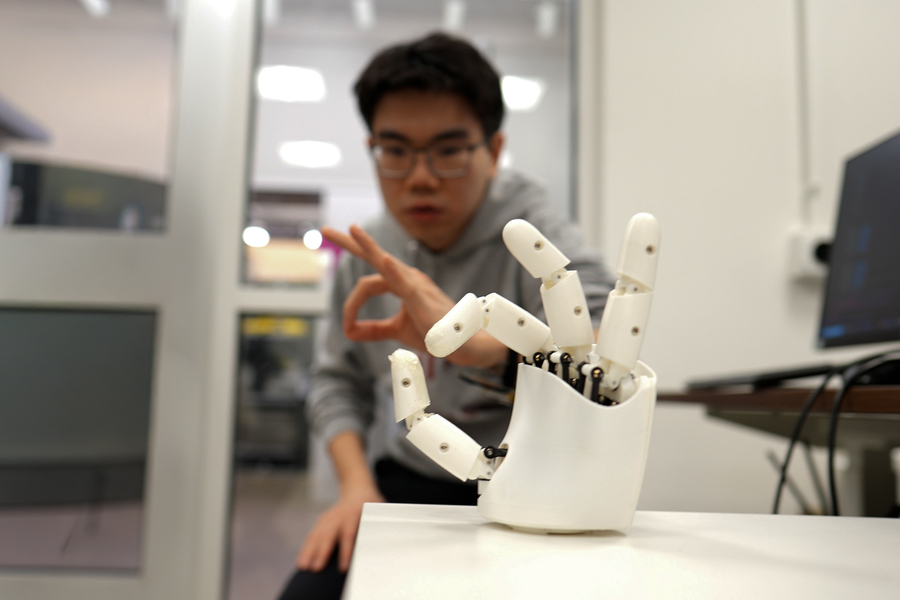
MIT's Ultrasound Wristband Tracks Hand Movements in Real-Time

Image source: robohub.org

Summary: MIT engineers unveiled an ultrasound wristband that tracks hand movements in real-time, allowing for wireless control of robotic hands and virtual object manipulation. This could be game-changing for robotics and VR developers.

Key Points:

  • The wristband uses AI to interpret muscle activity from ultrasound images, enabling precise tracking of hand gestures (Nature Electronics).

  • In tests with eight volunteers, the device accurately predicted hand positions and movements across various scenarios (August 2023).

  • Researchers trained an algorithm to recognize patterns in ultrasound data corresponding to specific hand motions and finger positions.

  • The wristband's design allows for different ways of extending or angling fingers and thumbs, offering 22 degrees of freedom.

  • MIT envisions using the device to train humanoid robots in dexterity tasks like performing surgical procedures.

Why it matters: If you're developing robotic prosthetics or VR interfaces, this wristband could drastically improve user interaction. It tracks hand movements with 22 degrees of freedom and can wirelessly control a robotic hand based on the wearer's gestures.

New Tools & Job

  • NeatScribe - NeatScribe is designed for anyone who needs to reuse information from recorded speech. It creates timestamped transcripts, supports translation, and exports results as text files, documents, subtitles, captions, or timed lyrics.

  • Sakana Marlin - Sakana Marlin is Sakana AI's first commercial product: an autonomous 'Ultra Deep Research' agent positioned as a Virtual Chief Strategy Officer. Given a research topic, Marlin works autonomously for up to roughly eight hours, forming hypotheses, gathering and reconciling information from online sources, and synthesizing a detailed strategy report up to ~100 pages plus executive-summary slides. It builds on Sakana AI research including AB-MCTS (NeurIPS 2025 Spotlight) and The AI Scientist (published in Nature). A closed beta ran from April 2026 with ~300 professionals across finance and consulting.

  • Upsolve AI - Upsolve AI is an Agent Studio for data teams to build, deploy, and evaluate grounded, governed, and trustworthy analytics agents. It layers institutional context (warehouse tables, validated SQL patterns, semantic models, KPI definitions, and business rules from sources like Notion, Slack, and email) on top of 30+ SQL database connectors so end users can ask questions in natural language and get accurate, traceable answers. Every conversation is fully traced end-to-end (tool calls, SQL, agent output), a built-in evaluation agent grades performance, and context monitoring surfaces gaps so accuracy improves with use. Agents deploy to Slack, Teams, Claude, ChatGPT, Cursor, or embed in your own product via MCP/SDK.

  • Buddy - Buddy is an AI design agent that lives in the Figma canvas. Chat to generate screens, flows, components, and variants using your existing design system; paste a public URL or drop an HTML file to recreate live websites as editable Figma layers; and run batch edits and layer organization across files. Supports multiple LLMs (Opus, Sonnet, GPT, Gemini, Codex). Works on any Figma plan including Free.

  • Tyto - Tyto by ai-coustics is a monitoring and diagnostics layer for Voice AI. It produces a single real-time risk score that predicts speech-to-text, voice-activity-detection, and turn-taking failures before they occur, scoring six qualities of incoming audio so teams can catch audio issues before they impact voice agents in production.

  • Principal Product Manager, AI agents - Search - Elastic, the Search AI Company, enables everyone to find the answers they need in real time, using all their data, at scale — unleashing the potential of businesses and people. The Elastic Search AI Platform, used by more than 50% of the Fortune 500, brings together the precision …

  • AI Research Engineer - Datadog AI Research (DAIR) - As a Research Engineer on our team, you will partner with Research Scientists to turn research ideas into working systems, building the data, tooling, and infrastructure that enable rapid iteration, trustworthy evaluation, and a smooth path from prototype to production. Building on our track …

  • Director, AI Forward Deployed Engineering (FDE) - CSQ427R87 Mission The AI Forward Deployed Engineering (AI FDE) team is a highly specialized customer-facing AI team at Databricks. We deliver professional services (PS) engagements to help our customers build and productionize first-of-its-kind AI applications with a focus on GenAI. We work cross-fu…

  • Senior Engineering Manager, AI Runtime - At Databricks, we are passionate about enabling data teams to solve the world's toughest problems, from making the next mode of transportation a reality to accelerating the development of medical breakthroughs. We do this by building and running the world's best data and AI infrastructure platform s…

  • Principal Data Scientist - RDQ427R169 While candidates in the listed locations are encouraged for this role, we are open to remote candidates in other locations. Databricks is looking for a Principal Data Scientist to serve as the statistical voice of the Data Science organization. This person will make Databricks smarter and…

QUICK HITS

Read more news here →

THAT'S A WRAP

Partner with Us

Showcase your product to our engaged community of Tech enthusiasts

Our newsletter reaches a diverse audience of tech professionals, investors, engineers, managers, and business leaders worldwide. Get in touch today.

Comments

Subscribe to join the conversation...

Be the first to comment

Want this in your inbox?

Get the daily edition delivered free every morning.

Join 2,075 builders reading daily.