Skip to content
ContentBuffer
ContentBuffer
November 3, 2026·~6 min read
ContentBuffer

ContentBuffer

Welcome, Tech Leaders.

Analytics agents are working, but barely more than half the time. Across surveyed organizations, an average of 48% of agent-generated insights now lead to actions that improve the business. A year ago that number was 37%, so progress is real. It's also a long way from good. If you're wiring agents into dashboards or pipelines, this is your problem to own. Descriptive insights get praised. Prescriptive ones, the recommendations that tell someone what to do, are where quality falls apart. Flawed insights don't just waste time. They can cause reputational or financial damage, and an agent that confidently suggests the wrong move at scale is worse than no agent. The root causes are boring and fixable. 55% of surveyed executives blame lack of business context, and 45% point to fragmented or inaccessible data. At a majority of organizations, agents generate more insights than people can evaluate, and fewer than a quarter can check all of them. Only a small cohort tops 70%. Their edge is governance (cited by 60% as a priority) and a semantic layer (45%).

SUSE is cutting about one in ten employees, and the company is pinning it on automation and AI. The Linux and enterprise open-source vendor says its current organizational design and cost base won't carry it forward, so it's shifting money toward high-priority areas and away from everything else. If you run SUSE Linux Enterprise in production, this is a signal about where your vendor's roadmap is heading. Engineering and support teams are being reshaped around what SUSE thinks it needs next, not what it built last year. Expect priorities to move, and check which product lines are getting investment before your next renewal. The numbers: about 10% of the global workforce is affected. Affected staff hear by November 4, employee representatives get nominated the next day, and one-to-one meetings start the following week. SUSE first asked for voluntary separation, but not enough people took it, so forced cuts followed. Worth watching: the fiscal 2027 strategy reveal on November 16, which should show exactly which bets SUSE is doubling down on. Let's dive deeper…

In today's ContentBuffer update:

  • Shopify's Overexposed scanner finds internet-facing GKE and Cloud Run endpoints without auth

  • AI-Generated Game Wikis Are Spreading Lies, Malware Links, and Server Bills

  • Proton's CEO Called Security Pentesting 'Loser Thinking' and Then Dropped an AI Job Threat

  • Agents Built the Same Pokémon App in Each Framework. Here's What Cost the Most.

  • 5 new AI tools & 5 new AI jobs

  • More tech news

Latest Development

Agentic Analytics
Analytics Agents Hit 48% Business Impact, Up From 37% in One Year

Image source: wp.technologyreview.com

Summary: Analytics agents now drive business-improving actions on 48% of insights, up from 37% last year. Most teams still can't review everything their agents produce, and prescriptive recommendations lag far behind. Governance and semantic layers are where the top performers are pulling ahead.

Key Points:

  • Across surveyed organizations, the average share of agent insights leading to business-improving actions reached 48%, up from 37% in the past year.

  • A small cohort of organizations has pushed past 70% of agent insights driving real business improvements, showing the ceiling is well above the current average.

  • Executives cite lack of business context as the top cause of weak insights at 55%, with fragmented or inaccessible data close behind at 45% of respondents.

  • Less than one-quarter of surveyed organizations can evaluate all their agent insights, and most rely on case-by-case review instead of systematic checks.

  • Strengthening AI and data governance is a priority for 60% of insight leaders, while adding a semantic layer to data architecture is a priority for 45%.

Why it matters: If your team ships agent-generated dashboards or recommendations, the 48% number is your baseline, and more than half of what you ship is going nowhere. Start by auditing which prescriptive outputs actually get acted on, because that's where the quality gap is widest. Put governance and a semantic layer in front of your agents before you add more of them.

Enterprise Linux
SUSE Cuts 10% of Global Workforce Citing Automation and AI Shift

Image source: image.theregister.com

Summary: SUSE is cutting about 10% of its global workforce and blaming automation and AI. Voluntary buyouts fell short, so forced layoffs are next. If you depend on SUSE Linux, watch the November 16 strategy reveal for roadmap shifts.

Key Points:

  • SUSE is cutting roughly one in ten employees, a reduction of about 10% of its global workforce, with the company explicitly citing automation and AI as the driver.

  • The layoffs follow a review of SUSE's future strategy, required capabilities, and team structures, which the company says ran through each at-risk role individually.

  • Affected employees get notified by November 4, employee representatives are nominated November 5, and one-to-one meetings begin the following week.

  • SUSE first offered voluntary separation to longer-tenured staff, but not enough accepted, so the company moved to involuntary job cuts instead.

  • Private equity owner EQT bought SUSE in 2018 for $2.5 billion, floated it in Frankfurt in 2021, took it private again in 2023, and reportedly weighed a sale in March.

Why it matters: If you run SUSE Linux Enterprise or depend on SUSE support, expect the product and support priorities to shift around the November 16 fiscal 2027 strategy. Teams that built on lower-priority SUSE components should start mapping their exposure now. Anyone evaluating SUSE against Red Hat or Canonical should factor in this restructuring and the possibility of another ownership change.

Cloud Exposure Scanning
Shopify Open-Sources Overexposed, Cutting Inconclusive Ingress Verdicts By 80%

Image source: res.infoq.com

Summary: Shopify rebuilt its internal scanner, Overexposed, to find Kubernetes Ingresses and Cloud Run services reachable without auth. Built on GCP Cloud Asset Inventory, it cut inconclusive verdicts by around 80%. If you run on GKE, the inventory-first approach is worth copying.

Key Points:

  • Overexposed queries GCP Cloud Asset Inventory, which includes Ingresses GKE accepts after admission, plus Cloud Run services and load balancers, instead of trusting infrastructure repo files.

  • The scanner sends HEAD requests first, falls back to GET, follows at most three redirects, and rechecks each redirect while testing path variations like /ADMIN.

  • Six verdicts come out of the scanner: exposed, expected, protected, not found, unreachable, and inconclusive, with inconclusive covering any evidence too uncertain to call protected.

  • An expected verdict applies only when an open endpoint matches a reviewed allowlist entry stored in code, so every exception needs a pull request and human sign-off.

  • Overexposed validates every DNS-returned IP, rejects private and loopback addresses, connects to the checked IP directly, and stores only verdicts, reasons, and owners, never bodies or credentials.

Why it matters: If your team runs GKE or Cloud Run, Overexposed is a blueprint for the exposure audit you keep postponing. Its key move is treating Cloud Asset Inventory as the source of truth, so Ingresses created after admission don't slip past your security review. Platform and security teams should also copy the SSRF hardening, since any scanner that fetches arbitrary hostnames needs IP validation and restricted egress to cloud metadata endpoints.

Ai-generated Content And Web Scraping
AI-Generated Game Wikis Flood Search With False Info and Malware Links

Image source: assetsio.gnwcdn.com

Summary: AI-generated game wikis are flooding search results with wrong info, data collection, and links to flagged software. Smaller community wikis are eating the bill, with server costs up three to ten times. If you rely on indie game wikis, verify before you trust.

Key Points:

  • The Dune: Awakening Community Wiki recorded 7 million requests from AI crawlers in a single 30-day period, according to publicly available internal data.

  • Server costs for independent gaming wikis have jumped between three and ten times, largely because of traffic spikes from AI-generated competitors and scrapers.

  • Spaceship, the service hosting the Nighthawks wiki, also offers an AI Website Builder, which is how these sites get spun up so quickly.

  • GameDB operates more than 20 AI-generated game wikis, and its creator has openly admitted using generative AI to produce the content.

  • Opening one flagged site triggered malware software warnings labeling it potentially unsafe, and the paid software it pushed had been reviewed poorly online.

Why it matters: If you maintain a wiki or community site for a small game, AI scrapers can hammer your servers with traffic you never budgeted for. Teams running on modest hosting should check their bandwidth logs and rate-limit known crawlers before the next spike hits. Developers who link to wikis from docs or launchers should audit those links, because a lookalike AI site can quietly outrank the official one in search.

Vendor-risk
Proton CEO Calls Security Pentesting 'Loser Thinking' Amid AI Push

Image source: blog.raed.dev

Summary: Proton's CEO called an engineer's pentest request 'loser thinking' and told staff to lean harder on AI for code. The privacy company's caution is the whole product, so this is a red flag for anyone trusting it with their mail.

Key Points:

  • Proton's CEO reportedly called an engineer's request for a few days of pentesting before shipping 'bullshit and loser thinking,' according to the leaked account of the exchange.

  • Staff were told their AI usage could decide whether they kept their jobs, a plan that was dropped only after it leaked publicly.

  • The CEO said the AI job-security plan had already served its purpose, which suggests the pressure was intentional rather than an accidental wording mistake.

  • The CEO accepted pentesting only if it did not slow the release pipeline, putting a fixed schedule ahead of security review for a privacy product.

  • Stated AI guardrails were reviewing model output, testing, and accountability, yet the leadership response suggests testing time is now treated as the bottleneck.

Why it matters: If you run Proton Mail or any privacy tool in a compliance-sensitive workflow, your vendor just signaled that security review is optional. Teams building on B2B vendors should add their own pentest and audit gates instead of trusting the release schedule. The bigger question is whether Proton's engineers keep their veto on shipping risky code once AI output becomes the default.

Frontend Frameworks
Benchmark Tests Five JavaScript Frameworks by Having Agents Build a Pokémon App

Image source: nolanlawson.com

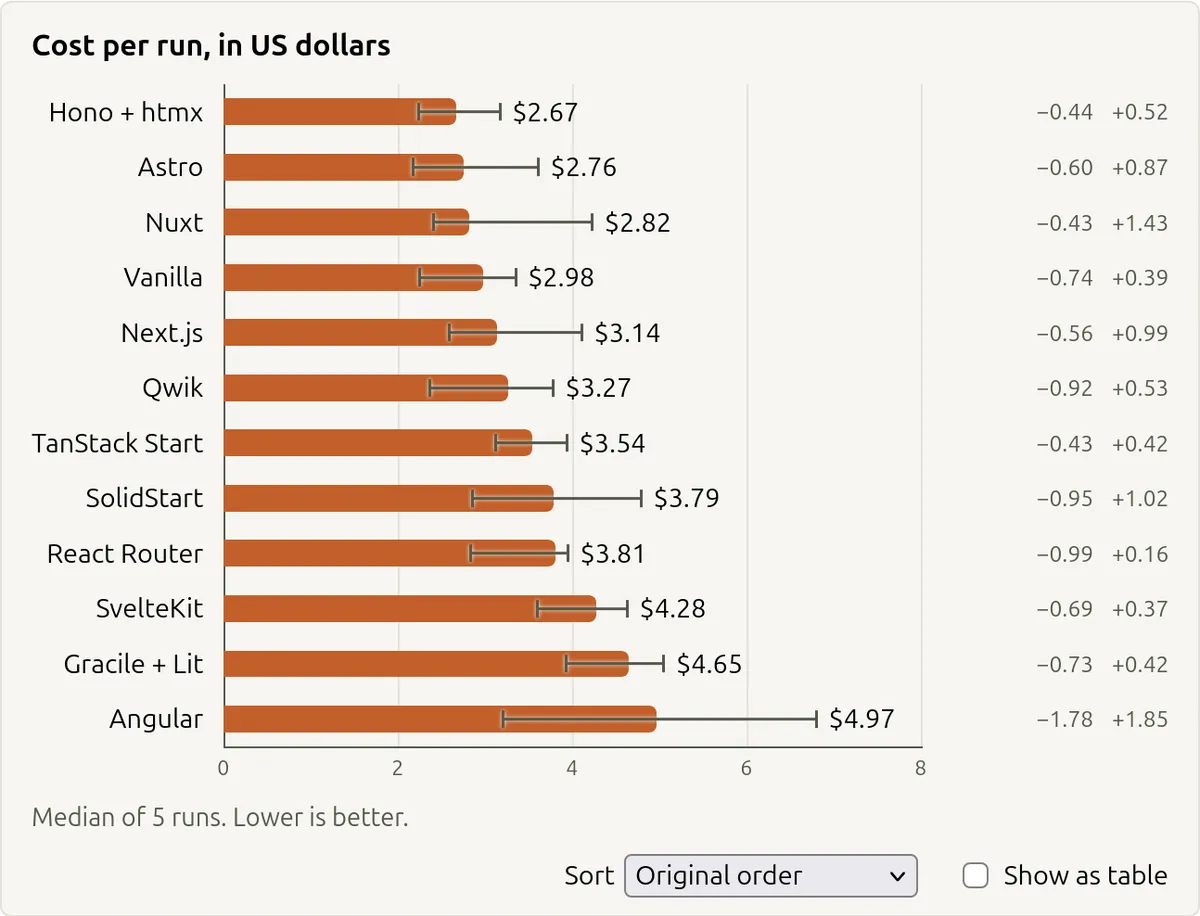
Summary: A new benchmark had agents build the same Pokémon app across JavaScript frameworks and measured cost, quality, and Lighthouse scores. Runs cost $2.67 to $4.97, with SvelteKit, Gracile+Lit, and Angular the most expensive. Before you switch stacks for 'agent-friendliness,' check the receipts.

Key Points:

  • Each run built a Pokémon app on PokéAPI, and outputs were checked against a spec conformance suite to block agents from gaming the test.

  • Cost per run ranged from $2.67 to $4.97, with a median of $3.14, making the framework choice a real line item on your agent budget.

  • SvelteKit, Gracile+Lit, and Angular cost more to build than the other frameworks tested, even after accounting for token spend and build time.

  • Metrics included development time, tokens spent, lines of code, and Lighthouse performance and accessibility scores, giving a multi-angle comparison.

  • Agents used MCP servers, skills, or Claude Code plugins unevenly, and not every framework had one, so tooling availability may skew the outcomes.

Why it matters: If you're picking a frontend stack for agent-written code, this is the first data point that puts a dollar figure on the 'better for agents' claim. Teams running Claude Code on SvelteKit or Angular should check their per-feature spend against the $3.14 median before assuming their setup is efficient. The MCP and plugin gaps mean any framework comparison you run internally needs to control for tooling, or you'll be measuring plugin coverage instead of the framework.

New Tools & Job

  • GeoEcho - Submitted by the GeoEcho team with AI-assisted preparation. GeoEcho helps brands, marketing teams and SEO agencies monitor visibility in AI-generated search answers. Teams configure projects, prompts and competitors, then review completed collections for brand mentions, sentiment, cited sources and competitive visibility. English and Chinese workflows are available. Available platforms and collection limits depend on the project and plan. Configuration is possible before payment; data collection requires a paid plan. The reports support investigation and do not guarantee rankings, traffic, sales or AI recommendations. Official website: https://geoecho.ai/ . Contact: support@geoecho.ai.

  • AI Black Friday - AI Black Friday is an editorial deals tracker for verified AI tool discounts. It lists 60+ AI tools with daily-checked deal status—not a coupon farm. Free to use at https://aiblackfriday.net.

  • Flow AI - Flow AI (flowai.studio) is a free, browser-based AI video generator. Create original videos from prompts, images, and references — including text to video, image to video, and first/last-frame generation — without signing up. Creators and teams use it as a zero-friction video workspace: describe a shot, generate, and iterate in the browser. Free path with no account required. Homepage: https://flowai.studio/

  • OCRZero - OCRZero runs the Xiaomi-OCR-0 model in the browser and as an API. Upload a scanned page, photo or PDF and get Markdown that keeps tables and formulas, or extract invoice and form fields as JSON. A free online demo covers quick jobs, and the batch OCR API is built for teams and developers processing documents at volume.

  • Audio AI Studio - A voiceover, a backing track and a transcript usually come from three different places, and each one asks for its own install and its own subscription. Audio AI Studio brings them into one workspace that runs in a web browser, so there is nothing to download.\n\nThe voice side covers more than reading a script aloud. An AI voice generator works from 400+ preset voices across 36 languages, or from a voice a user designs or clones from their own sample; delivery tags such as [laughs] or [pause] let a line be shaped while it is written. The same studio composes songs and instrumentals from a description or from supplied lyrics, splits a finished track into vocals, drums, bass and other stems, and transcribes recordings with speaker labels and timestamps. Results export as MP3, WAV, TXT, SRT, VTT or DOCX, which keeps a finished voiceover and its subtitles in step.\n\nAlongside these sit free browser tools for converting, trimming, joining and recording audio, plus a BPM Finder and a Key Finder for anyone who needs the tempo and key of a track. Credits are shared across all tools, and each one shows its cost before work starts, so a session can be planned rather than discovered.\n\nThe people most likely to need it are creators, podcasters, educators, marketers and musicians who want voiceovers, music or transcripts without installing software.

  • Data Scientist - Job ID: 111267 At Lyft, our purpose is to serve and connect. We aim to achieve this by cultivating a work environment where all team members belong and have the opportunity to thrive. Responsibilities: Partner with Engineers, Product Managers, Product Designers, and Business Partners to frame p

  • Staff Software Engineer, Product - About Decagon Decagon is the leading conversational AI platform empowering every brand to deliver concierge customer experiences. Our technology enables industry-defining enterprises like Avis Budget Group, Block’s Cash App and Square, Chime, Oura Health, and Hunter Douglas to deploy AI agents that

  • Senior Software Engineer, Product - About Decagon Decagon is the leading conversational AI platform empowering every brand to deliver concierge customer experiences. Our technology enables industry-defining enterprises like Avis Budget Group, Block’s Cash App and Square, Chime, Oura Health, and Hunter Douglas to deploy AI agents that

  • Applied AI Architect, Cyber Specialist - About Anthropic Anthropic’s mission is to create reliable, interpretable, and steerable AI systems. We want AI to be safe and beneficial for our users and for society as a whole. Our team is a quickly growing group of committed researchers, engineers, policy experts, and business leaders working tog

  • Staff Software Engineer, Storage - Crusoe is on a mission to accelerate the abundance of energy and intelligence. As the only vertically integrated AI infrastructure company built from the ground up, we own and operate each layer of the stack — from electrons to tokens — to power the world's most ambitious AI workloads. When you join

QUICK HITS

Read more news here →

THAT'S A WRAP

Partner with Us

Showcase your product to our engaged community of Tech enthusiasts

Our newsletter reaches a diverse audience of tech professionals, investors, engineers, managers, and business leaders worldwide. Get in touch today.

Comments

Subscribe to join the conversation...

Be the first to comment

Want this in your inbox?

Get the daily edition delivered free every morning.

Join 3,571 builders reading daily.

Also get

Latest Issues

View Archive →
Oracle filed plans to issue $10 billion in stock and $10 billion in bonds, capping its 2027-2030 outside funding at $20 billion. Shares are down 33% this year. If you build on OCI, watch how Oracle pays for its AI buildout.
Daily Edition#336

Oracle filed plans to issue $10 billion in stock and $10 billion in bonds, capping its 2027-2030 outside funding at $20 billion. Shares are down 33% this year. If you build on OCI, watch how Oracle pays for its AI buildout.

Anthropic added a system prompt to Claude Code on October 27 that blocks recreations of specific existing games, even renamed ones. Original games, genre games, and games built from your own assets still work. If you vibe-code game projects, expect refusals on clones.

November 3, 2026
Analytics agents now drive business-improving actions on 48% of their insights, up from 37% a year ago. That still means more than half get ignored or fail. For teams betting on agentic analytics, the fix is context and governance, not more agents.
Daily Edition#17

Analytics agents now drive business-improving actions on 48% of their insights, up from 37% a year ago. That still means more than half get ignored or fail. For teams betting on agentic analytics, the fix is context and governance, not more agents.

SUSE is cutting roughly 10% of its global workforce, blaming automation and AI for reshaping how software companies work. Staff get notified November 4, and the full fiscal 2027 strategy lands November 16. If you work at a software vendor, expect similar moves.

November 3, 2026
Everbloom's lab-made renoa, built from cashmere scraps, wool lint and feathers, just became the first new fiber class the FTC has approved in 25 years. First consumer blends hit the market in Q2 2027. Watch this one if you buy premium knitwear or care about goat-driven overgrazing.
Daily Edition#335

Everbloom's lab-made renoa, built from cashmere scraps, wool lint and feathers, just became the first new fiber class the FTC has approved in 25 years. First consumer blends hit the market in Q2 2027. Watch this one if you buy premium knitwear or care about goat-driven overgrazing.

A federal judge denied xAI's bid to dismiss an NAACP lawsuit over at least 35 gas turbines at its Memphis Colossus data center. The judge rejected xAI's mobile-source exemption and its standing arguments. If you build on AI infrastructure, expect permitting scrutiny to tighten fast.

November 2, 2026