🚕Uber Builds MCP Gateway Connecting AI Agents to 800+ Servers
Your internal APIs are about to become agent-ready
TL;DR
Uber built an MCP Gateway that lets AI agents discover and call over 5,000 internal tools across 800+ servers. Authorization and PII redaction are built in. If your company runs lots of internal APIs, this is the blueprint to copy.
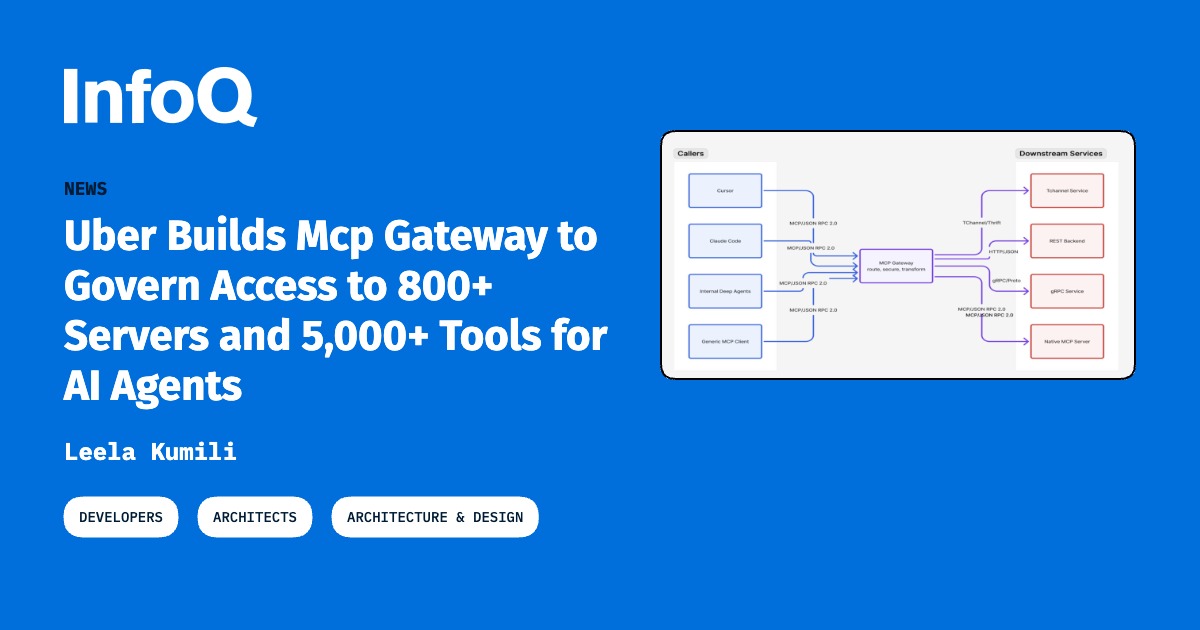
Uber just built a single front door for AI agents to reach its internal services. The MCP Gateway handles discovery, protocol translation, authorization, and execution, and it already fronts more than 800 MCP servers and 5,000 tools. If you maintain internal APIs, this matters. The gateway exposes existing APIs as MCP tools without touching the underlying services, so you don't rewrite anything to make your stack agent-accessible. Authorization is enforced at both the server and tool level through Uber's internal access control system, and PII redaction runs on tool responses before agents see them. Third-party calls to Jira and Google go through a separate token exchange service. The architecture splits a registry, which stores tool definitions, schemas, ownership, and enablement settings, from a proxy that converts MCP requests into HTTP, gRPC, or TChannel calls. Omni MCP handles incremental discovery, and Response Projection lets agents ask for specific fields instead of full payloads. AutoCrawler feeds the registry by scanning Protocol Buffers and Thrift schemas with Cadence.
Key Points
The platform supports more than 800 MCP servers and 5,000 tools, all reachable through one common gateway layer for discovery, translation, authorization, and execution.
Keep reading — it's free
Enter your email to keep reading — plus the best of AI & tech, daily. Free, forever.
Already a member? Sign in
Comments
Be the first to comment