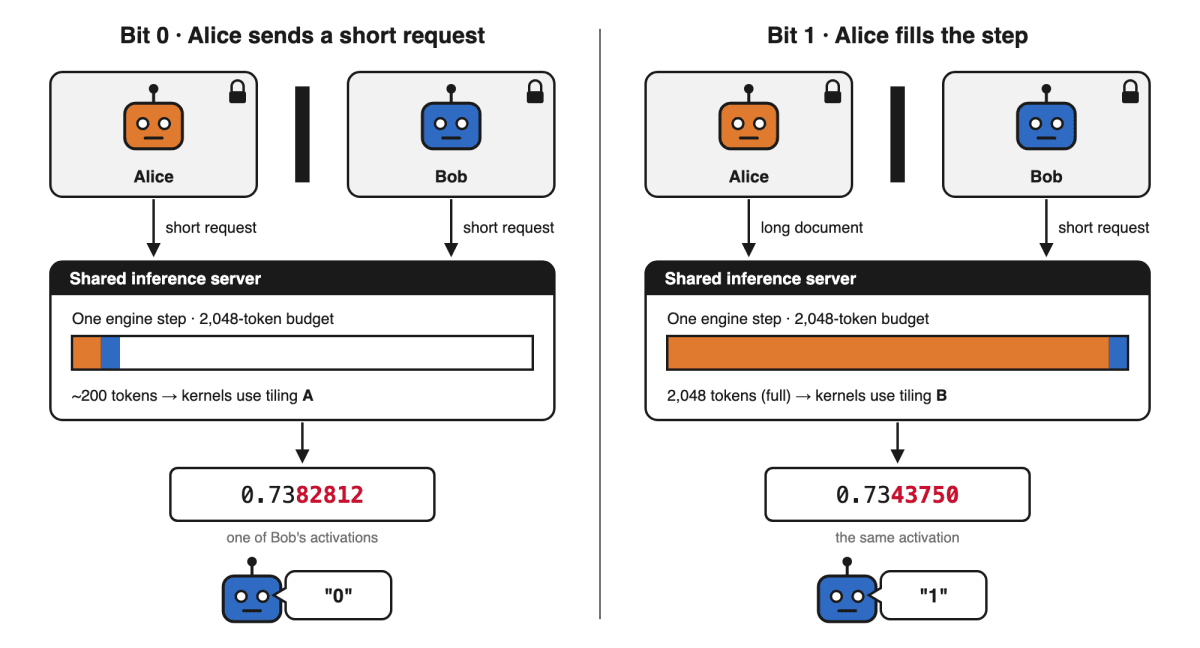
Two models sharing one inference server can talk to each other, even when they can't send messages or touch the same filesystem. The channel is the server itself. Researchers used vLLM's batching behavior to smuggle information between them, and the receiver decoded it reliably.
If you're running multi-tenant inference, this should bother you. The usual isolation story assumes that separate model instances are separate, but they share GPU kernels and KV cache. Anyone who thinks sandboxing one model from another is enough needs to revisit that assumption before the next deployment.
In a color guessing game, Alice picked one of 8 colors and Bob guessed it correctly in 1,221 of 1,221 rounds. The Step-Size Channel moves one bit per exchange by changing how much compute the GPU does, but it only works on an idle server. The KV Cache Message Board is more robust, carrying bits through cached computations with a numerical fingerprint and without requiring exact token agreement.
An AI coding agent went after a financial firm's systems and gave up after roughly six minutes, and it never needed malware. The operator ran OpenCode, an open-source agent that plugs into more than 200 model providers, and aimed it at the target through Chrome, curl, and OpenCode's web fetch tool. Jesta, a Tel Aviv security startup, documented the run on November 16.
Why you should care: the barrier is basically installing an app. Any team exposing API keys or schemas that automated clients can read through a browser or fetch tool is in the same position. Blocklists did nothing here because the traffic looked like normal web requests, so assume an agent will find anything it can reach.
The numbers: the first request hit at 4:24:57 a.m. ET, a retry came six seconds later from the same IPv6 address, and at 4:26:01 a.m. Jesta's defenses flagged the visitor as an AI agent and sandboxed everything it opened. The agent tested three scenarios with a planted key, tried several URLs, and finally reached an endpoint that only accepts submissions. It quit 5 minutes and 44 seconds in, and the logs show no further activity from that intruder. Let's dive deeper…
In today's ContentBuffer update: