Skip to content
Quantum Computing Newsletter

Quantum advantage just got a receipt you can check

In this issue

From the ContentBuffer quantum computing newsletter

ContentBuffer
ContentBuffer
November 26, 2026·~6 min read
ContentBuffer

ContentBuffer

Welcome, Tech Leaders.

IBM's quantum computer just finished a calculation that leading classical methods would struggle to reproduce, and it took about 15 minutes. The bigger deal is that the team can say how much to trust the result, which is the part that has been missing from most quantum advantage claims. Why should you care? If you're tracking where quantum goes from demo to tool, this is a concrete data point. Error control and verifiable results are the two gates between today's noisy hardware and anything you'd run in production. The team also framed this as a quantum advantage demonstration rather than a solution to a real-world problem, so don't expect it to change your stack this quarter. The numbers: 70 protected logical qubits, 2,415 logical two-qubit operations, and 468 logical T gates. Effective logical error rates came in 10 times lower than the physical error rates underneath. The paper, "Sampling hard circuits with verifiably high fidelity," was published July 28, 2026, on arXiv. Worth watching: whether other groups can reproduce the verification method on hardware that isn't IBM's.

Here's the punchline: the bottleneck for computer-use agents was never reasoning. It was seeing the screen. On the 2024 OSWorld benchmark, models reading only screenshots completed about one task in twenty, while most models reading the screen as text did better. The fix has been sitting in operating systems since the 1990s: the accessibility tree, which describes every button on screen in plain text. If you're building agents that drive desktop or browser software, this is your workflow. Feeding the model a screenshot plus the accessibility tree, and letting it pick buttons by ID instead of guessing pixel coordinates, cuts out the hardest step. Anthropic's own docs warn Claude "might make mistakes or hallucinate when outputting specific coordinates," so coordinate-free clicking is the safer default. The numbers are stark. GPT-4.1 went from 5.4% to 20.6% with the tree, then to 29.3% with ID clicks. GPT-5.2 went from 15.8% to 52.8%. Human testers completed 72% of the 172 OSWorld tasks, while the best model finished about 12% at release. The strongest models barely moved, so the tree is mainly a rescue for weaker ones. Watch whether these gains hold up outside the benchmark, since OSWorld scores its own runs and caps episodes at 50 steps. Let's dive deeper…

In today's ContentBuffer update:

  • New qLDPC magic state factory slashes quantum space-time costs 10x to 40x

  • Qubrio: LLM Agents Compile Neutral-Atom Quantum Circuits 4.7× Faster

  • Physicists Chase Ultralight Axions as WIMP Dark Matter Keeps Getting Ruled Out

  • Quantum chemistry prototypes are moving into pharma and industrial R&D labs

  • 5 new AI tools & 5 new AI jobs

  • More tech news

Latest Development

Error-correction

IBM Quantum Computer Finishes Hard Calculation in 15 Minutes With Verified Accuracy

Image source: www.sciencedaily.com

Summary: IBM's quantum computer finished a hard sampling problem in about 15 minutes, with a new technique that verifies the answer. The experiment used 70 logical qubits and beat classical simulation methods. It's a meaningful step toward error-corrected quantum computing that you can trust.

Key Points:

  • The experiment used 70 protected logical qubits, one of the largest logical quantum computing demonstrations published to date, according to the paper released July 28, 2026.

  • The circuit involved 2,415 logical two-qubit operations and 468 logical T gates, a workload that thousands of deep operations make very hard to keep faithful.

  • Effective logical error rates came in 10 times lower than the underlying physical error rates, which is the kind of error suppression the field has been chasing for years.

  • Researchers found many leading classical simulation techniques would need impractically long runtimes to reproduce the computation, while IBM's machine finished in roughly 15 minutes.

  • The paper is on arXiv under DOI 10.48550/arXiv.2607.25941, so you can read the verification method yourself rather than taking the claim on trust.

Why it matters: If your team is evaluating quantum vendors or planning error-corrected workloads, this result sets a new benchmark for what verifiable logical fidelity looks like. Quantum-chemistry and optimization groups should read the verification section, because a checkable answer is what turns a demo into something you can build a pipeline around. For anyone running today's noisy hardware, the 10x error suppression is the number to compare against your own logical qubit experiments.

Computer-use-agents

Claude and Codex Can Now Drive Your Computer, But Only 1 in 20 Tasks Passed Screenshot-Only

Image source: greptile.com

Summary: Claude and Codex can both drive a computer, and the big unlock is the accessibility tree, the text description of every button on screen. Adding it and clicking by ID lifted GPT-5.2 from 15.8% to 52.8% on OSWorld, while the strongest models barely changed. If you're building agents, stop relying on screenshots alone.

Key Points:

  • On OSWorld's 172 tasks, GPT-4.1 scored 5.4% with screenshots alone and 29.3% after adding the accessibility tree and clicking by ID.

  • GPT-5.2 rose from 15.8% with screenshots to 36.2% with the tree, then to 52.8% when it selected buttons by ID instead of coordinates.

  • GPT-6.1 Sol scored 83.8% with screenshots alone and 82.7% with the tree, a difference the benchmark's authors call statistically insignificant.

  • The accessibility APIs that make this possible date back to Microsoft Active Accessibility in 1997, Sun's AT-SPI for Linux in 2001, and Apple's API in 2002.

  • Human testers completed 72% of OSWorld tasks, while the best model at release reached about 12%, and ScreenSpot-Pro showed a top score of 18.9% on hitting targets.

Why it matters: If you're building agents on Claude or Codex that click through desktop or browser apps, the accessibility tree should be in your harness before anything else. Weaker models in this test gained 9 to 37 points just from the tree and ID clicks, which makes it the cheapest reliability upgrade available. Teams that rely on coordinate-based clicking should rethink that design, because Anthropic itself warns the model may hallucinate exact positions.

Fault-tolerant Quantum Computing

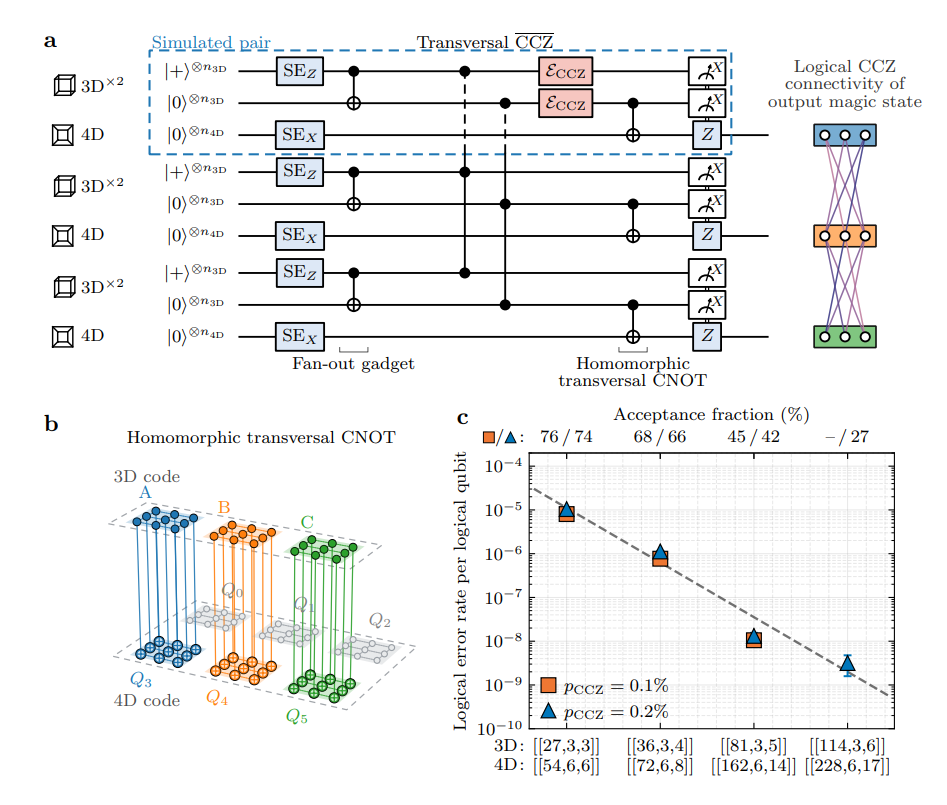
Harvard, MIT and QuEra Cut Magic State Costs Up to 40x With qLDPC Factory

Image source: quantumcomputingreport.com

Summary: Harvard, MIT, QuEra, Caltech and Maryland researchers built a qLDPC magic state factory that cuts space-time cost 10x to 40x versus surface-code cultivation. If you're sizing fault-tolerant quantum workloads, your resource estimates just got a lot more interesting.

Key Points:

  • The new 3D-4D qLDPC factory reaches a single-shot CCZ-converted error rate of 1.2 x 10^-6, matching surface-code cultivation at the same physical error rate of 10^-3.

  • Expected space-time volume is 4.3 x 10^3 for the new factory, compared with 0.4 x 10^3 for surface-code cultivation and 28.6 x 10^4 for color-code cultivation.

  • Postselection on transversal X measurements of tricycle blocks pushes logical error rates down to 10^-9 at a physical error rate of 10^-3, a major reliability gain.

  • The protocol runs a transversal CCZ in a single Rydberg pulse using a distance-2 repetition fan-out gadget, with the full factory executing within 33 array-traversal steps.

  • Quadcycle codes were identified through an AI-assisted algebraic search, showing automated code discovery can produce practical building blocks for fault-tolerant quantum hardware.

Why it matters: If you're modeling fault-tolerant quantum resource budgets, the magic state factory is usually the dominant cost, so a 10x to 40x drop changes your whole estimate. Teams working on neutral-atom platforms like QuEra's should look at the 33-step array-traversal mapping as a concrete compilation target. Anyone currently sizing surface-code cultivation pipelines should re-run their space-time numbers against the 4.3 x 10^3 figure before committing hardware plans.

Quantum Compilers

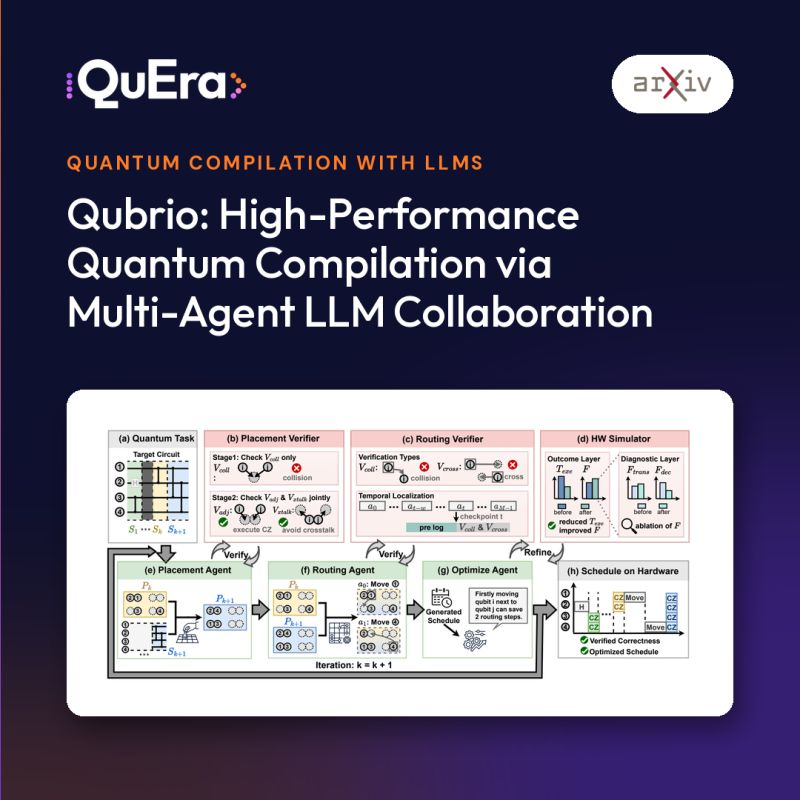
Qubrio Uses Multi-Agent LLMs to Compile Neutral-Atom Quantum Circuits 4.7× Faster

Image source: quantumcomputingreport.com

Summary: Researchers from UCSD, Rice, QuEra and others built Qubrio, an LLM agent framework that compiles neutral-atom quantum circuits. It runs 4.7× faster than PowerMove on average and lifts fidelity 1.3×. Relevant if you care about quantum compilers or constrained LLM design.

Key Points:

  • Qubrio averages a 4.7× runtime reduction and a 1.3× fidelity gain against PowerMove across QFT, QAOA, GHZ and Ising circuits scaling up to 78 qubits.

  • On zoned QFT-63, adapting to a new architecture through declarative constraints alone yields a 2,263× fidelity gain, with no algorithmic rewrites required by the team.

  • Convoy-style shuttling packs up to 30.3 qubits into a single AOD move on the GHZ-78 benchmark, cutting how many transport steps the schedule needs overall.

  • Backbone tests show 4.7× speedup with GPT-5.4, 2.5× with DeepSeek-V3.2 and 2.1× with Qwen-3.5, at API costs between $0.29 and $0.59 per compilation stage.

  • Batches of stages compile in roughly five minutes, and the system was evaluated on QASMBench workloads against both heuristic compilers and simulated annealing baselines.

Why it matters: If your team runs quantum experiments on neutral-atom hardware, Qubrio is a drop-in candidate for the placement and AOD routing steps you currently tune by hand. Engineers building LLM agent systems for hard-constrained domains should study its split between LLM proposals and deterministic verifiers, which keeps outputs physically valid. Teams choosing an LLM backend for compilation pipelines can use its per-stage cost and speedup numbers to weigh GPT-5.4 against cheaper models.

Dark Matter Detection

Scientists Devise New Hunts for Dark Matter Using Lasers, Magnets and Atomic Clocks

Image source: www.quantamagazine.org

Summary: Dark matter's favorite candidate, the WIMP, keeps failing tests. Physicists are now hunting ultralight axions with haloscopes, lasers, and magnetometers, and a Japanese team already flagged 65 suspicious signals.

Key Points:

  • The Axion Dark Matter Experiment at the University of Washington has searched much of the lighter axion range without finding anything yet.

  • Reina Maruyama's team is building a haloscope filled with copper rods to probe higher-mass axions than previous designs could reach.

  • DESY's ALPS II experiment runs a high-powered laser through a magnetic field, a 'light shining through a wall' setup aimed at the dark sector.

  • A Japanese group led by Atsushi Taruya analyzed 10 years of Scottish magnetometer data and found 65 electromagnetic signals matching ultralight dark matter.

  • Verifying any signal needs data from around the globe, since Earth's magnetic field varies by location, and Taruya's team plans to analyze new Japanese data next.

Why it matters: If you work on experimental physics or instrumentation, the shift from WIMPs to axions changes which hardware is worth building, and haloscope designs from the University of Washington and DESY are now the reference points. Teams running magnetometer networks should note that the Taruya analysis shows long-running sensor archives can yield dark matter candidates, so data retention matters. The catch is that 65 candidate signals are not a discovery, and anyone funding these projects should wait for the global cross-checks before reallocating budgets.

Quantum Chemistry And Life Sciences

Quantinuum, BMW, and Pasqal Race Quantum Chemistry Into Real Industrial Prototypes

Image source: www.insidequantumtechnology.com

Summary: Quantum hardware and software firms are now prototyping catalyst, battery, and drug-screening tools with BMW, BASF, GSK, Amgen and AstraZeneca. Almost all run as hybrid quantum-classical workflows on small subproblems. If you own molecular simulation or synthesis planning, start learning the stack now.

Key Points:

  • Quantinuum is partnering with BMW Group to simulate electrochemical processes and optimize fuel cell catalysts, targeting transition-metal systems that classical methods struggle to model accurately at scale.

  • IBM Quantum is working with Moderna, GSK and Amgen to simulate mRNA secondary structures, automate fragment-linking, and predict patient adherence from clinical records across multiple therapeutic programs.

  • IonQ is partnering with AstraZeneca, AWS and NVIDIA to simulate pharmaceutical synthetic chemistry workflows, combining quantum processors with GPU-accelerated classical pipelines in cloud environments.

  • Pasqal is combining neutral-atom quantum hardware with AI and GPU clusters through Qubit Pharmaceuticals to accelerate target-to-hit drug screening across large candidate libraries and shorten early discovery timelines.

  • D-Wave is working with GSK, Menten AI and POLARISqb, using quantum annealing paired with classical solvers to design peptide sequences and search combinatorial small-molecule spaces inside discovery pipelines.

Why it matters: If you run molecular simulation or docking pipelines, these hybrid workflows are the ones to prototype against now, starting with the IBM Quantum and D-Wave stacks. The real decision is where a quantum subroutine can replace a classical bottleneck, not whether to go all-in. Teams at BASF, Covestro, and the pharma partners are setting the early benchmarks, so their results will shape what gets adopted.

New Tools & Job

  • Magi2AI - Magi2AI is an independent web app for short videos that include sound. It runs Sand.ai's MAGI-2 model, but it is not a Sand.ai product. Write a scene, add spoken lines, and download an MP4. Pricing is paid: subscriptions start at $15 a month. There is no free plan.

  • Suzy Says Game - A short first-person horror game hidden inside a cheerful kids' interactive DVD. Obey Suzy, but only when she says "Suzy says". The Suzy Says game is a short first-person horror game by the indie studio MOONBIT. You can play the Suzy Says game here for free. There is no download, no account and no payment on this site. Content note: horror, jump scares, sudden loud sounds and flashing lights. This site is an independent fan page and is not run by MOONBIT.

  • AI Headshots - AI Headshots has crafted professional headshots for over 63,537 clients. A flawless headshot is essential for entrepreneurs, executives, and professionals. Craft your professional image in minutes, with no photo shoot required. Easily upload your photos, choose your desired styles, and receive over 120 refined headshots.

  • Optofriend - Optofriend is a web app for YouTube creators and channel managers. It uses video transcript context to draft titles, descriptions, keywords, hashtags and chapters. Creators can review and edit the generated metadata before publishing. The site also offers transcript and video idea tools, with free and paid plans.

  • VectorMint - VectorMint is an AI SVG generator that transforms text descriptions or uploaded images into editable vector files. Users can preview artwork, adjust colors, compare color and outline views, and export standard SVG files. The tool supports multiple styles including illustrations, icons, logos, and line art, with one free preview available before requiring a paid plan.

  • Staff Software Engineer, Platform Engineering - Crusoe is on a mission to accelerate the abundance of energy and intelligence. As the only vertically integrated AI infrastructure company built from the ground up, we own and operate each layer of the stack — from electrons to tokens — to power the world's most ambitious AI workloads. When you join

  • Senior Staff Software Engineer, Platform Engineering - Crusoe is on a mission to accelerate the abundance of energy and intelligence. As the only vertically integrated AI infrastructure company built from the ground up, we own and operate each layer of the stack — from electrons to tokens — to power the world's most ambitious AI workloads. When you join

  • Staff Software Engineer, Observability - Join us in building the future of finance. Our mission is to democratize finance for all. An estimated $124 trillion of assets will be inherited by younger generations in the next two decades. The largest transfer of wealth in human history. If you’re ready to be at the epicenter of this historic cu

  • Infrastructure Engineer, Workflow Engine - Who we are About Stripe Stripe, LLC. is a financial infrastructure platform for businesses. Millions of companies - from the world’s largest enterprises to the most ambitious startups - use Stripe to accept payments, grow their revenue, and accelerate new business opportunities. Our mission is to in

  • Staff Software Engineer, Trip Platform - Waymo is an autonomous driving technology company with the mission to be the world's most trusted driver. Since its start as the Google Self-Driving Car Project in 2009, Waymo has focused on building the Waymo Driver—The World's Most Experienced Driver™—to improve access to mobility while saving tho

QUICK HITS

Read more news here →

THAT'S A WRAP

Partner with Us

Showcase your product to our engaged community of Tech enthusiasts

Our newsletter reaches a diverse audience of tech professionals, investors, engineers, managers, and business leaders worldwide. Hear when ads open.

More from the Quantum Computing Newsletter

Quantum Computing Newsletter

Get the next issue

One email a week. Free. Unsubscribe anytime.

How we handle your email: Privacy policy

Comments

Subscribe to join the conversation...

Be the first to comment