Skip to content
ContentBuffer
ContentBuffer
November 11, 2026·~6 min read
ContentBuffer

ContentBuffer

Welcome, Tech Leaders.

Amazon just put a security camera on wheels, and it wants to go check on things for you. The Ring Rover Cam is a rolling robot that can be dispatched to a specific room or sent along a patrol route to investigate a disturbance. It's aimed at businesses that want security without the enterprise price tag. If you're the person who gets stuck with the office or facility security stack, this changes the decision. Instead of buying ceiling cameras for every corner, you get one robot that streams and records video the entire time it's moving. When it arrives, it runs a 360-degree scan to figure out what's actually wrong. There's also a siren, a flashing red light, and a blue ring projected onto the ceiling, all designed to deter trouble before it starts. The specs are modest. Battery life is about 30 minutes, coverage is roughly 5,000 square feet on a single floor, and the periscope camera shoots 4K. Preorders are $999.99, with shipping starting December 16. Multi-floor sites need multiple robots or pairing with Amazon's new flying Ring Drone Cam. Worth watching: Amazon's track record here. The Astro for Business launched in 2023 and was discontinued a year later, so this is a second swing at business robotics.

Ring is putting flying cameras inside your house. The new Ring Drone Cam weighs 165 grams, flies upstairs to monitor rooms, and its spotlights kick on in dark spaces so it looks like someone is physically home. For developers, the interesting part is the architecture. The drone's intelligence lives entirely in the cloud, which keeps the hardware light and nimble, and it can avoid people and objects on its own. Users can set custom flight routes and patrol schedules, and the drone responds automatically to alerts from security sensors. That makes it a real integration target for anyone building home automation workflows. The specs are modest. Flight time is five to eight minutes per charge. The drone refuses to fly if its motor health check fails, lands on its own if connectivity drops, and video is encrypted in transit with TAKE, or Throw Away the Key Encryption. The production model will be black, not white. It doesn't work outdoors and doesn't need FAA registration. The business-facing Ring Rover Cam, part of the same Ring Robotics brand, adds a telescoping 4K camera, two-way talk, and coverage up to 5,000 square feet, and it costs significantly less than Amazon's Astro. Let's dive deeper…

In today's ContentBuffer update:

  • Ring Enters Robotics With a $270 Indoor Drone and a $1,000 Patrol Robot

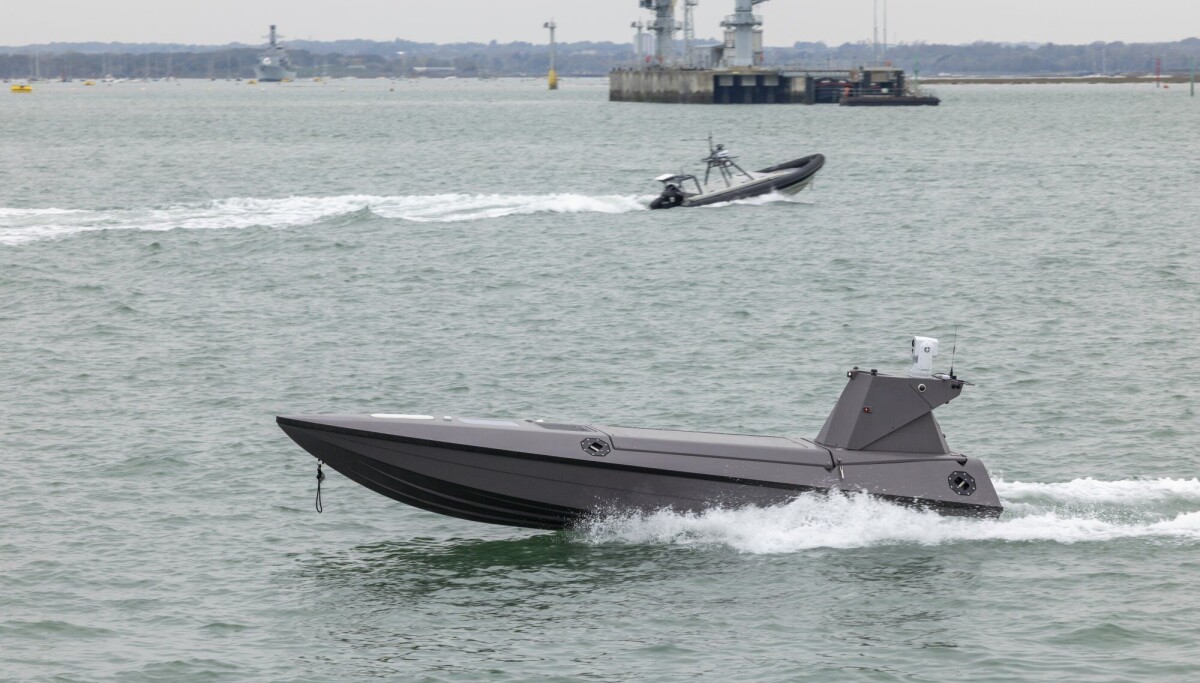
  • Royal Navy Launches Autonomous Boat Squadron Built on 20 Kraken Uncrewed Vessels

  • NVIDIA Holoscan 5 brings real-time robot control to a $ arm you can actually buy

  • Gemini 4 Argon Brings Physical Reasoning to Robot Control and Simulation

  • 5 new AI tools & 5 new AI jobs

  • More tech news

Latest Development

Security Robotics
Amazon Launches $999 Ring Rover Cam, a Wheeled Security Robot With 4K Periscope

Image source: platform.theverge.com

Summary: Amazon's Ring Rover Cam is a $999.99 wheeled security robot with a 4K periscope camera and a 30-minute battery. It patrols single floors of about 5,000 square feet and can be sent to investigate disturbances. Ships December 16, and it's Amazon's second business robot attempt after Astro for Business.

Key Points:

  • The Rover Cam rolls on large wheels that handle small obstacles and uneven terrain, letting it move through spaces where fixed cameras and simpler wheeled bases would struggle to follow.

  • Preorders open at $999.99 with shipping expected to start December 16, positioning the robot as an affordable option for businesses wanting proactive security instead of passive monitoring.

  • The telescoping periscope camera records 4K video and can raise or lower to set heights during scheduled patrols, a bigger role than it played on the earlier Astro hardware.

  • Battery life is estimated at about 30 minutes, and coverage is limited to roughly 5,000 square feet on one floor, so multi-level sites need extra robots or a Ring Drone Cam.

  • Amazon previously launched Astro for Business in 2023 and discontinued it just one year later, making the Ring Rover Cam a second attempt at business robotics under the new Ring Robotics brand.

Why it matters: If you manage security for a small office, warehouse, or retail stockroom, the Rover Cam replaces a handful of fixed cameras with one robot that can be dispatched to a specific room. The 30-minute battery and single-floor limit mean it's not a full replacement for a multi-floor deployment, so budget for extra units or the drone pairing. Before you sign off on the $999.99 preorder, check how the streaming and recording are handled against your compliance and data retention policies.

Consumer Security Robotics
Ring Unveils 165-Gram Indoor Drone Cam and Rover for Businesses

Image source: media.wired.com

Summary: Ring just launched Ring Robotics with a 165-gram indoor Drone Cam that patrols rooms and lands itself if internet drops. A business-grade Rover Cam with a telescoping 4K camera covers 5,000 square feet and undercuts Amazon's Astro on price.

Key Points:

  • The Ring Drone Cam weighs 165 grams and can fly upstairs to monitor a room, with spotlights that activate in dark environments to make the home look occupied.

  • Flight time is five to eight minutes per charge, which is enough for a scheduled patrol but not for long unattended surveillance sessions across a large house.

  • The drone runs a motor health check before every take-off and refuses to fly if it detects a problem, lands on its own if internet connectivity is lost.

  • Video is encrypted in transit using TAKE, or Throw Away the Key Encryption, and the propellers are intentionally loud to make remote snooping harder for bad actors.

  • The Ring Rover Cam covers up to 5,000 square feet with a telescoping 4K camera, two-way talk, and automatic return to its charging dock after each patrol ends.

Why it matters: If you're building smart home integrations on Ring's ecosystem, the Drone Cam adds a new device type that responds to sensor alerts and runs custom patrol schedules through the cloud. Teams deploying security for small businesses should look at the Rover Cam, which targets commercial sites at a price well under Amazon's Astro. Anyone shipping hardware with cloud-side intelligence can study how Ring keeps a 165-gram device light by offloading all of its decision-making to servers.

Home And Enterprise Security Robotics
Ring Launches Robotics Division With $270 Drone and $1,000 Rover

Image source: techcrunch.com

Summary: Ring is launching a robotics division with a $270 indoor security drone and a $1,000 enterprise patrol robot. Both run on Ring's AI Pilot system and integrate with Alexa. The drone ships January 27, the Rover December 16.

Key Points:

  • The home security drone flies room to room, shoots 2K video, and uses LED lights for night and low-light recording, retailing at $270 and shipping January 27.

  • The drone can be scheduled to patrol at specific times and controlled through Amazon's Alexa Home Map, tying it into the broader Ring and Alexa smart home stack.

  • The enterprise Rover streams continuous 4K video, includes a periscope camera and two-way audio, and automatically records when it detects a human presence in the area.

  • Both robots use AI Pilot, Ring's proprietary system that combines specialized vision models, sensors, and cloud processing to navigate autonomously and build schematics of spaces.

  • Ring says the Rover can sweep floors and investigate sensor trips at 2 a.m., with the $1,000 unit shipping December 16 and encrypted under TAKE, Ring's strongest default encryption yet.

Why it matters: If you manage physical security for a small business, the $1,000 Rover is now a direct alternative to hiring overnight patrol, and its scheduled routes and 2 a.m. sensor investigations map onto the same workflows your guard service covers. If you're building on Ring or Alexa Home Map, the drone's scheduling API surface is the thing to test before January 27, because integration is where these devices will live or die. The open privacy question is local storage, since Ring cameras send everything to the cloud by default and nobody has confirmed whether these robots will break that pattern.

Autonomous Maritime Systems
Royal Navy Stands Up First Autonomous Boat Squadron With 20 Kraken Drones

Image source: image.theregister.com

Summary: The Royal Navy stood up its first autonomous boat squadron with 180 personnel and 20 Kraken uncrewed boats. The K3 Scout does 55 knots and 650 nautical miles, and the squadron will pathfind drone ops under the Hybrid Navy plan.

Key Points:

  • The K3 Scout is an 8.4 m uncrewed boat capable of 55 knots, carrying payloads up to 600 kg across ranges of 650 nautical miles.

  • The Rattler is a 7.2 m boat with a 500 kg modular bay and up to 950 nautical miles of range, built for longer missions at sea.

  • The squadron has around 180 personnel split into two watches, giving the Royal Navy round-the-clock operations for its autonomous fleet.

  • Last year, five uncrewed boats were remotely piloted to escort HMS Tyne and mine countermeasures mothership HMS Stirling Castle in a demonstration.

  • The squadron replaces Project Beehive, the navy's experimental program, and gets 20 boats from Kraken Technology Group as its operational core.

Why it matters: If you build telemetry, remote control, or autonomy software, the Royal Navy just became a customer with hard latency and reliability requirements. Kraken's K3 Scout and Rattler will now generate real operational data across two watches, which means the integration work moves from demos to production. Teams building maritime autonomy stacks should expect procurement and interoperability standards to tighten fast.

Robot Control
NVIDIA Holoscan 5 Adds Robot Control Loops With Sub-Millisecond Partitions

Image source: developer-blogs.nvidia.com

Summary: NVIDIA's Holoscan 5 SDK adds robot control alongside sensor processing, with a tutorial on Seeed's $ reBot Arm. If you're doing learning-from-demonstration or human-robot interaction, the gravity-compensation loop is the piece to copy.

Key Points:

  • Holoscan 5 groups operator chains into partitions on a single thread, cutting cross-thread handoffs and unnecessary syscalls that inflate control latency and jitter in tight loops.

  • Clock and data-arrival triggers schedule work, while bounded drop-oldest queues stop stale sensor frames from piling up behind fresh commands during a control cycle.

  • The Seeed Studio reBot Arm B601-DM uses quasi-direct-drive actuators, giving the tutorial a low-cost arm with high torque bandwidth for both control and sensing work.

  • Pinocchio loads the arm's URDF model and runs a Recursive Newton-Euler Algorithm solver, computing inverse dynamics from link masses, dimensions, and moments of inertia.

  • The tutorial requires Python 3.12 or newer on Linux, and Nsight Systems annotations built into the Holoscan SDK let you measure latency and jitter per operator.

Why it matters: If you're running a learning-from-demonstration pipeline on a cheap arm, this tutorial gives you a working gravity-compensation loop built on Pinocchio and motorbridge. The loop doubles as a sanity check: if your simulated URDF doesn't hold the physical arm up, your model is wrong. Start with the Python version on Python 3.12 under Linux, then profile with Nsight Systems before you touch the C++ build.

Embodied Ai And Robot Foundation Models
Google Ships Gemini 4 Argon, Scores 87% on ERQA Robotics Benchmark

Image source: res.infoq.com

Summary: Google released Gemini 4 Argon, a physical-reasoning model scoring 87% on ERQA. It drives robots, tunes simulation twins, and is available now via the paid Gemini API as gemini-4-argon.

Key Points:

  • Gemini 4 Argon scores 87% on the Embodied Reasoning Question Answering (ERQA) benchmark using pure reasoning, without external tools or robot feedback in the evaluation loop.

  • A vision-language-action policy fine-tuned on domain-randomized MuJoCo episodes synthesized from one RGB photo rose from 56% to 75% success on the corresponding real-world setup.

  • Google's Real2Sim examples rebuild MuJoCo scenes from teleoperation video, and the simulation tuning matches contact events as well as visuals, not just pixel-level appearance.

  • The model is available to Google AI Ultra subscribers and through the paid Gemini API, with model ID gemini-4-argon listed in the official Gemini API models documentation.

  • Google's Gemini 4 Argon for Robotics dev blog documents the full Video-to-Sim-to-Real pipeline, but it publishes no per-demo failure rates beyond that single vision-language-action case.

Why it matters: If you're running a sim-to-real pipeline with MuJoCo, the contact-event matching in Argon's twin tuning is the part to read closely. Teams doing behavior cloning can use the labeling prompts to annotate demo footage, but expect to build and maintain your own verifiers and motion-primitive layers. Start with the gemini-4-argon endpoint on a small arm before committing a fleet, because the reported 56% to 75% gain comes from one setup.

New Tools & Job

  • Babydoll Dance AI - Babydoll Dance AI helps creators turn their own portrait, or photos of up to three people, into a coordinated Babydoll dance video. Upload a clear photo for the center dancer and optionally add friends on the sides. The output is a downloadable 15-second, 9:16 MP4. The site shows the example, photo requirements and credit price before generation. It uses one-time credit packs rather than a subscription.

  • TunedGift - TunedGift is a browser-based AI music tool for turning personal stories into songs for birthdays, weddings and anniversaries. Start with a recipient, an occasion and a few details from a shared memory. Review and edit the title and lyric draft, then listen to a one-minute audio excerpt before choosing whether to purchase the song. The workflow focuses on making a gift from your own details and gives you a way to review the lyrics and hear the result before checkout. Submitted by the TunedGift team.

  • ReelAI - Submitted by the ReelAI team with AI-assisted preparation. ReelAI helps creators animate photos into short videos using AI-powered motion templates and effects. It also offers AI image generation. Paid credit-based plans and current pricing are available at https://tryreelai.com/pricing.

  • Repostit Clips - Repostit Clips helps creators turn long YouTube videos, podcasts, interviews, webinars and livestreams into vertical short clips. It can find highlight moments automatically or let users choose them in a manual editor. Each clip receives a score, and users can schedule clips across their connected apps. Repostit is affiliated with this submission.

  • Vidlantern - Vidlantern is a browser-based photo-to-video tool with creative templates, including an AI rap duo workflow. Upload two separate photos or one shared photo, choose a template and available settings, and review the credit price before generating. Video generation is paid. Use photos you have permission to animate.

  • Staff Software Engineer, Ads Data Platform - We're transforming the grocery industry At Instacart, we invite the world to share love through food because we believe everyone should have access to the food they love and more time to enjoy it together. Where others see a simple need for grocery delivery, we see exciting complexity and endless op

  • Sr. Software Engineer, ML Platform - SpaceX was founded under the belief that a future where humanity is out exploring the stars is fundamentally more exciting than one where we are not. Today, SpaceX is actively developing the technologies to make this possible, with the ultimate goal of making life multiplanetary and expanding consci

  • Sr. Model Engineer - SpaceX was founded under the belief that a future where humanity is out exploring the stars is fundamentally more exciting than one where we are not. Today, SpaceX is actively developing the technologies to make this possible, with the ultimate goal of making life multiplanetary and expanding consci

  • Software Engineer, Services Platform - SpaceX was founded under the belief that a future where humanity is out exploring the stars is fundamentally more exciting than one where we are not. Today, SpaceX is actively developing the technologies to make this possible, with the ultimate goal of making life multiplanetary and expanding consci

  • Software Engineer, Storage - SpaceX was founded under the belief that a future where humanity is out exploring the stars is fundamentally more exciting than one where we are not. Today, SpaceX is actively developing the technologies to make this possible, with the ultimate goal of making life multiplanetary and expanding consci

QUICK HITS

  • Delft Researchers Build Algae-Powered Robot Arms That Bend Under Light - Delft researchers built soft robot arms covered in algae that bend when photosynthesis shifts the pH of a hydrogel layer. No batteries or motors needed, just light. It's slow, taking hours to bend significantly, but it's a fresh take on powering soft robotics.

  • MIT's FLEX Lets You Tell Robots 'Don't Spill' in Plain English - MIT's CLEAR Lab built FLEX, a pipeline that lets you tell a robot "don't spill on my laptop" and have it infer the broader safety rules. It runs in about five seconds in simulation. If you build manipulation planners, this is worth a close look.

  • Ornadyne's Bird-Shaped O1 Drone Passed As Wildlife During Air Force Test - Ornadyne's 1-pound O1 flapping-wing drone flew through a September Air Force test and registered as a bird on other companies' sensors. It's quiet, flies over an hour, and carries a camera. Anyone building counter-drone detection should be worried.

  • Servo 0.7.0 Lands 527 Commits, Adds Typed CSS Math and - Servo 0.7.0 landed with 527 commits, adding CSS typed arithmetic, :checked, , and a devtools console that evaluates JS. Embedders get breaking changes to focus and throttling APIs, so check before upgrading. Candy Crush now runs in it, which is a fun stress test.

  • Tartu's Robo-Moth Grows Its Own Sensors Using Artificial Blood and UV Light - Tartu researchers built a 3D-printed moth robot that grows its own sensors from pyrrole-laced artificial blood and UV light. The sensor gets more sensitive with every exposure and survived four months in storage. It's a prototype that can't fly, but self-building hardware just moved from concept to bench.

  • Amazon's MK30 Drones Face Noise Fights as Wing and Zipline Scale Up - Amazon, Wing, and Zipline are all scaling drone delivery, with targets reaching 500 U.S. cities and a million daily drops by 2029. The problem is noise and local pushback, and 15 states just sued the FAA over easier site reviews. Expect zoning fights to set the pace.

Read more news here →

THAT'S A WRAP

Partner with Us

Showcase your product to our engaged community of Tech enthusiasts

Our newsletter reaches a diverse audience of tech professionals, investors, engineers, managers, and business leaders worldwide. Get in touch today.

Comments

Subscribe to join the conversation...

Be the first to comment

Want this in your inbox?

Get the daily edition delivered free every morning.

Join 3,571 builders reading daily.

Also get

Latest Issues

View Archive →
Autark, an open-source tool built by a 14-year-old developer, runs AI agents as a delegated team fed from an inbox. It works with Claude Code, Codex, Gemini CLI, and local models. The catch: no sandbox, no approval prompts, and agents run with your user's full privileges.
Daily Edition#344

Autark, an open-source tool built by a 14-year-old developer, runs AI agents as a delegated team fed from an inbox. It works with Claude Code, Codex, Gemini CLI, and local models. The catch: no sandbox, no approval prompts, and agents run with your user's full privileges.

Chrome, Edge, Firefox and MDN teams built Modern Web Guidance, a set of skills that feed current web platform expertise into coding agents. It covers 250 features and steers agents away from legacy patterns and heavy polyfills. If your agent writes jQuery-era code, this is the fix.

November 11, 2026
Amazon's new Ring Rover Cam is a wheeled security robot with a 4K periscope camera, preorderable for $999.99 and shipping December 16. It patrols single floors of roughly 5,000 square feet and goes where you send it. For businesses, it's a mobile alternative to fixed cameras with blind spots.
Daily Edition#8

Amazon's new Ring Rover Cam is a wheeled security robot with a 4K periscope camera, preorderable for $999.99 and shipping December 16. It patrols single floors of roughly 5,000 square feet and goes where you send it. For businesses, it's a mobile alternative to fixed cameras with blind spots.

Ring just unveiled a 165-gram indoor drone that patrols rooms, lands itself if internet drops, and runs motor checks before every flight. A business-focused Rover Cam covers 5,000 square feet. Worth watching if you build smart home or security integrations.

November 11, 2026
Virginia now requires data centers to pay fully for new transmission lines, and developers expect cutoffs during peak demand. Many AI builders are heading to rural sites with gas turbines instead. For anyone planning capacity, power access is now the real bottleneck.
Daily Edition#343

Virginia now requires data centers to pay fully for new transmission lines, and developers expect cutoffs during peak demand. Many AI builders are heading to rural sites with gas turbines instead. For anyone planning capacity, power access is now the real bottleneck.

Apple now sells one-time Intelligence Usage Packs for $49.99, starting with Logic Pro. The packs expire after 12 months and can't be shared with Family Sharing. Other Creator Studio apps get Apple's AI chatbot this month, so expect more paywalls.

November 10, 2026