Skip to content
Robotics Newsletter

Humanoid robots are coming to chip fabs next year

ContentBuffer
ContentBuffer
November 18, 2026·~6 min read
ContentBuffer

ContentBuffer

Welcome, Tech Leaders.

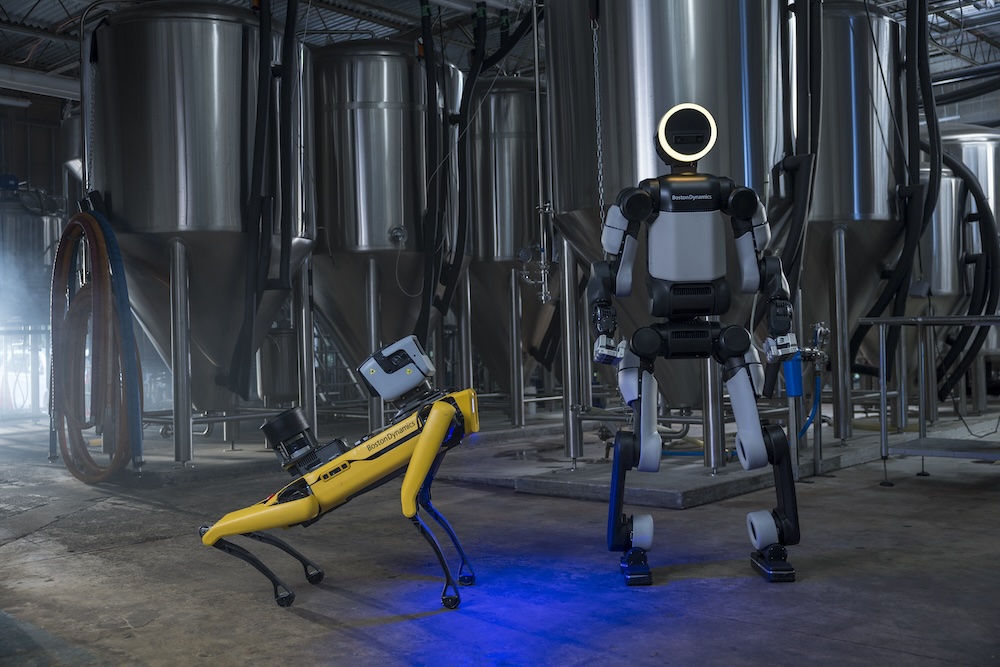
Boston Dynamics and GlobalFoundries are teaming up to test the Atlas humanoid in semiconductor manufacturing, with testing starting in early 2027. Atlas is no longer only a Hyundai story. GlobalFoundries is the first publicly named manufacturing customer outside Hyundai Motor Group, and the two companies will map out where humanoids fit in fab work, assess integration requirements, and start training Atlas on specific tasks. If you build or operate industrial automation, this is the signal to watch. Fabs are some of the most contamination-sensitive, tightly controlled environments on earth, so a humanoid that can work there without breaking process discipline would be a real milestone. GlobalFoundries already runs Spot quadrupeds for inspections, and its Singapore team has logged nearly 900 km and more than 90,000 sub-fab inspections since April 2026 with a 99% mission success rate. The companies have not said how many Atlas units will be involved, which facilities will host them, or what first tasks they will handle. Boston Dynamics also plans to take on additional customers in early 2027 and has a broader plan to build a U.S. factory capable of 30,000 robots per year.

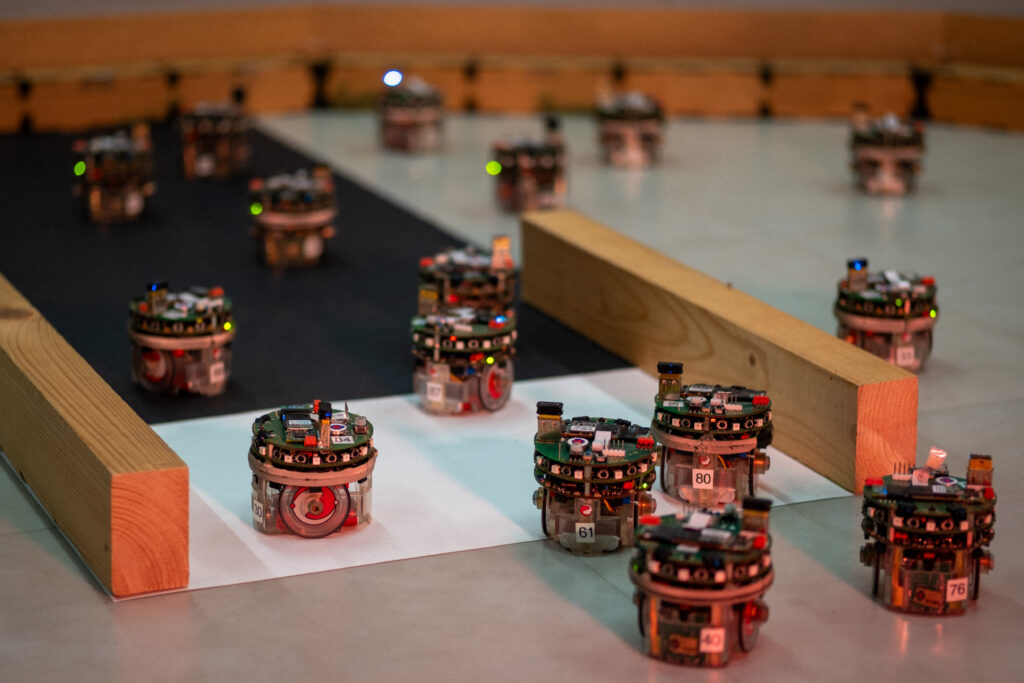
Robots trained in simulation usually fall apart in the real world. IRIDIA just found a way around that for robot swarms, and the trick is counterintuitive: give the learner less freedom. Instead of letting the algorithm set each wheel's speed, it picks from a handful of tested behaviors. Why should you care? If you build anything with multi-agent systems, simulation is your cheap testbed, and the reality gap is where that cheapness dies. This approach keeps policies from exploiting simulator quirks that don't exist on actual hardware. The catch is that you trade flexibility for reliability, so don't expect clever emergent tricks. The numbers: 20 e-puck robots, five collective missions, and 250 physical experiments. Swarms trained this way transferred reliably and substantially outperformed a state-of-the-art method that controls motors directly. Simpler, more constrained policies transferred better than larger ones, which is the counterintuitive part. The real story is the bridge between reinforcement learning efficiency and modular swarm robotics. Both will be needed before autonomous groups handle search and rescue or environmental monitoring. Bottom line: the sim-to-real problem just got a lot more tractable. Let's dive deeper…

In today's ContentBuffer update:

  • The US Is Set to Block a Binding Treaty on Autonomous Weapons

  • Mercedes-Benz Takes Aim at Tesla With Level 2 Driver Assist Features in 2027

  • Agile Robots Raises $500M Series F at $8.5B Valuation

  • Remedy's N1 Robot Tests Remote Thrombectomy Surgery for Stroke Patients

  • 5 new AI tools & 5 new AI jobs

  • More tech news

Latest Development

Humanoid Robotics

GlobalFoundries Will Test Boston Dynamics' Atlas Humanoid in Chip Fabs From 2027

Image source: www.therobotreport.com

Summary: Boston Dynamics and GlobalFoundries will test the Atlas humanoid in semiconductor manufacturing starting early 2027. It's the first public manufacturing customer outside Hyundai, and a clear signal that humanoids are heading into fabs.

Key Points:

  • GlobalFoundries' Singapore site has run two Spot robots for sub-fab inspections since April 2026, covering nearly 900 km and completing more than 90,000 inspections.

  • Those Spot robots reached a 99% mission success rate, a reliability figure that matters when evaluating whether humanoids can handle similar fab environments later.

  • Atlas is initially being trained for parts sequencing and material handling, the same kind of repetitive logistics work that dominates automotive and semiconductor floor operations.

  • Hyundai plans to deploy 25,000 Atlas humanoids across Hyundai Motor and Kia plants over the next several years, making it the largest announced humanoid rollout so far.

  • Boston Dynamics plans a U.S. factory capable of producing 30,000 robots annually, and it unveiled a four-fingered Atlas hand with 13 degrees of freedom in October.

Why it matters: If you run automation or industrial robotics in semiconductor or electronics plants, GlobalFoundries is the first outside test case that will show whether Atlas can handle contamination-sensitive, tightly controlled sub-fab work. Teams already using Spot for inspection should watch how the 99% reliability bar translates when a humanoid is asked to move materials. Robotics integrators and fab operations leads should expect early 2027 to bring real requirements for safety, cleanroom compatibility, and handoff to existing workflows.

Swarm Robotics

IRIDIA Trains 20 Robot Swarm Via Constrained Reinforcement Learning, 250 Real Experiments

Image source: robohub.org

Summary: IRIDIA researchers cracked the reality gap for robot swarms by constraining reinforcement learning to proven behaviors instead of raw motor commands. A 20-robot e-puck swarm transferred reliably across five missions and 250 real-world experiments, beating a state-of-the-art method. Relevant if you're betting on simulation-first robotics.

Key Points:

  • The swarm used 20 e-puck robots, a small, widely used research platform, to test the method across five distinct collective missions on physical hardware.

  • The team ran 250 experiments on physical robots in total, giving the reliability claim real statistical weight beyond a single demo or lucky run.

  • Instead of setting each wheel's speed directly, the learner chooses among a handful of tried-and-tested behaviors, cutting off simulator exploits before they form.

  • Swarms trained this way substantially outperformed a state-of-the-art method where the algorithm controls motors directly, according to the published comparison results.

  • The study appeared in Science Robotics in 2026 and was partially funded by Belgium's FNRS through the PDR project Reinforcement Learning for Robot Swarms.

Why it matters: If you're prototyping multi-robot behavior in simulators like Gazebo or Webots, this is a warning that unconstrained policies will likely break on hardware. The IRIDIA approach suggests your action space matters more than your model size, so consider picking from validated primitives before letting the learner loose. Teams building search-and-rescue or environmental monitoring fleets should evaluate constrained policy designs now, before sim-to-real failures eat their hardware budget.

Ai Policy And Regulation

UN Weapons Talks Open as US Resists Binding Autonomous Weapons Treaty

Image source: assets.newsweek.com

Summary: The US is expected to block talks on a binding treaty for autonomous weapons at the CCW review, November 16 to 20. 130 countries want one, but the US says existing humanitarian law is enough. If you build targeting AI, the rules you ship against may stay vague for years.

Key Points:

  • The CCW Seventh Review Conference runs November 16 to 20, and delegates will decide whether to launch negotiations on new rules for weapons that select and engage targets without human intervention.

  • 130 countries support a legally binding instrument on autonomous weapons, and more than 70 have said they are ready to move forward with negotiations right now.

  • The US has proposed five more years of work by the CCW expert group to develop a nonbinding instrument, arguing that such rules can be adopted and updated faster than treaties.

  • The US argues it has not been established that autonomous weapons are inherently indiscriminate or excessively injurious, a position that directly contradicts the UN's warnings about misidentified targets.

  • The UN has warned that autonomous weapons could misidentify targets, discriminate against vulnerable populations, and create accountability gaps when attacks go wrong, citing growing civilian risk.

Why it matters: If you're building targeting, computer vision, or autonomy stacks for defense, this decides what compliance looks like for your team. A nonbinding instrument means guidance that can shift with each review cycle, so your legal and safety reviews will be chasing a moving target. Teams already shipping AI-assisted targeting need to document human oversight now, before any binding rule defines it for them.

Autonomous-driving

Mercedes-Benz Puts Hands-Free Highway Driving at 85 mph by 2027

Image source: platform.theverge.com

Summary: Mercedes-Benz is launching two Level 2 driver-assist features in 2027, with California early access next month. MB.Drive Assist Pro handles city driving and highway assist hits 85 mph, both putting it squarely against Tesla. Expect the subscription model to be the real fight.

Key Points:

  • MB.Drive Assist Pro runs on 27 sensors paired with a computer rated at 254 TOPS, all managed by the new MB.OS architecture.

  • Hands-Free Highway Assist supports speeds up to 85 mph and includes Proactive Lane Change Assist that starts lane changes automatically.

  • Features roll out in CLA Electric, GLC Electric, GLE, GLS, and S-Class models, with nationwide availability planned for 2027.

  • Highway assist arrives in spring 2027, while the broader feature set follows the California early access program starting next month.

  • Owners unlock the software over the air through Mercedes' online store with one-month, one-year, or three-year subscription plans.

Why it matters: If you build for connected vehicles or ship in-car software, Mercedes is setting the template: over-the-air unlocks, tiered subscriptions, and a deterministic safety layer wrapped around an AI model. Fleet and platform teams should watch how the Halos guardrail gets validated, because that split between probabilistic AI and rules-based control is where most automotive software bugs will live. The subscription pricing is also a signal for anyone designing feature-gating in their own products.

Industrial Robotics

Agile Robots Raises $500M at $8.5B Valuation Led by SoftBank

Image source: www.therobotreport.com

Summary: Agile Robots raised $500M in a Series F led by SoftBank, reaching an $8.5B valuation. The money targets production capacity and US expansion, which means more supply for factory and warehouse automation buyers.

Key Points:

  • Agile Robots has deployed 20,000 industrial robots for customers across automotive, consumer electronics, healthcare, and service industries worldwide.

  • The Series F round was led by SoftBank Group and included NVIDIA, Hitachi Group, and T.Capital, bringing total funding raised to roughly $2 billion so far.

  • The company's portfolio spans humanoid robots, mobile robots, robotic arms, and robotic hands, plus the software and AI models that control them in production.

  • Agile Robots owns subsidiaries including Franka Robotics and Krause Automation, and manufactures in-house, with production facilities in Germany supporting its European base.

  • The Robot Report lists Agile Robots among more than 200 companies tracked in its humanoid robot database, alongside 2026 rounds like NEURA Robotics' record raise.

Why it matters: If your team is planning a warehouse or factory automation project, Agile Robots is now a vendor with real capital and a 20,000-unit deployment track record, so it belongs on the shortlist. The funding targets production capacity and US market presence, which should ease the lead-time and support problems that usually slow robotic arm rollouts. Teams building on its software and AI stack should also plan for a platform that will keep expanding rather than a small startup that might pivot.

Medical-robotics

Remedy Robotics Tests Telesurgery for Stroke Clot Removal Through Its N1 System

Image source: spectrum.ieee.org

Summary: Remedy Robotics is testing whether surgeons can run stroke clot removal from afar with its N1 System. The robot steers a catheter through blood vessels using computer vision, and only about 1 in 10 eligible patients get the procedure today. Remote access could fix that gap, but it's early days.

Key Points:

  • The N1 System's robotic arm advances a steerable catheter while tiny wires pull its tip in any direction, so no guide wire is needed to pave the path.

  • A computer-vision algorithm tracks the catheter's rotation inside the body, letting a surgeon toggle right on the X-ray image and watch the device move correctly.

  • The N1 feeds the catheter along a rail lined with seven modules, giving operators precise control while avoiding scraping or piercing artery walls during tight bends.

  • Ischemia causes the most strokes, and at least 5 million people worldwide suffer ischemic strokes each year, making thrombectomy access a large, measurable problem.

  • Only about 1 in 10 patients eligible for thrombectomy receive one, and remote operation could open access in hospitals that lack on-site neurointerventional specialists.

Why it matters: If you're building medical robotics or low-latency control systems, the N1 is a live case study in what remote actuation demands. Its catheter control loop, which pairs computer vision with X-ray feedback, has to hold up across whatever network links hospitals can actually provide. Hospital IT and neurointerventional teams will be the ones deciding whether telesurgery is feasible, so the real bottleneck is connectivity and workflow, not the robot.

New Tools & Job

  • AnswerDojo - AnswerDojo builds a mock interview around the job you're applying for. Choose one of 2,247 real postings from 28 companies, including Amazon, Google, and Netflix, or paste your own JD to see what the role tests. Then answer out loud as an AI interviewer asks questions, listens, follows up, and scores the session. Two voice mocks are free. No credit card required.

  • FullCastBook - FullCastBook turns a manuscript into an AI audiobook with a full cast. Upload an EPUB, PDF, DOCX, TXT or Markdown file, and it finds the chapters, works out who is speaking in each line and gives every character a distinct voice alongside an AI narrator. Regenerate a single line without redoing the chapter, then export the finished audiobook as one M4B with chapter markers, MP3 files or a ZIP. Freemium, paid plans from $9.90 a month.

  • Roomvana - Roomvana is an AI design tool for your home's exterior. Upload one photo of your house and try new siding or exterior paint colors, a new front door or garage door, new shutters or a new roof — or redesign the front yard, backyard or patio. The result keeps your layout, walls and windows, so what you see is still your house, just with the updates. It works indoors, too. Free to try on the web and as a mobile app.

  • British Accent Generator - British Accent Generator is an AI British/UK accent TTS workspace with 315 regionally labelled voices — RP and standard British, young British, Scottish, Welsh, and Northern Irish. Browse and preview speakers, paste a script, and download natural UK English audio for videos, lessons, podcasts, demos, and training. Also includes Voice Clone, Voice Design, Voice Effects, and AI Lip Sync. Free daily credits; paid credit packs and subscriptions unlock longer scripts and premium features.

  • Nano Banana (nanobananana.com) - Nano Banana at nanobananana.com is an independent AI image generation and editing tool for designers, content creators and marketers. Create images from text prompts, edit reference images with natural-language instructions and blend multiple images. A Chinese-language interface is available. It is separate from nanobanana.im and is not an official Google website.

  • Manager, Software Engineering (Code Standards) - At Affirm, we exist for the moments that matter—giving people a clear, predictable way to pay over time, with no hidden fees, no surprises, and no tradeoffs on what matters most. About the Engineering team The Engineering team builds systems that power Affirm’s mission. We take pride in our craft, b

  • Senior Software Engineer - Atlas Growth is a cloud engineering group whose mission is to guide customers through their app development journey—from cluster configuration, data modeling and load testing, to running a production workload at scale. We use an in-house experiments platform which helps us validate our features quic

  • AI Deployment Manager - Builder (Spanish- and Portuguese-Speaking) - About the Team The AI Deployment Manager (ADM) team enables organizations to turn OpenAI products into real, sustained impact through world-class enablement and training execution. Our mission is to help customers successfully adopt and operationalize AI across their organizations. We partner with e

  • Engineering Manager, External Search & AI Optimization - Airbnb was born in 2007 when two hosts welcomed three guests to their San Francisco home, and has since grown to over 5 million hosts who have welcomed over 2 billion guest arrivals in almost every country across the globe. Every day, hosts offer unique stays and experiences that make it possible fo

  • Staff+ Software Engineer, Deployment - About Anthropic Anthropic’s mission is to create reliable, interpretable, and steerable AI systems. We want AI to be safe and beneficial for our users and for society as a whole. Our team is a quickly growing group of committed researchers, engineers, policy experts, and business leaders working tog

QUICK HITS

  • Zoox Robotaxis Now Bookable Through Uber App in Las Vegas - Uber now matches Las Vegas riders with Amazon's Zoox robotaxis, the steering-wheel-free kind, at no extra charge. It's the first purpose-built AV on Uber's network and the first time Zoox opens its fleet to a third-party app. Expect the same playbook in LA in 2027.

  • Skydio's F10 Drone Ditches Circles With a Lopsided Wing Camera - Skydio's F10 is a fixed-wing camera drone with a wingtip-mounted camera that flies lopsided to avoid blocking its own shot. It hits 100 mph, flies 2 hours, and lands itself on the MegaDock, which catches it with a robot arm and handles up to five drones.

  • Food Robotics 2.0 Hits Scale: Chef Robotics Passes 145 Million Servings - Food robotics is pivoting from robot-made meals for consumers to robots sold to food businesses. Chef Robotics has logged 145M+ production servings, Botrista is in 6,000+ locations, and ATOMS and Wonder have raised $1.7B and $3B. If you run ops in food or retail, these are the workflows getting automated first.

  • NASA Plans Nuclear-Powered PROMISE Rover for Moon's South Pole Using Mars Hardware - NASA is sending a nuclear-powered rover called PROMISE to the Moon's South Pole, built mostly from Curiosity and Perseverance parts. Its NOM4D program also pulled off the first automated in-space truss assembly. Reuse of flight-proven hardware is the play, so expect more of it.

  • AGIBOT's Six Robots Run Live Store Trial, Four Pass Performance Test - AGIBOT ran six robots through a 24-hour livestreamed store trial, and four passed the performance assessment. The shared Genie Master framework coordinates tasks and learns from failures, which is a pattern worth stealing for any multi-agent setup.

  • Rhoda AI Raises $450M to Train Robots on Internet-Scale Video - Rhoda AI raised $450M in Series A to build robot models pretrained on internet-scale video. Its DVA model predicts the next few hundred milliseconds of motion and converts it into actions, with fine-tuning reportedly taking just 10 to 20 hours. If you care about generalist robotics, this is a data-strategy bet to track.

Read more news here →

THAT'S A WRAP

Partner with Us

Showcase your product to our engaged community of Tech enthusiasts

Our newsletter reaches a diverse audience of tech professionals, investors, engineers, managers, and business leaders worldwide. Get in touch today.

More from the Robotics Newsletter

Robotics Newsletter

Get the next issue

One email a week. Free. Unsubscribe anytime.

How we handle your email: Privacy policy

Comments

Subscribe to join the conversation...

Be the first to comment