Skip to content
Tech Newsletter

Patch your Cisco Expressway boxes today, not Monday

In this issue

From the ContentBuffer tech newsletter

ContentBuffer
ContentBuffer
November 24, 2026·~6 min read
ContentBuffer

ContentBuffer

Welcome, Tech Leaders.

Attackers are already exploiting a critical Cisco Expressway bug, and you should assume your gateway is next. CVE-2026-76466 lets anyone send a request and get root on the box, no login required. Cisco shipped a fix in October, but the advisory had no evidence of exploitation until CISA added the flaw to its Known Exploited Vulnerabilities catalog this week. If you run Expressway for firewall traversal, VPN-less remote access, or call routing for remote users, this is your problem. The bug hits both Expressway-C and Expressway-E in clustered setups, and it affects virtual and physical appliances alike. One compromised internet-facing node becomes a pivot into the rest of your cluster and the internal network behind it. Russian firm F6 documented the first observed campaign. Attackers popped two internet-facing Expressway devices, then reached two more cluster nodes inside the organization. They wrote Python to scan for SMB shares, and the scripts looked AI-assisted. Cisco's advisory caps the bug at 9.8 CVSS, and CISA's deadline for federal agencies is Monday. Watch the erlang.log on your Expressway nodes. A nodeup entry for "wombat@127.0.0.1" is a key indicator of compromise. If you find it, treat the device as breached and rebuild rather than trusting a patch alone.

Oracle's November 2026 Critical Patch Update is out, and the headline is Java4Shell, tracked as CVE-2026-114938. It's a remote code execution bug, so an attacker who can reach your service could run code on the host. Get the patch in before public exploit code shows up. If Java sits anywhere near the network, this one goes to the top of the queue. Affected builds include Oracle Java SE 27.0.1.0.3, 25.0.5.0.3, 21.0.13.0.3, 17.0.21.0.3, and 8u511b33-perf, plus GraalVM for JDK 21 and 17 and GraalVM Enterprise 21.3.20.0.3. Downstream builds like BellSoft Liberica got their own CSPU patches the same day, so check the exact distribution you ship. The rest of the drop is smaller but worth bundling in. Spring resolved 90 CVEs across its projects, and Azul Payara 7.6.0 fixed five more. On the roadmap, JEP 547 (Lazy Constants) moved to Targeted for JDK 28 and JEP 548 (Vector API) reached Candidate. JDK 28 Build 25 is available for early access testing. Watch for public proof-of-concept code over the next few days. Once that exists, unpatched internal services stop being theoretical. Let's dive deeper…

In today's ContentBuffer update:

  • Attackers Raided Azure API Management Classic Instances; Microsoft Patched, Customers Must Rotate Secrets

  • China-linked ARMORY CASTLE exploited a critical VMware vCenter bug in September

  • AWS ships a CC0 local emulator built by autonomous AI agents

  • US Approves 879,000 AI Chips for China as Nvidia Requested 3.4 Million

  • 5 new AI tools & 5 new AI jobs

  • More tech news

Latest Development

Vulnerabilities

Cisco Expressway Flaw CVE-2026-76466 Gives Unauthenticated Root Code Execution

Image source: image.theregister.com

Summary: Cisco Expressway has a 9.8 CVSS bug, CVE-2026-76466, that gives unauthenticated root to anyone who finds it. Attackers are already using it in the wild, and CISA wants federal patches by Monday. Patch your clusters and check erlang.log for a "wombat@127.0.0.1" nodeup entry.

Key Points:

  • CVE-2026-76466 carries a CVSS score of 9.8 and enables remote code execution as root without any authentication, which is about as bad as it gets for an internet-facing gateway.

  • Cisco issued a software update in October, but its advisory reported no known abuse until CISA added the flaw to its Known Exploited Vulnerabilities catalog this past week.

  • Russian security firm F6 documented attackers compromising two internet-facing Expressway devices, then moving laterally to two more cluster nodes on the victim organization's internal network.

  • The attackers used custom Python scripts to scan internal networks for files and folders shared over SMB, and the scripts suggested the operator relied on an AI assistant.

  • A nodeup entry reading "wombat@127.0.0.1" in the Erlang system log, erlang.log, is a key indicator of compromise on affected Cisco Expressway devices and should trigger an investigation.

Why it matters: If you run Cisco Expressway-C or Expressway-E for firewall traversal or VPN-less access to Webex-style voice and video, this bug lets an outsider become root with no credentials. Platform and network teams should patch clusters first, since one exposed node is enough to pivot inward through SMB shares. Security ops should grep erlang.log for the wombat nodeup entry on every node before assuming a patch closes the door.

Vulnerability-management

Oracle's November 2026 Patch Fixes Java4Shell RCE Across JDK 8 Through 27

Image source: res.infoq.com

Summary: Oracle's November 2026 patch fixes Java4Shell (CVE-2026-114938), a remote code execution flaw across JDK 27 down to 8. Spring also closed 90 CVEs, so production Java teams should schedule the upgrade now.

Key Points:

  • Java4Shell (CVE-2026-114938) is a remote code execution flaw in Oracle Java SE builds 27.0.1.0.3, 25.0.5.0.3, 21.0.13.0.3, 17.0.21.0.3, and 8u511b33-perf, all fixed in this release.

  • GraalVM for JDK 21.0.13.0.3 and 17.0.21.0.3, plus GraalVM Enterprise 21.3.20.0.3, carry the same flaw, so native-image and polyglot deployments need the matching update.

  • The Spring team resolved 90 CVEs across its projects, a batch big enough that dependency bumps belong in the same change window as the JDK patch.

  • BellSoft Liberica shipped CSPU patches for 27.0.1.1, 25.0.5.1, 21.0.13.1, 17.0.21.1, 11.0.33.1, 8u514, 7u523, and 6u523, so downstream distros use their own version strings to verify.

  • JEP 547 (Lazy Constants) moved to Targeted for JDK 28 and JEP 548 (Vector API) advanced to Candidate, showing which language and performance features are close to landing.

Why it matters: If your services run on Oracle JDK, GraalVM, or Liberica, Java4Shell is a same-week patch, not a backlog item. Platform and SRE teams should inventory which JDK build each service actually runs, since version strings differ across vendors. Teams on Spring should fold the 90-CVE batch into the same change window to avoid a second regression cycle.

Cloud-security

Microsoft Patches Azure API Management Flaw Exposing Secrets at Energy Firms

Image source: image.theregister.com

Summary: Attackers pulled secrets and ran admin operations on Azure API Management Classic instances, hitting two major Norwegian energy firms. Microsoft patched it on November 19, but Norway's NSM says to assume exposure and rotate all keys and tokens. If you run APIM Classic, go check your dev and test instances first.

Key Points:

  • Microsoft identified the vulnerability on November 18 and automatically applied a mitigation closing the access path the following day, November 19.

  • Exposed material includes named values, client secrets, subscription keys, and tokens used to call direct management APIs on affected Classic instances.

  • Only Azure API Management Classic tiers were affected; customers running Azure API Management v2 were not impacted, according to Microsoft's advisory.

  • Norway's National Security Authority urged organizations to map what each APIM instance can access, then rotate every token and secret that instance holds.

  • Norway's energy sector first detected the flaw last week, and NSM says the exposure reaches several sectors in Norway and beyond its borders.

Why it matters: If your team runs Azure API Management Classic, this hits your secrets pipeline directly: anything stored inline in APIM rather than referenced from Key Vault should be treated as compromised and rotated now. Platform and SRE teams need to check each instance's runtime version against Microsoft's published patch thresholds, since the automatic mitigation doesn't prove you weren't breached already. Forgotten dev and test APIM instances are the real gap, because they often reuse production credentials and nobody is monitoring them.

Threat-intelligence

Google's Mandiant Catches China-Linked ARMORY CASTLE Exploiting Critical VMware vCenter Bug

Image source: image.theregister.com

Summary: Google's Mandiant says China-linked ARMORY CASTLE exploited a critical VMware vCenter bug (CVE-2026-123890) in September, using BONESAW to forge tokens and bypass MFA. Broadcom is also ending free zero-day patches for old perpetual vSphere licenses, so check your support status now.

Key Points:

  • ARMORY CASTLE's BONESAW tool forged authentication tokens and bypassed MFA, letting the attackers impersonate any user on the compromised vCenter environment.

  • Google found BONESAW already running in July on a server patched against CVE-2026-59309, suggesting the campaign predates the September activity Mandiant reported.

  • The actor built five custom tools: webshells SLIMSAVAGE and CAGEMATCH, backdoor BEARBONES, SAML utility SAWSNAKE, and BONESAW for vCenter access.

  • Attackers added an SSH public key to the root account's authorized_keys, a persistence technique that survives password resets and is easy to miss during routine audits.

  • VMware's vDefend virtual patching and the new HyperArmor tool target VCF private cloud traffic, while zero-day patches for vSphere 8 remain free through October 11, 2027.

Why it matters: If you run VMware vCenter for a private cloud, this is your sign to audit root's authorized_keys and check your SAML and token configurations right now. Platform teams relying on MFA to protect vCenter should assume tokens can be forged, so review session lifetimes and privileged access paths. Teams still on perpetual vSphere 8 without a support contract will keep getting free zero-day patches only through October 11, 2027, so budget for renewal before then.

Aws Local Development And Testing

AWS Releases Free Open-Source Local Emulator Built Entirely by AI Agents

Image source: res.infoq.com

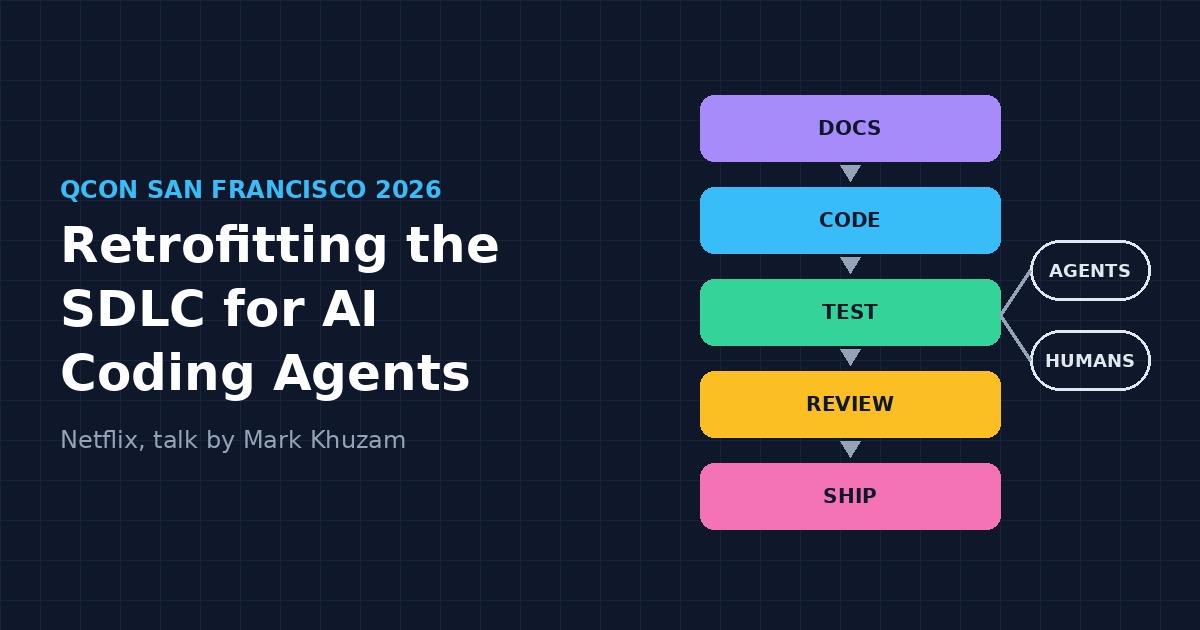
Summary: AWS released a free, CC0 local emulator built by AI agents from its 438 public API models. DynamoDB, S3, and SQS pass roughly 60 to 70 percent of fidelity tests, CloudFormation about 20 percent. Good for fast CI runs, not a replacement for a real sandbox.

Key Points:

  • The emulator ships as a single Rust binary generated from AWS's 438 public API models and listens on port 9297 by default.

  • Point an existing AWS SDK, CLI, or coding agent at the emulator by setting environment variables, with no code rewrites required for most workflows.

  • First independent fidelity numbers show DynamoDB, S3, and SQS passing roughly 60 to 70 percent of verified tests, while CloudFormation sits near 20 percent.

  • The production version is built by three agent teams, and every fix must pass a gate covering compiling, coding standards, security, and fidelity regression.

  • Teams used the emulator to rebuild a replication engine that took a human team four months to build by hand, and ran version 1.0.322 in GitHub Actions.

Why it matters: If your CI pipeline hits real AWS for every DynamoDB or S3 test, this emulator can cut that cost and latency for the fast feedback loop. The 60-70 percent fidelity on DynamoDB, S3, and SQS is good enough for smoke tests, but CloudFormation at around 20 percent means your infra-as-code tests still need a real account. Keep IAM policy checks and throttling scenarios on a real sandbox, since the emulator skips both entirely.

Ai Chips And Export Controls

BIS Approved 879,000 AI Chips for China Despite Nvidia's 3.4 Million Request

Image source: image.theregister.com

Summary: The BIS approved 879,000 AI chip sales to China, far below Nvidia's 3.4 million request. The approvals include buyers on the Pentagon's Chinese military company list, and a new remote-access ban is tightening the rules further.

Key Points:

  • The BIS authorized 879,000 advanced AI chips for China, roughly a quarter of the 3.4 million Nvidia originally requested for export licenses.

  • The regulator rejected the largest deals, including 610,000 chips for Alibaba and 508,000 chips for ByteDance, the owner of TikTok.

  • Alibaba and Tencent both appear on the Department of War's List of Chinese Military Companies, which makes the approvals a direct contradiction of stated national security policy.

  • Advanced GPUs are essential for designing nuclear weapons, stealth submarines, and advanced aircraft, which is the core reason the US bans their export to China.

  • Chinese chipmakers are expected to produce advanced AI hardware at scale in 2027 or 2028, after which Nvidia and AMD may lose access to Chinese backdoor sales channels.

Why it matters: If your team runs training or inference on Alibaba Cloud or Tencent Cloud, the new policy will shrink the compute those providers can offer, so price and capacity assumptions should be revisited now. The remote-access ban also means renting GPU time from overseas providers to reach restricted hardware is no longer a viable workaround for Chinese companies. For infra and platform leads planning multi-region AI deployments, the realistic window for cheap Nvidia capacity in China appears to be closing before domestic alternatives mature.

New Tools & Job

  • Optofriend - Optofriend is a web app for YouTube creators and channel managers. It uses video transcript context to draft titles, descriptions, keywords, hashtags and chapters. Creators can review and edit the generated metadata before publishing. The site also offers transcript and video idea tools, with free and paid plans.

  • VectorMint - VectorMint is an AI SVG generator that transforms text descriptions or uploaded images into editable vector files. Users can preview artwork, adjust colors, compare color and outline views, and export standard SVG files. The tool supports multiple styles including illustrations, icons, logos, and line art, with one free preview available before requiring a paid plan.

  • PavoAI - Pavo AI lets you create videos up to 15 seconds using Seedance 2.0 or Wan 2.7, and images using Nano Banana 2 or Seedream 4. Choose your model, set quality and aspect ratio, enter a text prompt, and generate using paid credits. Results can be downloaded and used in editing workflows.

  • Online AI Video Generator - Flovie is a browser-based AI video generator. Type a prompt or upload an image, pick a model, and get a short clip in a few minutes. There is no software to install. New visitors can make a first video for free without an account, and signing in with Google adds more free credits. Every video shows its credit cost before you confirm, and failed jobs return their credits. After the free credits, you can buy a one-time credit pack or a monthly plan from $9.90/month. Models include MiniMax H3 for everyday clips, plus Veo 3.1 and Seedance 2.0 for members. People use Flovie for social clips, product shots, ad concepts and storyboards.

  • NarraScout - NarraScout helps UGC creators review short scripts before filming. It links notes to source lines and checks the creative brief, word budget and CTA, with focused rewrites and version history. Verified sign-up includes one free standard report, no card required. A separate free Script Timer needs no account or upload. Paid plans are not open. Feedback does not predict CTR, retention or ROAS.

  • Senior Software Engineer - Platform Billing Core - Elastic, the Search AI Company, enables everyone to find the answers they need in real time, using all their data, at scale — unleashing the potential of businesses and people. The Elastic Search AI Platform, used by more than 50% of the Fortune 500, brings together the precision of search and the i

  • Software Engineer 3 - MongoDB’s mission is to empower innovators to create, transform and disrupt industries by unleashing the power of software and data. Cloud Payments sits at the heart of that mission: we make sure usage of MongoDB Atlas and our growing suite of products turns into accurate, reliable revenue — every s

  • Principal Software Engineer - Search Infra - Elasticsearch - Elastic, the Search AI Company, enables everyone to find the answers they need in real time, using all their data, at scale — unleashing the potential of businesses and people. The Elastic Search AI Platform, used by more than 50% of the Fortune 500, brings together the precision of search and the i

  • Senior Software Engineer - Vector Search - Elasticsearch - Elastic, the Search AI Company, enables everyone to find the answers they need in real time, using all their data, at scale — unleashing the potential of businesses and people. The Elastic Search AI Platform, used by more than 50% of the Fortune 500, brings together the precision of search and the i

  • Operating Systems Engineer, Linux Kernel | Consumer Devices - About the Team OpenAI Consumer Devices is building the next generation of products that bring powerful AI into people’s everyday lives. Guided by OpenAI’s mission to ensure AGI benefits all of humanity, our team combines world-class researchers, engineers, designers, and operators who care deeply ab

QUICK HITS

Read more news here →

THAT'S A WRAP

Partner with Us

Showcase your product to our engaged community of Tech enthusiasts

Our newsletter reaches a diverse audience of tech professionals, investors, engineers, managers, and business leaders worldwide. Hear when ads open.

More from the Tech Newsletter

Tech Newsletter

Get the next issue

One email a week. Free. Unsubscribe anytime.

How we handle your email: Privacy policy

Comments

Subscribe to join the conversation...

Be the first to comment