Skip to content
Quantum Computing Newsletter

Your classical simulators have a shelf life now

ContentBuffer
ContentBuffer
November 19, 2026·~6 min read
ContentBuffer

ContentBuffer

Welcome, Tech Leaders.

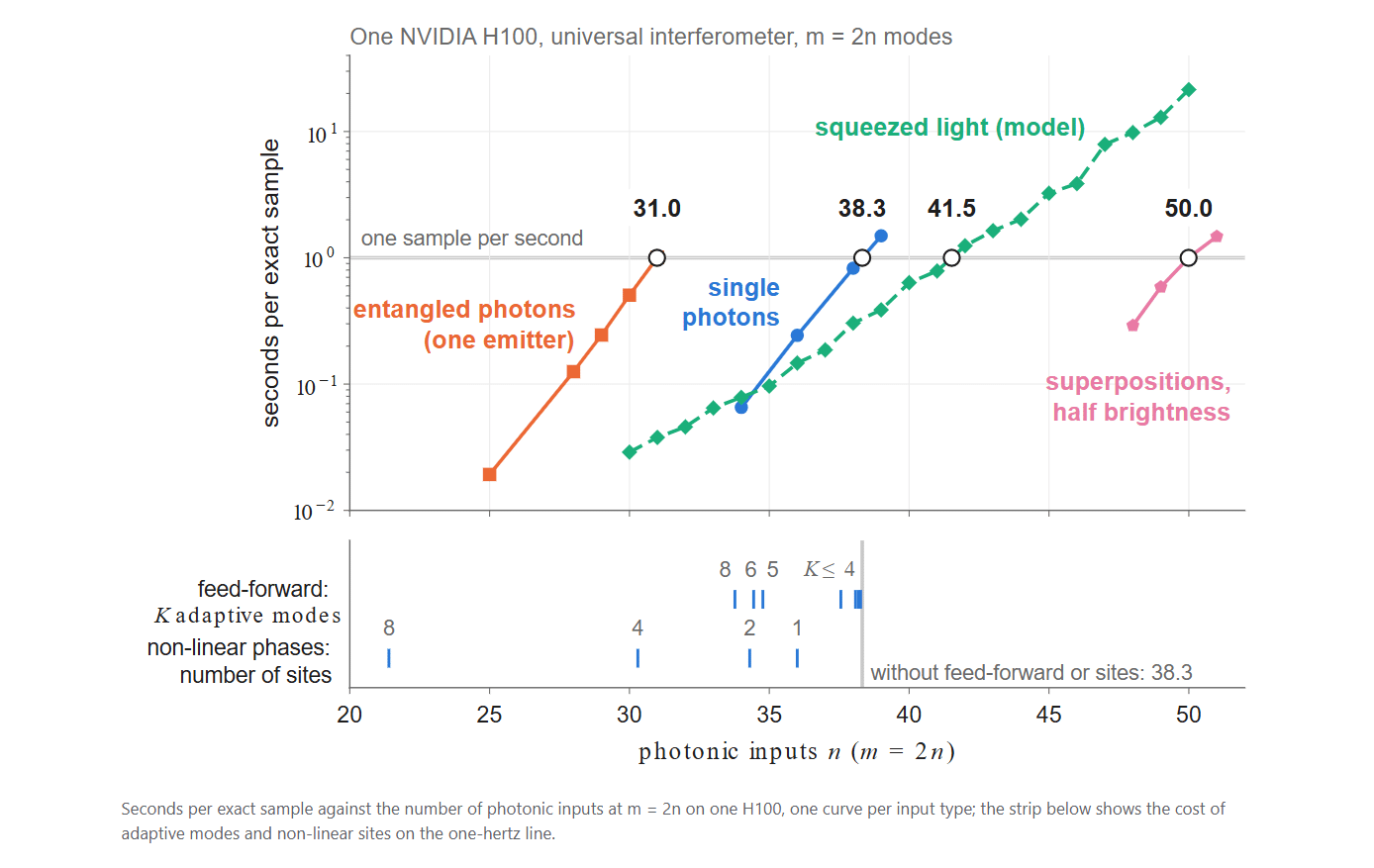
Photonic quantum processors are about to outrun exact classical simulation, and the line sits lower than many people assumed. A new benchmarking study defines a single number for where that happens: the input count at which the fastest exact classical sampler produces one sample per second on a single NVIDIA H100 PCIe GPU, using interferometers with twice as many modes as inputs. If you work on quantum software or evaluate quantum hardware claims, this gives you a yardstick that replaces a mess of literature thresholds ranging from 50 to 98 photons. Teams comparing vendor advantage claims can now ask one concrete question: what is the frontier for this specific source type? The study runs on the open-source photonic-engines GPU library, so you can reproduce the numbers yourself. The headline figures: 31.0 inputs for entangled quantum emitters, 38.3 for single photons, 41.5 for squeezed light, and 50.0 for coherent superpositions. Quantum coherence lowers the frontier by 14.2 inputs compared to incoherent lossy photons, which sit at 64.2. Adding 8 H100s buys only +3.5 inputs, while 16,384 GPUs add +16.2. The catch? Hardware scaling is brutally slow compared to hardware growth on the quantum side.

SAXON Q just shipped a safety layer that watches the hardware itself, not only the qubits. Quantum Watchdog runs on an independent classical processor. It tracks power draw, temperature, and ambient magnetic fields while your workload runs. If you build for defense, robotics, or automotive edge, this is the part you need. Quantum error correction handles qubit errors. It does not tell you the chip is physically degrading. Watchdog sits alongside error correction and catches the physical faults that would otherwise corrupt results quietly. The system slips verified test calculations into live workloads at intervals, and you can give up to 50% of runtime to diagnostics. Multi-core SXQ128 and SXQ512 configurations get dual-processor comparison or majority-voting redundancy. Initial custom implementation lands in early 2027, with OEM licensing after that. Formally safety-certified versions follow independent audits and field testing. Let's dive deeper…

In today's ContentBuffer update:

  • IQM and AMD Demo Hybrid Quantum-Classical Chemistry Workflow

  • IQM's benchmark: quantum kernels win at 15 qubits, but noise decides the margin

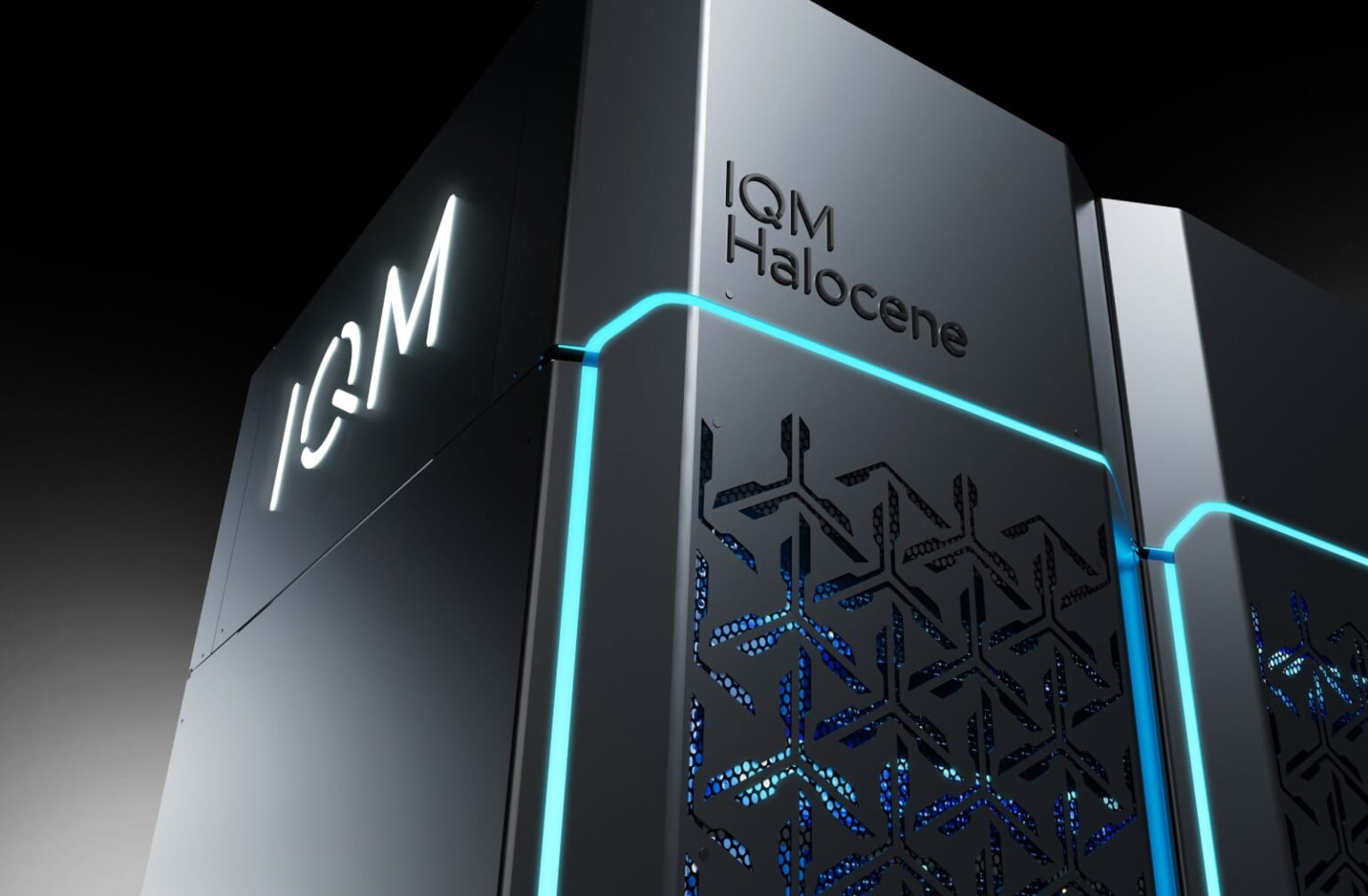
  • IQM's Halocene Upgrade Program Lets HPC Centers Scale Qubits Without Stopping Workloads

  • Qiskit Slips to 56.8% as PennyLane and Classiq Chase in 2026 Quantum Survey

  • 5 new AI tools & 5 new AI jobs

  • More tech news

Latest Development

Photonic Quantum Computing Benchmarks

Photonic Quantum Chips Pass Exact Classical Simulation at 31 Inputs on One H100

Image source: quantumcomputingreport.com

Summary: Researchers published a single metric for when photonic quantum chips outrun exact classical simulation. Entangled emitters cross the line at 31 inputs on one H100, single photons at 38.3. Adding GPUs barely moves the frontier, so the quantum-advantage race just got a lot more concrete.

Key Points:

  • Entangled quantum emitters reach the simulability frontier at 31.0 photonic inputs, meaning the fastest exact classical sampler manages only one sample per second at that size on one H100 GPU.

  • Single-photon Fock inputs push the frontier to 38.3, with an exponential base of 1.82 in the scaling, making each additional photon roughly 82 percent more expensive to simulate classically.

  • Eight H100 GPUs add only 3.5 inputs to the frontier, while scaling to 16,384 GPUs adds just 16.2, showing classical hardware scaling is painfully slow compared to quantum gains.

  • Coherent superpositions with alpha equal to pi over four hit 50.0 inputs, while incoherent lossy photons sit at 64.2, meaning coherence lowers the classical simulation frontier by 14.2 inputs.

  • Reaching 100 single-photon inputs with exact classical methods would need roughly 10 to the 16th power GPUs absent algorithmic breakthroughs, and an exact 38-photon sample costs about 7.3e-2 Wh on an H100.

Why it matters: If you're building or evaluating quantum photonics tooling, the 31-input entangled frontier is the number to pin your benchmarks against, not vendor marketing claims about classical intractability. Teams running classical baselines for quantum advantage comparisons should use photonic-engines directly, since a 16,384-GPU cluster only buys 16 extra inputs over a single card. Anyone planning hardware budgets for simulation should note that the bottleneck is algorithmic, not raw GPU count.

Quantum Hardware Reliability

SAXON Q Unveils Quantum Watchdog to Catch Hardware Failures Mid-Computation

Image source: quantumcomputingreport.com

Summary: SAXON Q announced Quantum Watchdog, a classical co-processor that monitors physical quantum hardware for failures during live operation. It targets defense, robotics, and automotive edge deployments and complements quantum error correction. Custom implementations start early 2027.

Key Points:

  • Quantum Watchdog monitors power draw, temperature, and ambient magnetic fields on an independent classical processor while quantum workloads run continuously.

  • Users can allocate up to 50% of processor runtime to diagnostic verification, interleaving verified test calculations into active workloads at periodic intervals.

  • Multi-core SXQ128 and SXQ512 room-temperature processors support dual-processor comparison or majority-voting redundancy as configurable options for system integrators.

  • The architecture uses a dedicated onboard control circuit for safety monitoring, separating diagnostics from the quantum computation path.

  • Patents are granted in Europe, the United States, and China, with initial custom implementation slated for early 2027 and OEM licensing to follow.

Why it matters: If you're building quantum-assisted systems for defense or automotive edge deployments, silent hardware degradation is the failure mode that quantum error correction alone won't catch. Watchdog's separate classical processor gives platform teams a monitoring path that doesn't compete with the qubits for resources. Integrators evaluating SXQ128 or SXQ512 hardware should plan for the 2027 timeline and watch for formal safety certification before putting it in a regulated product.

Hybrid-quantum-classical Computing

IQM and AMD Run Hybrid Quantum-GPU Chemistry on a 20-Qubit Chip

Image source: quantumcomputingreport.com

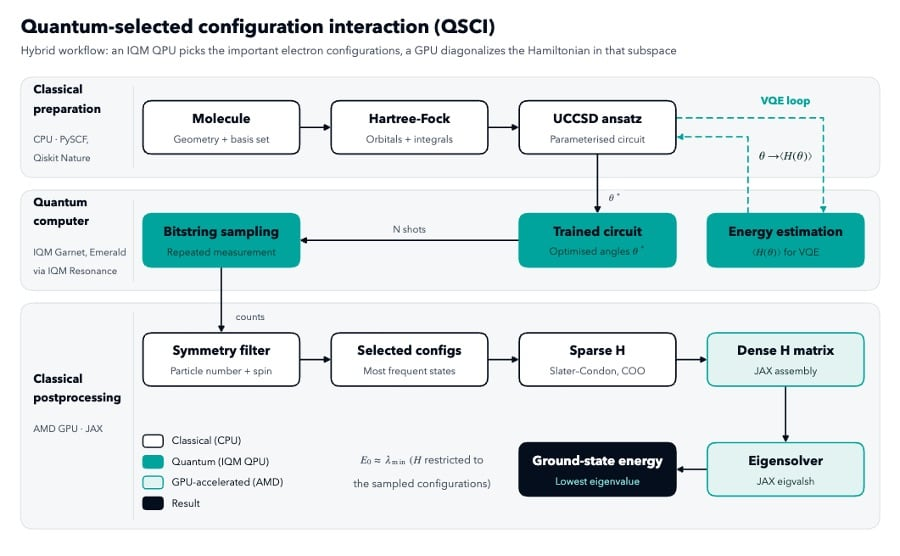
Summary: IQM and AMD split a hydrogen molecule energy calculation between a 20-qubit Garnet processor and AMD GPUs, reproducing a dissociation curve across 17 bond lengths. It's an interoperability proof, not quantum advantage, but the open-source notebook is runnable today on AMD Developer Cloud.

Key Points:

  • The quantum processor is IQM's 20-qubit superconducting Garnet chip, which prepares a parameterized trial circuit and samples bitstrings to find dominant electron configurations.

  • The AMD GPU filters unphysical samples, builds the projected subspace Hamiltonian, and runs cubic-scaling O(N3) diagonalization in JAX on ROCm.

  • The pipeline was validated on molecular hydrogen in the minimal STO-3G basis and reproduced the dissociation curve across 17 bond lengths on physical hardware.

  • The workflow ships as an open-source Jupyter notebook on IQM Academy and runs on AMD Developer Cloud GPU instances without local hardware.

  • Partners are targeting tighter physical interconnects and molecular active spaces above eight qubits, which is where the real test of hybrid scaling begins.

Why it matters: If you run HPC or quantum research clusters, this gives you a working template for pairing a superconducting QPU with AMD GPUs through QSCI. Teams evaluating JAX on ROCm for scientific diagonalization now have a reproducible notebook to benchmark against their own stack. The catch is that the validated case is H2 in STO-3G, so anyone planning around active spaces larger than eight qubits should treat this as a blueprint, not a benchmark.

Quantum-machine-learning

IQM Benchmark Shows 15-Qubit Quantum Kernels Beating Classical ML by 30 Points

Image source: quantumcomputingreport.com

Summary: IQM and QbitSoft benchmarked quantum kernels on Emerald and Garnet processors and found 15-qubit models hitting 81% accuracy versus 51% for the best classical model. Error mitigation drives most of that gap, so treat quantum ML claims with skepticism until baselines are this rigorous.

Key Points:

  • The 15-qubit projected quantum kernel reached 81% quantum accuracy, compared with 51% for the best of 11 classical ML models, a 30-point statistically significant gap.

  • Without error mitigation, deep 15-qubit circuits managed only 68% versus 64% classical, a 4-point difference the researchers found was not statistically significant.

  • Adaptive Pauli twirling on the 54-qubit Emerald processor brought ideal-label accuracy to within 2.5 percentage points of a noise-free processor, cutting feature residuals directly.

  • The 45-qubit kernels matched a quantum processor unit's 72% accuracy, and the classical matrix product state simulator reproduced that circuit in under 20 seconds.

  • Zero-noise extrapolation widened the measured classification gap by changing the referee's labeling bandwidth, a reminder that mitigation choices can inflate reported advantage.

Why it matters: If your team is prototyping quantum machine learning on IQM hardware, this benchmark gives you a template for the cross-device referee-challenger setup, which is the part most people skip. The 15-qubit result is the only regime where the gap survived significance testing with mitigation on, so that is where experiments should start. Teams running classical kernel baselines in scikit-learn should rerun them against this 11-model suite before concluding quantum wins anything.

Quantum Hardware And Hpc Integration

IQM Launches Halocene Upgrade Path From 150 Qubits to 1,000-Plus Qubits

Image source: quantumcomputingreport.com

Summary: IQM Quantum Computers launched an on-premises upgrade program that lets HPC and enterprise data centers swap in larger Halocene quantum systems without interrupting workloads. The path runs from 150 qubits to over 1,000, with HPC integration bundled in. No delivery dates for the 1,000-qubit tier yet.

Key Points:

  • The program takes facilities from IQM's initial 150-qubit Halocene processor to future systems exceeding 1,000 physical qubits, with a defined procurement path for early adopters.

  • New Halocene units are installed and commissioned beside the existing system first, so the older hardware is only decommissioned after the replacement is live and validated.

  • Each hardware transition includes IQM's HPC integration service, building on 10 supercomputing integrations completed since 2021 across European research centers.

  • Halocene integrates with NVIDIA CUDA-Q Logical and runs real-time QEC decoding over NVQLink, letting teams pair quantum processors with existing CPU and GPU clusters.

  • LUMI AI Factory selected the Halocene logical-qubit roadmap for its LUMI-IQ superconducting system, a concrete deployment signal ahead of the 1,000-qubit timeline.

Why it matters: If you're running Slurm-managed HPC clusters with GPU interconnects, this program means a quantum upgrade no longer requires a maintenance window that kills your queue. Teams building hybrid AI and simulation pipelines can plan a multi-generation quantum roadmap without re-engineering their scheduler configs at each step. Procurement teams at research centers get a defined upgrade path, but should press IQM for delivery dates before budgeting for the 1,000-qubit tier.

Quantum Developer Tools And Surveys

Qiskit Still Leads Quantum Dev Tools, But PennyLane Gains Ground in 2026 Survey

Image source: quantumcomputingreport.com

Summary: Unitary Foundation's 2026 survey of 1,800+ quantum developers shows Qiskit dipping to 56.8% while PennyLane climbs to 34.3%. The real bottleneck for teams isn't software, it's QPU access at 54.4%.

Key Points:

  • Qiskit still leads full-stack SDKs at 56.8% adoption, down from 69.1%, while PennyLane rose from 30.8% to 34.3% over the survey period.

  • IBM Quantum Platform holds 54.9% active cloud access, ahead of Classiq at 22.8% and Amazon Braket at 17.9%, with Azure Quantum trailing at 9.6%.

  • Classiq Library and Qiskit Machine Learning each drew 23.2% of respondents planning adoption in 2027, the highest planned rates recorded in the survey.

  • Qiskit holds 51.7% usage for quantum error correction, followed by PennyLane at 30.0% and Stim at 29.8%, with 35.2% of respondents using QEC tools overall.

  • Anthropic Claude Code leads AI coding assistants at 71.6%, ahead of OpenAI Codex at 41.8% and Google Gemini at 39.4%, while 77.8% use AI in quantum workflows.

Why it matters: If your team is standardizing on Qiskit, the 12-point drop in adoption means it's worth checking whether PennyLane's plugin ecosystem fits your hybrid ML pipelines before you lock in. The bottleneck data is the bigger story: with 54.4% of teams citing limited QPU access and 41.8% citing compute cost, your procurement and cloud strategy will matter more than your SDK choice this year. Anyone using AI-generated quantum code should adopt the verification habits the survey reports, since only 42.9% always verify outputs.

New Tools & Job

  • AnswerDojo - AnswerDojo builds a mock interview around the job you're applying for. Choose one of 2,247 real postings from 28 companies, including Amazon, Google, and Netflix, or paste your own JD to see what the role tests. Then answer out loud as an AI interviewer asks questions, listens, follows up, and scores the session. Two voice mocks are free. No credit card required.

  • FullCastBook - FullCastBook turns a manuscript into an AI audiobook with a full cast. Upload an EPUB, PDF, DOCX, TXT or Markdown file, and it finds the chapters, works out who is speaking in each line and gives every character a distinct voice alongside an AI narrator. Regenerate a single line without redoing the chapter, then export the finished audiobook as one M4B with chapter markers, MP3 files or a ZIP. Freemium, paid plans from $9.90 a month.

  • Roomvana - Roomvana is an AI design tool for your home's exterior. Upload one photo of your house and try new siding or exterior paint colors, a new front door or garage door, new shutters or a new roof — or redesign the front yard, backyard or patio. The result keeps your layout, walls and windows, so what you see is still your house, just with the updates. It works indoors, too. Free to try on the web and as a mobile app.

  • British Accent Generator - British Accent Generator is an AI British/UK accent TTS workspace with 315 regionally labelled voices — RP and standard British, young British, Scottish, Welsh, and Northern Irish. Browse and preview speakers, paste a script, and download natural UK English audio for videos, lessons, podcasts, demos, and training. Also includes Voice Clone, Voice Design, Voice Effects, and AI Lip Sync. Free daily credits; paid credit packs and subscriptions unlock longer scripts and premium features.

  • Nano Banana (nanobananana.com) - Nano Banana at nanobananana.com is an independent AI image generation and editing tool for designers, content creators and marketers. Create images from text prompts, edit reference images with natural-language instructions and blend multiple images. A Chinese-language interface is available. It is separate from nanobanana.im and is not an official Google website.

  • Manager, Machine Learning Engineering - At Affirm, we exist for the moments that matter—giving people a clear, predictable way to pay over time, with no hidden fees, no surprises, and no tradeoffs on what matters most. At Affirm, we exist for the moments that matter—giving people a clear, predictable way to pay over time, with no hidden f

  • Software Engineer II, Backend - At Affirm, we exist for the moments that matter—giving people a clear, predictable way to pay over time, with no hidden fees, no surprises, and no tradeoffs on what matters most. About the Engineering team The Engineering team builds systems that power Affirm’s mission. We take pride in our craft, b

  • Director, AI Product Management (GTM) - Who we are Samsara (NYSE: IOT) is the pioneer of the Connected Operations™ Cloud, which is a platform that enables organizations that depend on physical operations to harness Internet of Things (IoT) data to develop actionable insights and improve their operations. At Samsara, we are helping improve

  • Software Engineer, DevAI - Airbnb was born in 2007 when two hosts welcomed three guests to their San Francisco home, and has since grown to over 5 million hosts who have welcomed over 2 billion guest arrivals in almost every country across the globe. Every day, hosts offer unique stays and experiences that make it possible fo

  • Senior Machine Learning Engineer, Driver Refinement & Validation - Waymo is an autonomous driving technology company with the mission to be the world's most trusted driver. Since its start as the Google Self-Driving Car Project in 2009, Waymo has focused on building the Waymo Driver—The World's Most Experienced Driver™—to improve access to mobility while saving tho

QUICK HITS

Read more news here →

THAT'S A WRAP

Partner with Us

Showcase your product to our engaged community of Tech enthusiasts

Our newsletter reaches a diverse audience of tech professionals, investors, engineers, managers, and business leaders worldwide. Get in touch today.

More from the Quantum Computing Newsletter

Quantum Computing Newsletter

Get the next issue

One email a week. Free. Unsubscribe anytime.

How we handle your email: Privacy policy

Comments

Subscribe to join the conversation...

Be the first to comment